The State Legislative Analyst’s Office has prepared a summary and analysis for each of the six measures.
The Secretary of State has now posted the ballot summaries, arguments for and against, and other information.
The State Legislative Analyst’s Office has prepared a summary and analysis for each of the six measures.
The Secretary of State has now posted the ballot summaries, arguments for and against, and other information.
Senate Republicans have a new leader today after the caucus ousted Sen. Dave Cogdill and replaced him with Sen. Dennis Hollingsworth shortly after midnight.
Despite speculation that Senate Republicans may ask to reopen budget talks, Senate President Pro Tem Darrell Steinberg insisted the change has absolutely no effect on his strategy to break the budget deadlock this week.
"We're going to maintain our focus towards solving the problem of getting one vote regardless of who the leader is," Steinberg said after his house took a recess around 1 a.m. "Leadership doesn't change the fact that there is no other idea put forward that would take $41 billion out of a budget deficit. And so, for me, it doesn't change anything."
After the Senate failed to approve the contentious tax hike bill, Steinberg made good on his threat to keep his members locked in for the night. He said he plans to resume talks later Wednesday with Sen. Dave Cox, R-Fair Oaks, and Sen. Abel Maldonado, R-Santa Maria, to see if either one will back the budget package.
"I would describe it as a bit of a discouraging day," Steinberg said of Tuesday. "Despite a lot of effort, and a lot of work today by our office, the governor's office, they're not there. But they have to be there eventually."
Schwarzenegger flew home to Brentwood around 9 p.m., a sign that the budget deal remained elusive Tuesday. His spokesman, Aaron McLear, said the governor plans to continue speaking to Cox and Maldonado on Wednesday.
Hollingsworth, an ardent tax opponent, made it clear that he continues to oppose the budget. When asked whether he wants to reopen the "Big 5" negotiations, he said he'd take a wait-and-see approach.
"I think the majority of my caucus doesn't want to see a tax increase passed in this particular package," Hollingsworth said. "But we'll see what happens in the next few minutes, the next few hours, the next few days."

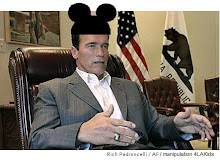
Rich Pedroncelli / Associated Press - FRUSTRATION: Gov. Schwarzenegger says there is only so much he can do to resolve the state’s problems.
Monday, 15 December 2008 -- Reporting from Sacramento -- Gray Davis had just landed in Pennsylvania on a trip last June when he was struck by the differences between that state and the one whose voters drove him out of office early in his second term, blaming his leadership for state government failures that included deep debt and legislative paralysis.
Pennsylvania roads were clean. The state's budget was balanced. Lawmakers had socked enough away in a rainy-day fund to build what was then a decent surplus. Government seemed to run effectively.
"It's not like other people can't do this," the former governor said recently.
But California government is arguably more dysfunctional now than it was when Davis, a Democrat, got the boot. The budget deficit has grown so huge that a shutdown of government services looms. Partisan gridlock grips the Legislature, and lawmakers bicker as the state plunges into crisis.
"The recall absolutely hasn't helped at all," said Gary Jacobson, a professor of political science at UC San Diego.
The state's latest collision course with insolvency has renewed the question in the Capitol: Has California become ungovernable?
Gov. Arnold Schwarzenegger, who ousted Davis with a campaign built on the premise that the state simply needed the right leader, said last week that there is only so much he can do to tame Sacramento.
"Look, I'm frustrated," the governor told reporters. "I'm sitting here and we have a system where we rely on the 120 legislators to make those decisions. I cannot make them stay here. I cannot lock them into the building. I don't have those kinds of powers. Believe me, I would do it otherwise."
The governor has no shortage of critics who say the fault lies with him. If he were a more effective, engaged leader, they charge, the lawmakers would follow.
"There's only 120 people in the state who don't care when Arnold Schwarzenegger calls them, and it's the members of the Legislature," said Democratic strategist Jason Kinney. "The fact that he has forfeited his relationship and influence over the Legislature has hurt him."
Others say this nation-state is so oversized, Balkanized and polarized that it is destined for dysfunction no matter who is in charge. They cite its influx of immigrants, its constant tensions over water supply and its large, self-contained regions that bear little resemblance to one another.
It has even been suggested that the state should break into multiple, more manageable pieces. More than two dozen attempts at that have been tried over the years, the latest by a Northern California lawmaker in the early 1990s. More recently, a blog called Three Californias [blog|website] was created to advocate carving California out of the union and turning it into a new country with three states.
The state's Constitution also makes governing a challenge. California is one of only three states that require two-thirds of the Legislature to agree on a budget. A few lawmakers from the minority party can derail a spending plan -- and they do, sometimes to the point of preventing the government from paying its bills.
And California's heavy use of the initiative system, intended to let voters solve problems when lawmakers don't, has created conflicting mandates that experts say undermine rational policymaking.
Some of the political leaders who for years have been engaged in efforts -- largely unsuccessful -- to make state government run better fret that the current dysfunction creates a fertile environment for more shortsighted ballot measures.
"If this continues, there is the danger that the public will again express itself through an initiative or some kind of constitutional convention or something that will become a vehicle for their anger with elected leaders," said Leon Panetta, a former California congressman and White House advisor who co-chairs California Forward [home|on budget], a bipartisan think tank focused on solving the state's problems. "God knows where that will take us. The danger is it will lead to the wrong steps being taken."
Panetta said the political process has broken down.
"For whatever reason, democracy is not working in Sacramento right now," he said. "I am convinced it can be fixed. But people have to make sacrifices" -- in politics and policy.
Davis concurred that, in theory, the state is governable. But "in reality," he said, "it hasn't been governed properly for a long time."
In his view, the problem stems from extremist politics that began three decades ago with the anti-tax movement that led to Proposition 13 and has continued with gerrymandered legislative districts that make lawmakers accountable only to the party faithful who vote in primary elections.
Analysts say that if Schwarzenegger had the ability to make California more governable, it has declined substantially since the recall, when his immense popularity gave him political capital. Now he is a lame duck with a financial crisis that he can no longer argue was inherited from another administration.
He has championed multiple efforts to reshape government. But the public did not embrace his vision for how to do so. Voters rejected most of his plans at the ballot box, and there was no uprising against lawmakers when they left his legislative proposals to grow moldy on the shelf.
Last month, voters did heed his call to change the way legislative districts are drawn by passing Proposition 11. The new rules governing that process take effect next year, and supporters of the measure, including Schwarzenegger, say it will ultimately lead to fewer ideologues in Sacramento.
The governor also managed to push through the Legislature some limited restraints on spending, including a requirement that the state put more money in a rainy-day fund when revenues are up.
But special legislative sessions that Schwarzenegger called on the state's fiscal crisis, water supply and healthcare all ended without resolution. The latest special session on the budget is ongoing.
This year, the governor has threatened and cajoled the Legislature -- even gone to court -- over money management, but his strategies have been met with shrugs. On Tuesday, as he handed out medals of valor to state employees he said were great examples of "service and selflessness," the governor cracked: "I wish that the legislators have just a little bit of that."
Former state Senate Leader Don Perata (D-Oakland), who has on more than one occasion accused Schwarzenegger of lacking in that department, concedes that the governor may have a point. He said the state's term limits law, which forced him from office last month, has created a group of lawmakers who are well-intentioned but lack the institutional knowledge to deal effectively with the state's outsized problems.
In recent months, he said, he witnessed lawmakers failing to recognize the severity of the crisis and unable to respond to it; they lacked the grounding that comes with years of learning how to govern the state.
"There is no center," Perata said. "I'm not talking about political center. There is no action center, or moral center, or anything else left in Sacramento."
Halper and Rothfeld are Times staff writers.
Mac Taylor forecasts that the state will need to close a $27.8-billion budget gap in the next 20 months. He calls for a smaller sales tax increase than Gov. Schwarzenegger has suggested.
Webcast: Assessment of Special Session Proposals
HTML | SummaryLAO REPORT:
Overview of the 2008 Special Session Proposals
November 10, 2008
HTML | PDF | Summary“We concur with the administration’s assessment that the state’s struggling economy signals a major reduction in expected revenues. Combined with rising state expenses, we project that the state will need $27.8 billion in budget solutions over the next 20 months. The state’s revenue collapse is so dramatic and the underlying economic factors are so weak that we forecast huge budget shortfalls through 2013‑14 absent corrective action. From 2010‑11 through 2013‑14, we project annual shortfalls that are consistently in the range of $22 billion.”
By Jordan Rau – LA Times
November 12, 2008 — Reporting from Sacramento — While offering the grimmest forecast yet of California's finances, the Legislature's nonpartisan fiscal analyst recommended Tuesday that lawmakers pare back Gov. Arnold Schwarzenegger's proposed 1 1/2 -cent sales tax increase and instead hike fees on cars.
In a new report, Legislative Analyst Mac Taylor forecast that the state would need to close a $27.8-billion budget gap during the next 20 months. That projection is more than $3 billion higher than the Schwarzenegger administration has estimated.
"The numbers are just truly awful," Taylor told reporters. "There are no good options left."
The analyst's wider budget gap was influenced by the rapid decline in the state's housing market. He projected that school districts would lose $1.5 billion over the next three years, requiring the state to fill that gap.
The economic downturn also has led to more people on health and social services programs. In addition, firefighting costs are higher than projected.
The governor last week called a special session of the Legislature and proposed deep cuts in services and tax increases to deal with California's collapsing finances.
Though calling the governor's proposal "credible," the analyst said that raising the sales tax would further hurt the economy by discouraging Californians from buying products locally and instead shifting them to Internet purchases that escape the state sales tax.
Schwarzenegger's proposed increase would make California's sales tax, which varies from city to city, the highest in the nation, at an average of about 9.5%, the analyst said.
"That's not something you want to be No. 1 in," he said. Taylor recommended a smaller increase of 1 cent on the dollar.
The analyst favored increasing the annual vehicle license fee, from 0.65% of a car's value to 1%. It is an idea that has traction among Democratic lawmakers, but one that Schwarzenegger has resisted.
His opposition to that fee was a main plank of his 2003 election, and he reduced the fee, then 2%, as one of his first acts in office.
The governor instead has proposed charging people an additional flat fee of $12 more when they register their automobiles each year. That would bring in only about a 10th of the $1.6 billion in revenue that a vehicle license fee increase would net.
The analyst said that without major changes, the state would run shortfalls on the order of $22 billion annually over the next five years even if the economy rebounded.
Taylor offered some variations to the $10.6 billion in cuts to schools, healthcare, welfare and transit that Schwarzenegger has proposed, but he endorsed the governor's view that the severity of the budget gap requires both new revenue and program cuts.
"The magnitude of the problem has now reached such a level that we're not clear how you could do one side or the other," he said.
Shortly after Taylor spoke to reporters, Roger Niello (R-Fair Oaks), the ranking Republican on the Assembly budget committee, issued a statement saying, "We strongly disagree with the analyst's call for higher taxes."
Some GOP votes would be needed for the Democrat-led Legislature to pass any tax increase.
Meanwhile, Assembly Speaker Karen Bass (D-Los Angeles) on Tuesday urged the federal government to bail out states as well as banks.
"We think that with the state of California about to go over a cliff, we ought to be part of the bailout as well," she said at a news conference. "Can we have $5 billion or $10 billion?"
The analyst said that although California should press for federal assistance, lawmakers should not count on or wait for such relief, which he estimated would probably not be more than $3 billion.
"If the state has any hope of developing a fiscally responsible 2009-10 budget, it must begin acting now," Taylor wrote in his report.
THE VEHICLE LICENSE FEE THAT GOT GRAY DAVIS RECALLED AND ARNOLD SCHWARZENEGGER ELECTED LOOKS LIKE A GOOD IDEA AGAIN.
The Times points out that the Car Tax/VLF served California well for 60 years. Undoing it has failed the state for six years. Until last year reimplementing it would have actually balanced (or come close to balancing) the budget. It's not enough anymore, but it's got to be on the table. Along with spitting the rolls on Prop 13 …but one sacred cow/third rail/taboo metaphor at a time.
—smf
November 11, 2008 -- Gov. Arnold Schwarzenegger has shown he's capable of learning. Not every governor who rode into office on a no-new-taxes pledge would propose a sales-tax increase of 1.5%. He's right to insist that every solution to the state's fiscal crisis be on the table, so we're happy to pitch in with a suggestion -- bring back the car tax.
There, we said it. Again. California's leaders took a wrong turn in 1999 when they slashed the vehicle license fee, or car tax. The move frittered away a rare revenue surplus that should have been used instead to fix the state's structural deficit. The plan supposedly called for the rate to go back up during fiscal crises to the same level it had been since 1948 -- 2% of vehicle value. But when then-Gov. Gray Davis tried to do just that, Schwarzenegger fanned voter anger and booted Davis from office.
It's not out of a sense of mischief that we now call on Schwarzenegger to bring the tax back to its historical level. Not solely, anyway. The car tax is a smarter choice than a sales tax for digging out of the current budget hole. Asking Californians to pitch in through their vehicle registration fees rather than at the cash register would have fewer negative effects on sales, which we can expect to be diminished too much already in the coming months.
Sales taxes are regressive: They take a higher percentage of household income from the poor than from the rich. A 1999 California Policy Research Center study found vehicle license fees to be nearly as regressive, but at least the proceeds are unrestricted and could be used to bail the state out of its mess. Because of voter fiat, sales taxes paid at the gas pump are off limits for any use but transportation. Local government also claims a share. Another advantage of car taxes: They are deductible from federal income tax. Try deducting your sales tax on your 1040 form and see how far you get.
Schwarzenegger already has swallowed his pride a bit on car taxes: He's proposing that each vehicle owner pay $12 more. But that's an especially regressive fee, imposing barely an irritant on a wealthy motorist while packing a wallop for a low-income one. The state can do far better for itself and its residents by returning to the tried-and-true vehicle license fee.
Any tax hike will cause pain, but not nearly as much as the deepest budget cuts the governor is proposing. And sales taxes are already rising: If the 1.5% state increase is adopted, the rate in two Los Angeles County cities will be 11.25%, and just a penny less in the rest of the county. That's not the way to go. Cutting the car tax helped get us into this mess. Restoring it to the rate that served California for 60 years can help get us out.