Showing posts with label Governor Schwarzenegger. Show all posts

Saturday, July 4, 2009

CALIFORNIA GOVERNOR SIGNALS KEY BUDGET CONCESSION ON EDUCATION CUTS: Schwarzenegger sees possible compromise + GOVERNOR BACKS OFF PLAN TO SUSPEND PROP 98


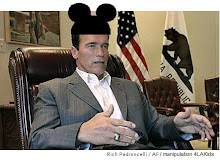
Gov. Arnold Schwarzenegger said Friday he is willing to reconsider his most recent proposal to help close the state's $26.3 billion budget shortfall by suspending state constitutional rules that control education spending in order to make deep cuts in school funding.  View Larger Image


Sat Jul 4, 2009 3:56pm EDT

By Jim Christie - Reuters

SAN FRANCISCO, July 4 (Reuters) - Governor Arnold Schwarzenegger, optimistic California can finish its budget negotiations in a few days, is willing to reconsider his proposed cuts to education in hopes of averting a cash crisis, the San Francisco Chronicle said on Saturday. (ARTICLE FOLLOWS)

A compromise between the Republican governor and Democratic lawmakers may help clear the way for an agreement on an overdue state budget and avert a cash crisis for the government of the most populous U.S. state. California already is issuing billions of dollars in "IOUs" and, without a deal, is on track to run out of cash this month.

The San Francisco Chronicle reported that Schwarzenegger, in a Friday meeting with its editorial board, said he would be willing to reconsider his proposal to help reduce California's $26.3 billion budget deficit with cuts to school spending that would require suspension of constitutional rules on education expenditures.

"We are not stuck ... about the suspension," Schwarzenegger said during the meeting. "We've got to analyze all this."

He said budget negotiations are moving fast. "I think if we continue this way we can get this done in the next few days," he said.

Backing off on education spending cuts would go a long way with Democrats who control the state legislature.

On Thursday Democrats said they would no longer hold out for increasing taxes to help raise revenues to fill the budget gap. That was a major concession to Schwarzenegger and Republican lawmakers, who had opposed tax hikes and pressed for balancing the state's books with deep spending cuts.

That helped Republicans gain confidence that a budget deal could be reached soon.

"I think there is at least a 50-50 chance that we'll find a solution that is acceptable to all parties within a week," Assembly Republican Leader Sam Blakeslee said.

Democrats see backing off on education spending cuts as an important concession by Schwarzenegger.

"While taxes may be off the table, education cuts also have to be off the table," Democratic state Senator Leland Yee told Reuters.

GRIM REVENUE OUTLOOK

Lawmakers failed to agree on balancing the state's budget on Tuesday and the state government began its fiscal year on Wednesday without a spending plan in place.

In response, state finance officials began issuing "IOUs" in lieu of payments for tax refunds owed to taxpayers to preserve cash from higher prior payments, including payments to investors holding the state's debt. They warned that local agencies overseeing health programs and a variety of recipients of state financial aid, including the disabled and college students, could be in line for IOUs.

The state controller plans to issue more than $3 billion this month in registered warrants promising payments if Schwarzenegger and lawmakers fail to agree on a budget.

California is experiencing a severe revenue downturn as a result of the recession, rising unemployment and the lengthy housing downturn that will leave the state's government with an austere budget. It likely will force additional spending cuts throughout the fiscal year.

"The reality is that the revenues are not looking good," Yee said. "We just simply don't have the money to keep up the pace of services we're providing."

California finance officials hope a budget deal is reached soon so they can stop their IOU effort, which aims to reassure the municipal debt market that the state will honor its bond payments ahead of nearly all other obligations.

Finance officials also want to reassure the market in anticipation of having to sell short-term debt for cash-flow purposes once a budget deal is reached.

California's budget turmoil has made Wall Street nervous. Standard & Poor's warned in a statement on Wednesday that if California's budget is not settled soon, the state's A-credit rating, already the lowest of any of the 50 states, is at risk of falling.


GOVERNOR BACKS OFF PLAN TO SUSPEND PROP 98

Matthew Yi, sAN Francisco Chronicle Staff Writer

Saturday, July 4, 2009 -- Gov. Arnold Schwarzenegger said Friday he is willing to reconsider his most recent proposal to help close the state's $26.3 billion budget shortfall by suspending state constitutional rules that control education spending in order to make deep cuts in school funding. That concession may help him avoid a political battle with the influential California Teachers Association. Although the powerful union has been largely quiet during budget talks, it could sway lawmakers who are desperately needed to pass a budget. A source told The Chronicle on Friday that the union is preparing a statewide television advertising campaign to fight any attempt to ignore the education spending rules that voters passed in 1988 as Proposition 98.

On Wednesday, Schwarzenegger had proposed suspending Prop. 98, which among other things requires that school funding be based in part on what was spent the previous fiscal year. The requirement can make it difficult, if not nearly impossible, to make large cuts in education - an expense that makes up about half of the state's discretionary spending.

Such cuts became even more inevitable when the state's gaping deficit grew overnight by $2 billion because the Legislature failed to approve a budget fix by midnight Tuesday, the end of the 2008-09 fiscal year.

Still, the governor, who has proposed cutting this year's education spending by $3 billion, said he was willing to consider other solutions.

"We are not stuck ... about the suspension" of Prop. 98, he said in a meeting Friday with The Chronicle's editorial board. "We've got to analyze all this. ... We have to figure out how to deal with it."

Democratic lawmakers said they are encouraged by Schwarzenegger's willingness to reconsider the Prop. 98 issue. Yet Senate President Pro Tem Darrell Steinberg quickly pointed out that the issue would have never surfaced had the governor on Tuesday supported three budget bills that would have saved $3 billion.

"This problem was completely avoidable. The administration is stuck because of its own ... strategy," said Steinberg, D-Sacramento.

The governor has refused to support partial budget fixes. But the budget impasse has caused a cash crunch that on Thursday forced the state controller to begin issuing IOUs to some taxpayers, businesses and creditors.

That impasse would become even more complicated by an enraged California Teachers Association and other education groups.

"They had not declared war on this governor who had made billions of dollars in cuts to education in his budget proposals ... and to have additional rounds of cuts proposed by him on top of the huge reductions they've already made have gotten them very, very upset," said Kevin Gordon, an education lobbyist.

Gordon noted that the California Teachers Association, which led the effort to torpedo Schwarzenegger's ballot measures to reform government in 2005, had supported the governor's budget-related ballot measures that failed in the May 19 special election. That could spell trouble for the governor, who is one of the biggest proponents of next year's ballot measure that would create an open primary system.

Telephone calls to CTA representatives were not returned Friday.

Nevertheless, despite this new wrinkle in the budget negotiations, Schwarzenegger said talks with Democratic legislative leaders have been progressing and he's hopeful that a resolution is near.

The governor said there has been a greater sense of urgency since Tuesday. Since then, the bulk of the budget negotiations have centered on how much to cut spending in health and human services.

"There's more willingness to look at our proposals more seriously - to look at reforms more seriously ... and to look at cuts more seriously," said Schwarzenegger, who has backed away from outright elimination of popular state programs such as health care for poor children, a welfare-to-work program for single mothers, and in-home support services for the elderly and the disabled.

The governor said "there's movement" in budget negotiations. "I think if we continue this way we can get this done in the next few days."

Monday, March 2, 2009

UNIONS HOLD THE WILD CARD ON PROPOSED STATE SPENDING CAP

By Kevin Yamamura | The Sacramento Bee


How ‘sweet’ does it have to be before the diabetes kicks in?1W2ELECTION.JPG
  - Gov. Arnold Schwarzenegger urges support for six budget measures – topped by a state spending cap and school funding sweeteners – in a special election May 19. [BRIAN BAER Sacramento Bee file, Feb. 26 ]

Monday, Mar. 2, 2009 --Labor unions that blasted a state budget deal for its constitutional spending limit have gone quiet as the state gears up for a May 19 election asking voters to ratify the agreement.Campaign veterans believe Gov. Arnold Schwarzenegger and legislative leaders can only succeed in persuading voters to pass six budget-related ballot measures if unions remain on the sidelines.

Labor groups will hold internal meetings over the next month to decide how to proceed.

"That's the multimillion- dollar question," said Dan Schnur, a former Republican strategist who now directs the Jesse M. Unruh Institute of Politics at the University of Southern California.

"Initiatives like this only pass when there isn't much money spent against them," he said. "And the only people who have that kind of money and that kind of motivation are unions. If they decide to sit this one out, it probably passes."

Schwarzenegger hopes the special election will be nothing like the one four years ago, when he suffered multiple defeats at the hands of labor groups.

One immediate difference is that the powerful California Teachers Association has backed Proposition 1B to ensure that schools receive $9 billion in future years, one of the six proposals that Schwarzenegger and legislative leaders are selling as part of an overall "budget reform" package.

In 2005, the CTA worked against the governor by galvanizing opposition to his various ballot proposals.

The most controversial ballot measure this year is Proposition 1A, which establishes a cap on future state spending based on a trend line over the previous decade.

Public employee labor unions fear the measure would mean less money for government jobs, yet the cap was essential to winning Republican support for the budget package.

Unions last month were attacking the budget deal for including a limit on future state spending growth and $15 billion in cuts to state programs. The spending limit must be approved by voters in Proposition 1A to take effect.

Fearing that unions could mount a successful opposition campaign, lawmakers and Schwarzenegger crafted the budget deal so that increased taxes on income, sales and vehicles would last up to an additional two years if Proposition 1A passes.

The strategy assumed that the additional state tax revenue, worth as much as $16 billion between 2011 and 2013, would provide enough incentive for unions to let Proposition 1A go unchallenged.

Different branches of the Service Employees International Union, which represents tens of thousands of public-sector workers, are having internal discussions about what approach they want to take toward the ballot measures.

"We have always been against the spending cap," said Jeanine Meyer Rodriguez, spokeswoman for the state council of SEIU, representing 750,000 workers statewide. "We have to go through our internal process."

If unions decide to pony up money in the special election, they will find vocal partners in the Howard Jarvis Taxpayers Association, an anti-tax group usually on the opposite side of labor in public policy debates. The group opposes the tax hikes linked to Proposition 1A and believes the spending limit allows for too much growth in the state budget.

"I think the opposition is not only there, but I think it will grow the closer we get to May 19," said Jon Coupal, president of the Jarvis group. "It's well known that some bargaining units are not happy and may have motivation to oppose Proposition 1A. Politics makes for strange bedfellows."

Lawmakers and Schwarzenegger crafted the budget deal to win support from education groups. They placed Proposition 1B on the ballot to specify that the state would pay schools $9.3 billion beginning in 2011-12. They tied the measure to Proposition 1A, partly to discourage teachers unions from opposing the spending limit.

CTA President David Sanchez said that his group has taken an interim support position on Proposition 1B, but that it will take positions on all the measures at a state council meeting next month.

"We're going to be having a campaign to encourage electorate support for repayment back to schools," Sanchez said.

Schwarzenegger held a kickoff news conference Thursday for the six ballot proposals with Senate President Pro Tem Darrell Steinberg, D-Sacramento, former Senate Republican leader Dave Cogdill and leaders from business, public safety and construction groups.

The governor plans to build a substantial war chest in case any financial heavyweights emerge to oppose the six budget-related ballot proposals.

Schwarzenegger, who has set gubernatorial fundraising records, already has the support of major business-backed groups, including the California Chamber of Commerce and the California Taxpayers Association.

"We will get enough money together so we can have an effective TV campaign because even though there's no opposition at this point, you never know," Schwarzenegger said last week. "We want to make sure that if there is opposition coming up and spending money against it, that we have enough money available to push back and get the message out."

The unions may not be Schwarzenegger's only concern.

Republican gubernatorial candidate Meg Whitman, a former eBay CEO whose net worth has been estimated at more than $1 billion, hasn't ruled out using the special election as a means to court the party's anti-tax base by spending heavily to oppose Proposition 1A. She already is on record opposing the measure.

Friday, February 27, 2009

THE MAY 19 BALLOT MEASURES

The State Legislative Analyst’s Office has prepared a summary and analysis for each of the six measures.

The Secretary of State has now posted the ballot summaries, arguments for and against, and other information.

Thursday, February 19, 2009

Day 106 | 6:17 AM: SENATE APPROVES BUDGET PLAN!

http://cl.exct.net/?ju=fe5e1775726501787513&ls=fdf01672736d037572177274&m=fefc1172766306&l=feca16737661057a&s=fe391572756d017d761670&jb=ffcf14&t=

http://cl.exct.net/?ju=fe5d177572650178751c&ls=fdf01672736d037572177274&m=fefc1172766306&l=feca16737661057a&s=fe391572756d017d761670&jb=ffcf14&t=

Senate approves budget plan

The state Senate voted early Thursday to approve a massive budget package of tax increases, spending cuts and borrowing to close a $40 billion deficit after granting major concessions to one holdout Republican senator.
Read More
 

Wednesday, February 18, 2009

AM Alert - REPUBLICAN SENATORS FIRE THEIR LEADER: Hollingsworth in, Cogdill out

The Sacramento Bee CapitolAlert

Senate Republicans have a new leader today after the caucus ousted Sen. Dave Cogdill and replaced him with Sen. Dennis Hollingsworth shortly after midnight.

Despite speculation that Senate Republicans may ask to reopen budget talks, Senate President Pro Tem Darrell Steinberg insisted the change has absolutely no effect on his strategy to break the budget deadlock this week.

"We're going to maintain our focus towards solving the problem of getting one vote regardless of who the leader is," Steinberg said after his house took a recess around 1 a.m. "Leadership doesn't change the fact that there is no other idea put forward that would take $41 billion out of a budget deficit. And so, for me, it doesn't change anything."

After the Senate failed to approve the contentious tax hike bill, Steinberg made good on his threat to keep his members locked in for the night. He said he plans to resume talks later Wednesday with Sen. Dave Cox, R-Fair Oaks, and Sen. Abel Maldonado, R-Santa Maria, to see if either one will back the budget package.

"I would describe it as a bit of a discouraging day," Steinberg said of Tuesday. "Despite a lot of effort, and a lot of work today by our office, the governor's office, they're not there. But they have to be there eventually."

Schwarzenegger flew home to Brentwood around 9 p.m., a sign that the budget deal remained elusive Tuesday. His spokesman, Aaron McLear, said the governor plans to continue speaking to Cox and Maldonado on Wednesday.

Hollingsworth, an ardent tax opponent, made it clear that he continues to oppose the budget. When asked whether he wants to reopen the "Big 5" negotiations, he said he'd take a wait-and-see approach.

"I think the majority of my caucus doesn't want to see a tax increase passed in this particular package," Hollingsworth said. "But we'll see what happens in the next few minutes, the next few hours, the next few days."

Friday, February 6, 2009

CALIFORNIA’S @ ROCK BOTTOM: If California wants its share of federal largesse, Sacramento had better get its act together, fast.

Editorial From the Los Angeles Times

February 6, 2009 -- California is now the Wile E. Coyote of states. Our governor and lawmakers have dickered and dawdled all of us off a cliff, but we're trying desperately to resist the realization that there is no ground beneath us. Our legs  imageare pumping and our eyes are on Obama administration stimulus packages and bailout money on the far, sunny slope, and we might just reach them if we don't acknowledge that the bridge is out, or that we've run off the road, or that our Acme wings have failed. Once we notice that we're hanging in midair, we'll fall.

Too bad for us, but Standard & Poor's has already noticed. It said this week that California is a monumentally bad bet for investors, presumably because the state lacks both the will to adopt a budget and the ability to raise enough tax money to guarantee it will pay back all those bonds voters keep approving; S&P now ranks California 50th among states in credit ratings.

If ratings agencies recommend California as the last choice for bond buyers, how attractive could the state look to Washington? President Obama and Congress want federal dollars to go to work immediately, so they hardly could be blamed for guiding those dollars to states with governments that pay contractors with Federal Reserve notes rather than IOUs, with budgets that balance, with governors who lead and legislatures that function. Take a look -- that's not us.

Gov. Arnold Schwarzenegger has identified "shovel ready" projects lined up for federal cash. But they will fall behind similar projects ready to go in states where governors and lawmakers are not arguing about permits and approvals, and where state treasuries are solvent so state dollars can go to work. The State Children's Health Insurance Program, reauthorized and expanded and signed by Obama on Wednesday, means $1.5 billion in funding for California's much-needed Healthy Families program only if the state is functioning sufficiently to run it. Federal aid for Medi-Cal will be wasted if California fails to produce its state match.

So it's hard not to pretend that Obama will ride to the rescue because of all the campaign fundraising and phone calling by true-blue California Democrats.

A budget vote is set for next week, and with any luck, California will once again join the ranks of functioning states, but powerful people here keep tripping over their own cleverness. Two cases in point: the recent warning by a union official that he will target Democrats for recall if they cut the wrong things from the budget, and the pronouncement by state GOP official and blogger Jon Fleischman that Republicans who vote to increase taxes will be censured. With folks like these pulling the levers of power, the best way out of the recession may be to invest heavily in Acme.

FRIDAY BUDGET UPDATE: The state of emergency in the State of Emergency

From Wikipedia, the free encyclopedia: A state of emergency is a governmental declaration that may suspend certain normal functions of government, alert citizens to alter their normal behaviors, or order government agencies to implement emergency preparedness plans. It can also be used as a rationale for suspending civil liberties. Such declarations usually come during a time of natural disaster, during periods of civil disorder, or following a declaration of war (in democratic countries, many call this martial law, most with non-critical intent). Justitium is its equivalent in Roman law.

from SacBee Capitol Update

Feb 6 -- The news Thursday was that Senate leader Darrell Steinberg said a vote was upcoming next week. No deal yet, as the negotiations continue behind closed doors.

That secretive process is being pretty well criticized here, here, here, here and here.

Asked if there would be any time for public input before any sort of deal is rammed through the Legislature, Steinberg expounded:

"Certainly, the public has the absolute right to review what we do eventually put forward. And our members certainly do as well. We're going to afford the public, our members that full opportunity," he said. "On the other hand, this is an emergency. We're going to balance those two concerns."

Friday, January 16, 2009

PTA LEGISLATIVE ALERT & PRESS RELEASE

LOGO_website
Legislative Alert

January 15, 2009


California State Budget:

Our responsibility to children cannot be cut in bad economic times

Action Needed – you need not be a PTA member to act for children:

Please call or email your state assembly member, state senator and the governor right away and deliver the following messages:

  • We must find a balanced approach to the budget crisis that includes sufficient new revenues to protect children and the future of California.
  • Support continued funding for programs and services that help ensure that all children can succeed, such as smaller class sizes, arts and physical education, science, counselors, nurses, librarians, and health and social services for children.
  • We cannot build a world class public education system by going backwards in funding for education and other children's services.

To find your legislators' contact information, click here. To contact the governor, click here.

Background

With a worsening economy, state legislators and the Governor are faced with difficult decisions to adopt a balanced state budget. The Governor's 2009-2010 budget proposal includes deep cuts to education, health and human services as well as tax increases and borrowing.

In releasing the proposed budget last week, the Governor stated:

"California, like the rest of the nation is in the midst of a severe economic downturn. The combined effect of the state's continuing structural budget deficit and the loss of revenues resulting from the economic downturn results in a budget gap of $41.6 billion, just under half of the revenues projected for 2009-10. This is the most challenging budget in the state's history. It demands quick action and calls for every type of solution possible, including major spending cuts, revenue increases, borrowing and cash management strategies."

California State PTA issued a press release (copy follows) yesterday in response to the latest budget proposal. In the release, Pam Brady, President, states:

"Don't think for a minute that we don't understand the magnitude of the current financial crisis. Families throughout California are living each day with the realities of the economic downturn. But families also understand that we have a responsibility to children and their future which cannot be compromised in bad economic times.

"We believe the smartest economic stimulus plan for California right now is to invest in the future by investing in the education, health and welfare of our state's children."

The Governor's latest budget proposal would cut an additional $6 billion to public schools over the next 18 months.  When combined with cuts already made to our schools in the current year and proposed accounting maneuvers to delay other payments owed to schools, the total cuts are nearly $11 billion -- not including other cuts to vital children's services.

A recent national study revealed that California recently slipped from 46th to 47th in the nation in terms of per-student funding -- funding which goes to hire and train teachers, provide instructional programs and materials, ensure smaller class sizes, and provide all other aspects of a quality education to every student. 

Next Steps

The Board of Managers of the California State PTA has voted to launch an aggressive campaign to protect children. In the coming weeks we will be providing additional information, resources and advice to help you communicate a strong message for a greater investment in children and against deeper budget cuts.

Budget Details on the Web

Press release issued by PTA in response to the state budget

Education Coalition Response to the Governor's State of the State: California's Schools Face State of Emergency

California Budget Project Analysis

Schwarzenegger seeks education cuts

Governor Holds Press Conference to Discuss State Budget

Legislative Analyst's Office 2009-10 Budget Analysis Series: Overview of the Governor's Budget

Governor's Budget 2009-2010

California State PTA | 2327 L Street | Sacramento | CA | 95816 | info@capta.org


press release

LOGO_website

CONTACT: Carol Kocivar
Vice President, Communications
(415) 577-1125
Alison apRoberts, Communications Manager
(916) 440-1985, ext. 106

FOR IMMEDIATE RELEASE:

January 14, 2009

PTA Responds to State Budget:

Our responsibility to children cannot be cut in bad economic times

Pam Brady, President of the California State PTA, issued the following statement in response to the Governor's budget proposal and ongoing negotiations with legislators.

“Don’t think for a minute that we don’t understand the magnitude of the current financial crisis. Families throughout California are living each day with the realities of the economic downturn. But families also understand that we have a responsibility to children and their future which cannot be compromised in bad economic times.

“We believe the smartest economic stimulus plan for California right now is to invest in the future by investing in the education, health and welfare of our state’s children.

“The latest budget proposal would cut an additional $6 billion to schools. When combined with cuts already made to our schools in the current year and proposed accounting maneuvers to delay other payments owed to schools, we’re looking at total cuts of about $11 billion.

“Cuts of this magnitude fail the basic test of good government. They hurt our children.

“These proposed cuts will completely derail efforts to provide a world-class education to all students. We are already 47th in the nation in terms of how much our state spends per student on education. These cuts are likely to make us dead last.

“The mission of California State PTA is to positively impact the lives of all children and families. We cannot and will not back away from that mission during tough economic times. In fact, these are the times when the children of California need our advocacy the most.

“The 120-member Board of Managers of the California State PTA has voted to launch an aggressive campaign to protect children from drastic budget cuts.”


The California State PTA is a branch of the 111-year old National PTA, with nearly one million members statewide. The PTA is the nation's oldest, largest and highest-profile volunteer organization working on behalf of public schools, children and families, with the motto "Every child, one voice." PTA volunteers work in their schools and communities to improve the education, health and welfare of all California children and youth. The PTA also advocates at national, state and local levels for education and family issues. The PTA is non-profit, non-partisan, non-sectarian and non-commercial. For more information, go to www.capta.org.

Thursday, January 1, 2009

SCHWARZENEGGER PROPOSES BUDGET

By JENNIFER STEINHAUER

The New York Times


January 1, 2009 — LOS ANGELES — Gov. Arnold Schwarzenegger, at war with the California Legislature over how to close tens of billions of dollars in projected budget shortfalls, proposed a budget Wednesday that contains a hefty sales tax increase and would cut away at state services.

Mr. Schwarzenegger, a Republican who has repeatedly derided lawmakers — particularly those in his own party — for failing to come to an agreement over how to close the budget gap, released his latest plan through his staff while on a ski vacation in Utah.

The plan is unusual in that it covers 18 months instead of 12, the six remaining months of this fiscal year and the new fiscal year that begins on July 1.

It calls for increased taxes and fees amounting to roughly $9.3 billion, and spending cuts and other solutions — mainly accounting changes and hopeful projections about lottery and other revenues — of more than $18 billion. Fees for higher education would increase, but class offerings would be cut. Health care would be trimmed, and the state work force would be reduced through layoffs.

The plan calls for a 1.5-cent increase to the state sales tax, which is now 7.25 percent — a rise Republicans have repeatedly rejected — and would cut the dependent credit permitted on the 2009 state income tax return by about two-thirds.

California’s fiscal situation is among the direst in the nation, in large part because of the confluence of large tax cuts made early in Mr. Schwarzenegger’s administration and declining tax revenues resulting from high rates of home foreclosures.

The state has already reduced school and health care programs, laid off workers and halted infrastructure projects because of the difficulty it is having selling municipal bonds.

The Legislature passed its own version of a similar budget earlier in December, but Mr. Schwarzenegger, arguing that it lacked sufficient spending cuts, has refused to sign it.

“I appreciate the governor acknowledging today the necessity of the cuts and revenues the Legislature approved,” Speaker Karen Bass, Democrat of Los Angeles, said in a prepared statement. “And I hope the governor’s first act of the new year will be to sign the responsible package we are putting before him.”

Big Government, Schwarzenegger-Style
U.S. News & World Report, DC 
We might want to wave the caution flag on the triumphal return of Big Government. As least on the state level, the recession might merely bring about ...

Schwarzenegger's latest budget plan: Deep cuts, large tax hikes,...
San Jose Mercury News,  USABy Mike Zapler SACRAMENTO — Gov. Arnold Schwarzenegger's staff Wednesday released his most detailed plan yet to tackle the state's staggering budget deficit ...

Schwarzenegger opens new push on state budget
San Francisco Chronicle,  Gov. Arnold Schwarzenegger's office made the latest attempt on Wednesday to pressure state lawmakers into a budget deal, unveiling a plan to close an ...

Addressing the budget shortfall
Los Angeles Times, CA - Gov. Arnold Schwarzenegger wants lawmakers to approve several new taxes and deep cuts in government services to close a projected $41.6-billion gap through ...

Schwarzenegger steps up release of budget plan
Los Angeles Times, CA -
Citing a projected $41.6-billion budget shortfall, the governor unveils an early blueprint calling for a sales tax increase and cuts in education and ...

Details of latest Schwarzenegger budget plan
San Jose Mercury News,  USA - By AP Gov. Arnold Schwarzenegger's administration released a proposal Wednesday to address California's anticipated $41.6 billion budget shortfall over the ...

Schwarzenegger Offers 2010 Budget Plan With New Debt
Bloomberg - Dec 31, 2008
By William Selway Dec. 31 (Bloomberg) -- California Governor Arnold Schwarzenegger proposed closing the state’s widening budget deficit by selling almost $5 ...

Schwarzenegger tries again to close $41.6B deficit
The Associated Press - Dec 31, 2008
SACRAMENTO, Calif. (AP) — Gov. Arnold Schwarzenegger's administration on Wednesday released his latest plan to close a deficit projected at $41.6 billion ...

California governor offers new budget fix plan
Reuters - Dec 31, 2008
By Peter Henderson SAN FRANCISCO, Dec 31 (Reuters) - California Gov. Arnold Schwarzenegger on Wednesday proposed closing a $42 billion budget gap by ...

Schwarzenegger unveils new budget plan
Bizjournals.com, NC - Dec 31, 2008
The Schwarzenegger administration released a new plan Wednesday to deal with the gaping $41.6 billion state budget deficit and called on legislators to act ...

Reaction to Schwarzenegger's latest budget plan
San Jose Mercury News,  USA - Dec 31, 2008
By AP "The fact that the Legislature has failed to reach a compromise between Republicans and Democrats and take action during the last three special ...

Governor's new budget: More taxes, more cuts and borrowing
San Francisco Chronicle,  USA - Dec 31, 2008
(12-31) 14:12 PST SACRAMENTO -- Gov. Arnold Schwarzenegger will propose a state budget that uses more new taxes, wider program cuts and nearly $5 billion in ...

Schwarzenegger Offers 2010 Budget Plan With $5 Billion New Debt
Bloomberg - Dec 31, 2008
By William Selway Dec. 31 (Bloomberg) -- California Governor Arnold Schwarzenegger proposed selling almost $5 billion of debt, cutting costs for state ...

Schwarzenegger's budget proposes tax hikes, steep cuts
Los Angeles Times, CA - Dec 31, 2008
A sales-tax increase, hike in vehicle registration fees, reduction of state workforce and cuts to state and community colleges are part of the governor's ...

Schwarzenegger releases budget with tax hikes, spending cuts
Los Angeles Times, CA - Dec 31, 2008
Gov. Arnold Schwarzenegger released a new budget plan to deal with a $41.6-billion budget deficit, saying tough action is needed to avoid a financial ...

Arnold's Plan: Destroy Public Schools
PolitickerCA, CA -
By Robert in Monterey, Calitics The details of Arnold's budget plan are in and it is even more insane than we thought. His budget includes large cuts to ...

California governor proposes new budget fix plan
TopNews, Arkansas - Borrowing about $5 billion, shortening the K-12 school year by a week, tapping the state lottery and raising the sales tax - these are the main proposals of ...

Schwarzenegger Gives State Budget Another Push Ahead Of Jan. 10 ...
AHN - Sacramento, CA (AHN) - California Gov. Arnold Schwarzenegger is giving California's proposed 2009-10 state budget another push before the Jan. ...

CA plans more taxes less healthcare
PRESS TV, Iran -
California governor Arnold Schwarzenegger offers a new budget, proposing more taxes while cutting school hours and healthcare plans. ...

Budget breakdown
Sacramento Bee, 
Gov. Arnold Schwarzenegger's plan to close a roughly $40 billion budget deficit over the next 18 months and provide a $2 billion reserve relies on tax ...

Schwarzenegger urges health care shift for state workers
Sacramento Bee,  USA -
By Jon Ortiz State workers would see a change in how they get their health insurance under the 2009-10 budget proposal the Schwarzenegger administration ...

Schwarzenegger's new budget plan has some ifs and buts
Sacramento Bee,  USA -
By Kevin Yamamura and Steve Wiegand Gov. Arnold Schwarzenegger's latest $40 billion budget solution relies on ballot-box contingencies and a borrowing plan ...

Schwarzenegger seeks education cuts
Sacramento Bee,  USA - By Jim Sanders California schools could eliminate a week of instruction and increase class sizes next year under Gov. Arnold Schwarzenegger's new plan for ...

Published: Thursday, Jan. 01, 2009 | Page 3A
Sacramento Bee,  USA -
u -- Gov. Arnold Schwarzenegger usually has commanded the spotlight during the Capitol's budget events, with his finance director, Mike Genest, ...

Schwarzenegger vetoed bills at record rate in 2008
Sacramento Bee,  USA -
By Steve Wiegand "For of all sad words of tongue or pen, the saddest are these: 'It might have been!' " • An edict to ensure that rodents destined to be ...

Latest budget proposal falls short
Fresno Bee, CA -
We've seen a lot of state budget proposals in the past year, and the only one that was enacted was laughably and obviously out of touch with reality. ...

Gov. Schwarzenegger released the latest plan to close the budget ...
ABC30.com, CA - By Laura Anthony SACRAMENTO, CA (KFSN) -- Wednesday, the governor's finance team released his plan to solve the deficit problem. "The governor doesn't feel ...

REGIONAL: Educators expect another rough year financially
North County Times - Californian, CA - By STACY BRANDT - Staff Writer | Wednesday, December 31, 2008 6:58 PM PST ∞ First-graders Alicia Garcia, left, Morgan Alexander and Cassidy Manuto blow ...

Schwarzenegger's staff releases latest California budget fix, but ...
Contra Costa Times, CA - By Mike Zapler Mercury News SACRAMENTO — In years past, Gov. Arnold Schwarzenegger has unveiled his annual budget under bright lights before a gaggle of TV ...

Sunday, December 21, 2008

BUDGET STANDOFF CARRIES BIG RISKS, MARGINAL REWARDS FOR CALIFORNIA GOVERNOR: Arnold Schwarzenegger is putting the state's solvency in jeopardy while seeking largely symbolic concessions.

By Evan Halper | NEWS ANALYSIS From the Los Angeles Times

December 21, 2008 -- Reporting from Sacramento — Gov. Arnold Schwarzenegger's rejection last week of the tax hikes and service cuts the Democrats rammed through the Legislature seemed frivolous to many in the Capitol: He had put the state's solvency on the line over items normally considered too marginal to derail an emergency spending plan.

But the experiments in privatization, tweaks in environmental laws and trims to state welfare programs the governor has demanded are laden with symbolism. They have been on his agenda for years. Signing a budget without them would signal capitulation to Democrats, especially at a time when whatever standing the Republican governor has left in the GOP is being undermined by his support for billions of dollars in new taxes.

"I don't see how the governor could have signed that package and saved face with the people of California," said GOP political consultant Bill Whalen.

But rejecting the plan carries big risks for Schwarzenegger. It shifts responsibility to him if things get bad enough that the government has to shut down or go into default. He must get the Democrats to blink to keep the situation from careening out of control.

The governor hit the stump Friday -- a day after spurning the latest fiscal plan -- with rhetoric that positions him to declare victory if Democratic lawmakers get on board with his proposals, even if the things he wants do little to change the Democrats' package.

At a Fresno news conference, he complained of the lawmakers' incompetence. He said they are controlled by special interests. He groused that they live lavishly on the taxpayers' dime. He called the situation in Sacramento "sad."

"They passed legislation with a whole bunch of high taxes, to punish you, as if they didn't do anything wrong -- you did something wrong," Schwarzenegger told a group of students and supporters gathered at a high school. "But they passed a whole bunch of legislation of high taxes, but no real spending cuts, no real jobs package."

The governor gave no indication that the additional cuts he is seeking amount to less than 1% of state expenses. Nor did he let on that a day earlier, he had told the Capitol press corps the tax hikes were not what stopped him from signing the Democratic package; rather, he wanted lawmakers to incorporate more of his ideas.

The governor and Democratic leaders will return to the negotiating table in coming days. The governor has said publicly that he is prepared to sign off on the $9.3 billion in higher taxes that they seek on gasoline, retail sales and oil companies. And the Democrats say they have come too far to walk away.

They used audacious legal maneuvers Thursday to sidestep a requirement that new taxes be approved by at least two-thirds of the Legislature, which would have required some support from anti-tax Republicans. They rushed their tax bills through on simple majority votes, and now all they need to put them into effect is the governor's signature.

"The silver lining is he did essentially agree with our innovative approach to increase the state's revenues," Senate Leader Darrell Steinberg (D-Sacramento) said of the governor. "Sometimes the best deals, the best arguments, the biggest accomplishments . . . have to break apart two or three times before they come together."

State Treasurer Bill Lockyer reminded reporters at a news conference Friday how high the stakes are. About 2,000 public works projects for which the state suspended funds last week will not get their money absent an agreement. Lockyer said the state simply can't sell bonds for the projects amid deep fiscal uncertainty.

A downgrade in California's credit this month leaves California with the distinction of the lowest rating in the country, on par with some developing countries.

"I think right now Wall Street is believing that California is not a place you invest in," Lockyer said. "Until these things are fixed, investors are going to stay away."

Yet Democrats are under considerable pressure not to budge, especially from unions and environmental organizations -- their support base.

Turning over to private interests the construction and maintenance of roads, schools, courthouses and other public works projects, as Schwarzenegger wants, would threaten thousands of union jobs. And easing environmental restrictions would chip away protections guaranteed by the California Environmental Quality Act, which conservationists have fought for years to protect.

Additionally, the welfare reductions the governor seeks would further fray a safety net that Democrats and organized labor have spent decades stitching together.

Some rank-and-file Democrats say the governor is exploiting a crisis. Even if their leaders ultimately strike a deal with him, there are no guarantees that the caucus will fall into line. The governor Friday ordered mass layoffs in the state workforce and unpaid furloughs for tens of thousands of state employees, irking Democrats across the board.

The Capitol standoff may feel familiar to lawmakers. The governor rejected a budget they passed in September. But he quickly signed a nearly identical document after they agreed to bolster the state's rainy day fund, a concession unlikely to have much effect on state spending until after he leaves office.

Schwarzenegger, however, had positioned himself to declare a big victory.

The governor almost appears to relish these games of chicken.

"Put the pressure on the legislators," Schwarzenegger urged the public in Fresno on Friday. "E-mail them, call them, send them cards, really bombard them."

evan.halper@latimes.com

Friday, December 19, 2008

A CALIFORNIA BUDGET -- YES, AND NO: Democrats do an end run on Republicans; then the governor threatens a veto.

Editorial from the Los Angeles Times

…in which Monty Python (hint, hint; nudge,  nudge; say n’ more) rakes a seat on the Time’s Editorial Board.

Not that they’re wrong!

Friday, 19 December 2008 -- The Legislature's Republicans had their nonstarter budget proposal; Thursday it was the Democrats' turn. Gov. Arnold Schwarzenegger promised to veto their budget not because it was just too clever and quasi-legal in circumventing the GOP and the state's two-thirds vote requirement to pass a budget, but because it didn't have, in his words, "exactly what we proposed" in an economic recovery package. Who's being obstructionist now, governor?

The Democratic road map to a majority-vote budget for California was, ahem, simple and (cough, cough) straightforward: Get rid of taxes on gasoline, raise sales and income taxes and add an oil extraction tax, but make sure all of those revenues combined don't exceed the amount lost from eliminating the fuel taxes. There's a legal opinion somewhere that says the Legislature can make revenue-neutral moves without the two-thirds threshold that otherwise would be needed to approve a budget.

Now replace the lost fuel taxes, this time calling them fees, which also can be adopted by a majority instead of a two-thirds vote. In fact, raise those fees to 13 cents a gallon more than the current level of gasoline taxes and enhance transportation programs.

Next, undo part of the "triple flip" -- don't ask -- by revoking the state's hold on a quarter-cent sales tax that Sacramento grabbed to pay off economic recovery bonds left over from the last fiscal meltdown, and in so doing allow counties to raise sales taxes by the same amount. Withhold income taxes from contractor payments. And slash deeply from schools, seniors and the disabled.

At least it was a budget, which is something the Legislature otherwise hasn't been able to come up with despite a fiscal emergency. It would have put some cash in state coffers, which in turn would have put people back to work on economy-stimulating projects, which California needs badly right now, even if it's not the full package Schwarzenegger wanted.

Whatever budget the Legislature finally passes will necessarily be some version of ugly, given the state's economic circumstances and the unacceptable delay caused by the two-thirds vote requirement, the Republicans' intransigence on taxes, and now Schwarzenegger's hard line on his own wish list. Democrats are hardly blameless, given their refusal to deal on workplace and contracting rules, but they at least came forward with a short-term emergency plan.

If the three-way failure that the governor and both parties delivered this week is a sort of Grand Guignol precursor to a pre-Christmas budget package, well, Californians can watch in horror and relief.

So far, it's just horror.

Tuesday, December 16, 2008

STATE’S HEALTHY FAMILIES PROGRAM GETS A LAST-MINUTE LIFELINE

A $16.8-million check from First 5 California would allow the children's health insurance program to keep enrollment open through June. GOP leaders suggest $15.6 billion in cuts to schools, healthcare

By Jordan Rau | LA Times

Tuesday, 16 December 2008 -- Reporting from Sacramento -- The state's healthcare program for the working poor received a temporary reprieve Monday when First 5 California's board voted to provide $16.8 million to avert imminent enrollment restrictions that were expected to leave 162,000 children without medical coverage in the next six months.
The money will allow the Healthy Families Program to continue enrolling children through the end of the fiscal year in June instead of capping enrollment, as state officials planned to do Wednesday.

    But the unexpected intervention, hailed by children's advocates, is only a stopgap measure as the Legislature remains deadlocked over how to erase a budget gap that is projected to reach $41.8 billion by mid-2010.

    The severity of that problem was highlighted as Republican legislative leaders, who have been under attack for not offering their own solution, endorsed cutting $15.6 billion in funding for schools, healthcare for working-class families, and welfare, reducing many of these programs nearly to the minimum levels allowed by law.

    The plan includes a $10.6-billion cut in school spending over the next 1 1/2 years, increases in class sizes at the state's universities and community colleges, and a 10% reduction in welfare grants.

    The GOP plan would also seek voter approval to take $6 billion from pots of money the electorate set aside to bolster healthcare for children and the mentally ill -- including $2.1 billion from First 5, which voters created in 1998 and funded with a portion of the tobacco tax. Republicans want to divert that money to help pay for existing programs in those areas.

    The $22.1 billion in combined savings from the GOP proposal, while larger than alternatives offered by either the governor or the Democrats who hold the majority in the Legislature, would still address only a little more than half of the anticipated budget gap.

    Assemblyman Mike Villines of Clovis and Sen. Dave Cogdill of Modesto, the Republican leaders, said that they continue to oppose raising taxes, and that the plan would go a long way toward dealing with the state's long-term budget troubles. "If we had any of this in place, the problem wouldn't be as bad as it is today," Cogdill told reporters at an afternoon news conference.

    The GOP plan also included some of their longtime priorities, including tax credits for businesses, but did not include the costs to the state's treasury. It listed other breaks for businesses, including delays in requirements for companies to meet new rules intended to limit greenhouse gas emissions, "regulatory flexibility" for the agriculture industry, and allowing schools to hire private contractors to handle transportation, cafeterias and other services.

    The Republicans said they wanted to avoid future budget crises by limiting future state spending growth to inflation and population increases, which currently amount to about 5%, and expanding the state's reserve account to help the state in tough times.

    Aaron McLear, the governor's press secretary, said the plan was "not a negotiated compromise" but a "rehash" of past GOP ideas.

    Democratic leaders said they would hold hearings on the proposal, but made clear they found the GOP's ideas unsatisfactory. Senate President Pro Tem Darrell Steinberg (D-Sacramento) said the plan relied on "phantom revenues that may never materialize," and Assembly Speaker Karen Bass (D-Los Angeles) said that "at first glance it appears this proposal is not the serious response this crisis requires."

    The enrollment restrictions for Healthy Families was expected to be one of the first concrete effects of the budget crunch. The Managed Risk Medical Insurance Board, which runs the program, had scheduled a meeting Wednesday to limit new enrollments in the program, which provides medical insurance for 900,000 children whose families are slightly above the federal poverty line.

    The money from First 5, which is charged with improving healthcare for young children, will be used for enrollment of children under 6.

    Kris Perry, executive director of First 5 California, said the idea came about after her group was approached by Healthy Families leaders looking for a way to avoid the cuts. The board is expected to accept the financing offer Wednesday.

    "If this goes through, it would be a lifeline to tens of thousands of kids who wouldn't be able to see a doctor otherwise because they don't have health insurance," said Wendy Lazarus, co-president of Children's Partnership, a Los Angeles-based advocacy group. "It is just critical that we protect kids whose parents need to turn to our state's health insurance programs because they're losing their jobs or they can't pay."

    Rau is a Times staff writer.

    GOP BUDGET PLAN: SLASH $10 BILLION FROM SCHOOLS


    Senate Minority Leader Dave Cogdill, R-Modesto, right, di... (AP)

    Senate Minority Leader Dave Cogdill, R-Modesto, right, discusses a Republican state budget proposal at a Capitol news conference in Sacramento on Monday. (AP)

    Matthew Yi, San Francisco Chronicle Sacramento Bureau

    Tuesday, 16 Dec 2008 - Sacramento- Republican state lawmakers unveiled their answer Monday to the state's budget crisis - a $22 billion plan that would avoid raising taxes, cut deeply into education spending and dip into voter-approved funds intended to pay for mental health services and children's health care.

    The plan is the Republicans' first comprehensive proposal since Gov. Arnold Schwarzenegger called a special legislative session last month to try to solve the state's fiscal crisis. That special session ended without any action by lawmakers, prompting Schwarzenegger to declare a fiscal emergency Dec. 1, the first day on the job for newly elected legislators, and to call another special session to fix the budget.

    Senate Republican leader Dave Cogdill of Modesto insisted Monday that raising taxes was not the answer to California's problems. Republicans have refused to consider tax increases as California's money problems piled up, and they can block any budget that includes increases because both the Assembly and Senate must muster two-thirds votes to approve a spending plan.

    "We have said time and time again that because California taxpayers, quite frankly, are more burdened than the average taxpayer in this country, and the fact that we are ground zero as it relates to the economic realities that this country and the world face right now, we've got to find a better way," Cogdill said.

    The GOP budget plan would raise $6.5 billion of new revenue for the general fund and reduce spending by $15.6 billion over the next 18 months, about two-thirds of it from K-12 schools. The proposed cut in education is far deeper than Schwarzenegger and legislative Democrats have called for in separate plans for reducing the deficit.

    As part of their proposal, Republicans also suggested measures they said could stimulate the economy, such as granting tax credits to businesses, and relaxing environmental and labor regulations. Those would include extending deadlines to retrofit diesel engines in trucks and changing the rules on overtime pay and meal breaks.

    Schwarzenegger had expressed frustration with Republicans for bringing little to budget negotiating sessions other than a refusal to raise taxes. In a sign of how frayed relations between GOP lawmakers and the Republican governor have become, Schwarzenegger's office was as critical of the Monday's proposal as legislative Democrats were.

    "It's simply a rehash of the tax cuts that have been on the table for months with some borrowing on top of that," said Aaron McLear, Schwarzenegger's spokesman. "It's not a negotiated compromise. Until Republicans and Democrats negotiate with one another, our problem continues to get worse."

    Assemblywoman Noreen Evans, D-Santa Rosa, chairwoman of the Assembly Budget Committee, said the GOP plan balances the budget "on the backs of poor children and the mentally ill."

    Evans plans to convene a committee hearing today to consider the Republican plan. If and when a vote is held, the Democrat-controlled panel is certain to reject it.

    Assembly Speaker Karen Bass, D-Baldwin Vista (Los Angeles County), said she would hold a floor session this afternoon to vote on a separate budget proposal, even though there wasn't a deal in sight Monday.

    Bass did not spell out what exactly was in the proposal, but she said it would include elements of plans put forward by Schwarzenegger and Democrats.

    The governor has suggested nearly $10 billion in cuts and temporarily increasing the sales tax to help close the deficit, along with other revenue increases that would total around $12 billion. Democrats have proposed a $17 billion mix of spending cuts and tax increases, including increasing the vehicle license fee.

    Under the Republican lawmakers' plan, the bulk of the new revenue - $6 billion - would be siphoned into the state's general fund by asking voters to alter Proposition 63, a 2004 measure that funded mental health services for homeless adults, and Proposition 10, a tobacco tax approved in 1998 that pays for health care and education programs for young children. A special election would be called to consider the changes.

    The rest of the revenue would be generated by delaying certain loan payments and transferring money from other special funds.

    The largest chunk of spending cuts, nearly $10 billion over the next 18 months, would come out of K-12 education. This year, the state is spending $58 billion on public schools.

    Republicans also want to cut monthly payments for supplemental security income recipients - to $830 from $870 for singles, and to $1,407 from $1,524 from couples.

    The Republican proposal also would reduce the Legislature's operating budget across the board by 5 percent, including lawmakers' salaries, and eliminate $6 million for Schwarzenegger's plan to build an infrastructure to support hydrogen-powered cars.

    The budget crunch is so bad that, unpleasant as they are, none of the proposals set forth by Schwarzenegger, Democrats and Republicans would eliminate a deficit now expected to hit $40 billion by June 2010.

    State Treasurer Bill Lockyer warned last week that budget problems were making it hard to sell voter-approved bonds that pay for public works projects. Lockyer, state Controller John Chiang and Schwarzenegger's finance director, Mike Genest, will decide Wednesday whether to halt spending on all such projects until lawmakers reach a budget solution.

    With the state rapidly running out of cash, the need to find budget solutions quickly was one area that all sides seemed to agree on.

    "If you keep doing business the way we're doing business in California today, we're heading for the cliff," said state Sen. Bob Dutton, R-Rancho Cucamonga (San Bernardino County), vice chairman of the Senate Budget committee. "We've got to change."

    Competing plans

    California's fiscal crisis is expected to create a nearly $40 billion budget deficit by June 30, 2010. Here's how Gov. Arnold Schwarzenegger, and legislative Democrats and Republicans would reduce that total:

    -- Schwarzenegger has suggested a $22.4 billion plan that includes $9.8 billion in cuts and $12.5 billion in revenue increases. He would raise the sales tax by 1 1/2 cents on the dollar, broaden the sales tax to include certain services, add an oil severance tax, add an excise tax on alcoholic drinks and increase the vehicle registration fee.

    -- Democrats have come up with a $17 billion plan divided almost equally between cuts and new taxes that include restoring the vehicle license fee that Schwarzenegger cut when he took office and increasing the income tax by eliminating this year's inflation adjustment.

    -- Republicans want a $22 billion plan that includes $15.6 billion in spending cuts and $6.5 billion in new revenue for the general fund, most of which would be taken from money that now pays for mental health care for homeless adults and children's health care.

    Sources: state Department of Finance, Chronicle research

    Other versions/same story:

    GOP proposes deep cuts to schools, aid to needy to close deficit
    San Jose Mercury News,  USA 
    By Mike Zapler Mercury News SACRAMENTO — Long accused of blocking solutions to the state's fiscal mess while offering few of their own, ...

    Calif. GOP lawmakers propose $22B in budget cuts
    The Associated Press 
    SACRAMENTO, Calif. (AP) — Republican lawmakers on Monday rehashed their proposals for making large cuts to education and social service programs while ...

    GOP legislators call for deep education cuts to close deficit
    San Francisco Chronicle,  USA (12-15) 16:11 PST SACRAMENTO -- Republican state lawmakers unveiled a set of budget fixes today worth $22 billion that would avoid raising taxes, ...

    GOP legislators propose cutting $15.6 billion from schools ...
    Los Angeles Times, CA
    The governor and Democratic leaders are expected to reject the plan, which would reduce funding for those programs to near minimum levels and address about ...

    State GOP lawmakers seek $22B in cuts, borrowing
    San Jose Mercury News,  USA AP SACRAMENTO—Republicans in the state Legislature are seeking a combination of cuts to state programs and borrowing from others to help close California's ...

    GOP budget plan ripped by gov, Democrats
    Capitol Weekly, CA By Anthony York (published Monday, December 15, 2008) Almost as soon as Republicans unveiled their $22 billion budget proposal – with more than $15.6 ...

    Calif. Democrats' plan to fix budget
    abc7.com, CA - 2 hours ago
    SACRAMENTO (KABC) -- The public will get a closer look at what state Democrats have planned to fix California's budget deficit. ...

    GOP Lawmakers Say Significant Cuts are the Budget Solution
    KPBS, CA - 2 hours ago
    GOP state lawmakers are calling for cuts to schools and social services to help soak up the red ink in Sacramento. Republicans unveiled a long-awaited ...

    Democratic Legislative Leaders Respond to Republican Proposal
    California Progress Report, CA 
    The California Progress Report is published by Frank D. Russo, a longtime observer of and participant in California politics. Got a news tip? ...

    AM Alert: Analyzing the GOP plan
    The Sacramento Bee's Capital Alert, CA - 4 hours ago
    Legislative Republicans unveiled their budget plan Monday and crossed their fingers that majority Democrats wouldn't immediately toss the $22 billion ...

    State Lawmakers Try To Reach Deal In Cash Crunch
    CBS 2, CA SACRAMENTO (AP) ― State lawmakers will try again today to reach agreement on a plan to address a cash crunch expected to hit the state within two months. ...

    GOP seeks deep cuts
    Sacramento Bee,  USA 
    By Jim Sanders Republicans finally threw a no-new-taxes proposal on the table Monday that calls for easing the state's massive budget shortfall by cutting ...

    GOP: Slash education and social spending
    Central Valley Business Times, CA - 10 hours ago
    After blocking Democratic plans to balance California’s careening budget with tax increases and spending cuts, state Republicans hatched their own plan ...

    Peter Schrag: California needs a GOP for 2009, not 1977
    Sacramento Bee,  USA By Peter Schrag It's no secret that in the past 30 years, Californians have become more tolerant of gay rights, as have millions of other Americans. ...

    Republican budget plan doesn't melt deadlock
    Fresno Bee, CA 
    By Dan Walters / The Sacramento Bee The Legislature's Republicans, after months of dithering, finally unveiled their proposal for dealing, at last partially ...

    Democrats, Schwarzenegger critical of Republican budget proposal
    KSWT-TV, AZ 
    AP - December 15, 2008 11:04 PM ET SACRAMENTO (AP) - The Schwarzenegger administration and Democratic leaders say a Republican proposal to close the state's ...

    CA Republicans Unveil Budget Proposal
    KCBS, CA -
    SACRAMENTO, Calif. (KCBS) -- Republican state lawmakers Monday presented a budget plan that aims to save the state more than $22 billion over the next 18 ...

    Republicans offer to cut legislature's budget, pay
    Sacramento Bee,  USA - 16 hours ago
    Cap Alert colleague Shane Goldmacher notes that Republicans have offered $26.2 million in legislative budget cuts as part of their state budget package. ...

    Republicans Propose Education Cuts to Minimum Funding Levels
    LAist, CA 
    Among the $22 billion in proposed cuts by state Republicans today, close to half that, 10.6 billion, would be cut from K-12 schools and community colleges. ...

    Steinberg: GOP plan is 'ideology and posturing'
    The Sacramento Bee's Capital Alert, CA Senate President Pro Tem Darrell Steinberg issued a sharp statement, which began, "Republicans obviously don't think the time for ideology and posturing is ...

    What revenues the Republicans proposed
    The Sacramento Bee's Capital Alert, CA Legislative Republicans have chanted that California has a spending problem, not a revenue problem for years. But the GOP leadership did propose two large ...

    What cuts the Republicans proposed
    The Sacramento Bee's Capital Alert, CA 
    Legislative Republicans proposed a total of $22 billion in cuts and revenues to help close California's estimated $41.8 billion budget deficit on Monday. ...

    GOP wants deep cuts to schools, social services
    Sacramento Bee,  USABy Jim Sanders Republican legislative leaders released a long-awaited plan Monday to ease the state's massive shortfall without raising taxes. ...

    GOP To Reveal Plan For Reducing Deficit
    KQCA, My58.com, CA SACRAMENTO, Calif. -- Republicans in the state Legislature were expected Monday to reveal their proposal to address California's nearly $15 billion budget ...

    AM Alert: Unveiling the GOP cuts plan
    The Sacramento Bee's Capital Alert, CA 
    Legislative Republicans are expected today to unveil their "mostly cuts" plan that they say will balance the books for the current fiscal year and make a ...

    GOP offers budget plan that relies on deep cuts
    San Diego Union Tribune, CA -
    By James P. Sweeney, UT Sacramento Bureau Background: California faces a $42 billion deficit, a record gap that has left the state unable to sell bonds and ...

    Monday, December 15, 2008

    IS CALIFORNIA UNGOVERNABLE? As the state faces fiscal crisis and partisan gridlock, some wonder if this nation-state is so oversized, Balkanized and polarized that it is destined for dysfunction no matter who is in charge.


    Schwarznegger

    Rich Pedroncelli / Associated Press - FRUSTRATION: Gov. Schwarzenegger says there is only so much he can do to resolve the state’s problems.

    News analysis By Evan Halper and Michael Rothfeld | Los Angeles Times

    "There is no center," former state Senate Leader Don Perata (D-Oakland) said. "I'm not talking about political center. There is no action center, or moral center, or anything else left in Sacramento."

    Monday, 15 December 2008 -- Reporting from Sacramento -- Gray Davis had just landed in Pennsylvania on a trip last June when he was struck by the differences between that state and the one whose voters drove him out of office early in his second term, blaming his leadership for state government failures that included deep debt and legislative paralysis.

    Pennsylvania roads were clean. The state's budget was balanced. Lawmakers had socked enough away in a rainy-day fund to build what was then a decent surplus. Government seemed to run effectively.

    Related Content

      "It's not like other people can't do this," the former governor said recently.

      But California government is arguably more dysfunctional now than it was when Davis, a Democrat, got the boot. The budget deficit has grown so huge that a shutdown of government services looms. Partisan gridlock grips the Legislature, and lawmakers bicker as the state plunges into crisis.

      "The recall absolutely hasn't helped at all," said Gary Jacobson, a professor of political science at UC San Diego.

      The state's latest collision course with insolvency has renewed the question in the Capitol: Has California become ungovernable?

      Gov. Arnold Schwarzenegger, who ousted Davis with a campaign built on the premise that the state simply needed the right leader, said last week that there is only so much he can do to tame Sacramento.

      "Look, I'm frustrated," the governor told reporters. "I'm sitting here and we have a system where we rely on the 120 legislators to make those decisions. I cannot make them stay here. I cannot lock them into the building. I don't have those kinds of powers. Believe me, I would do it otherwise."

      The governor has no shortage of critics who say the fault lies with him. If he were a more effective, engaged leader, they charge, the lawmakers would follow.

      "There's only 120 people in the state who don't care when Arnold Schwarzenegger calls them, and it's the members of the Legislature," said Democratic strategist Jason Kinney. "The fact that he has forfeited his relationship and influence over the Legislature has hurt him."

      Others say this nation-state is so oversized, Balkanized and polarized that it is destined for dysfunction no matter who is in charge. They cite its influx of immigrants, its constant tensions over water supply and its large, self-contained regions that bear little resemblance to one another.

      It has even been suggested that the state should break into multiple, more manageable pieces. More than two dozen attempts at that have been tried over the years, the latest by a Northern California lawmaker in the early 1990s. More recently, a blog called Three Californias [blog|website] was created to advocate carving California out of the union and turning it into a new country with three states.

      The state's Constitution also makes governing a challenge. California is one of only three states that require two-thirds of the Legislature to agree on a budget. A few lawmakers from the minority party can derail a spending plan -- and they do, sometimes to the point of preventing the government from paying its bills.

      And California's heavy use of the initiative system, intended to let voters solve problems when lawmakers don't, has created conflicting mandates that experts say undermine rational policymaking.

      Some of the political leaders who for years have been engaged in efforts -- largely unsuccessful -- to make state government run better fret that the current dysfunction creates a fertile environment for more shortsighted ballot measures.

      "If this continues, there is the danger that the public will again express itself through an initiative or some kind of constitutional convention or something that will become a vehicle for their anger with elected leaders," said Leon Panetta, a former California congressman and White House advisor who co-chairs California Forward [home|on budget], a bipartisan think tank focused on solving the state's problems. "God knows where that will take us. The danger is it will lead to the wrong steps being taken."

      Panetta said the political process has broken down.

      "For whatever reason, democracy is not working in Sacramento right now," he said. "I am convinced it can be fixed. But people have to make sacrifices" -- in politics and policy.

      Davis concurred that, in theory, the state is governable. But "in reality," he said, "it hasn't been governed properly for a long time."

      In his view, the problem stems from extremist politics that began three decades ago with the anti-tax movement that led to Proposition 13 and has continued with gerrymandered legislative districts that make lawmakers accountable only to the party faithful who vote in primary elections.

      Analysts say that if Schwarzenegger had the ability to make California more governable, it has declined substantially since the recall, when his immense popularity gave him political capital. Now he is a lame duck with a financial crisis that he can no longer argue was inherited from another administration.

      He has championed multiple efforts to reshape government. But the public did not embrace his vision for how to do so. Voters rejected most of his plans at the ballot box, and there was no uprising against lawmakers when they left his legislative proposals to grow moldy on the shelf.

      Last month, voters did heed his call to change the way legislative districts are drawn by passing Proposition 11. The new rules governing that process take effect next year, and supporters of the measure, including Schwarzenegger, say it will ultimately lead to fewer ideologues in Sacramento.

      The governor also managed to push through the Legislature some limited restraints on spending, including a requirement that the state put more money in a rainy-day fund when revenues are up.

      But special legislative sessions that Schwarzenegger called on the state's fiscal crisis, water supply and healthcare all ended without resolution. The latest special session on the budget is ongoing.

      This year, the governor has threatened and cajoled the Legislature -- even gone to court -- over money management, but his strategies have been met with shrugs. On Tuesday, as he handed out medals of valor to state employees he said were great examples of "service and selflessness," the governor cracked: "I wish that the legislators have just a little bit of that."

      Former state Senate Leader Don Perata (D-Oakland), who has on more than one occasion accused Schwarzenegger of lacking in that department, concedes that the governor may have a point. He said the state's term limits law, which forced him from office last month, has created a group of lawmakers who are well-intentioned but lack the institutional knowledge to deal effectively with the state's outsized problems.

      In recent months, he said, he witnessed lawmakers failing to recognize the severity of the crisis and unable to respond to it; they lacked the grounding that comes with years of learning how to govern the state.

      "There is no center," Perata said. "I'm not talking about political center. There is no action center, or moral center, or anything else left in Sacramento."

      Halper and Rothfeld are Times staff writers.

      Sunday, December 14, 2008

      GOP HANGS TIGHT ON TAXES AS RED INK RISES

      sacbee.com

      by Jim Sanders | Sacbee / Our Region / Top Stories

      Sunday, 14 Dec. 2008 -- California is bleeding Republican red as the state's minority party tries to squeeze a spending cap and pro-business policies from fiscal chaos.

      Badly outnumbered and often ignored by the Democratic-dominated Legislature, the GOP is not getting sand kicked in its face these days.

      California is hurtling toward a financial abyss, projecting a $40 billion shortfall by July 2010, and no deal can be struck without at least three Republican votes in both the Assembly and Senate.

      GOP officials clutch that trump card with relish as the state braces to pull the plug on $5 billion in public works projects and warns it won't be able to pay all its bills by February or March.

      Democrats and Republican Gov. Arnold Schwarzenegger want to shrink the gap through a combination of program cuts and tax increases – but Republican lawmakers adamantly oppose raising taxes and nearly all have signed national pledges to hold firm.

      Democrats say the GOP is holding California coffers hostage.

      But Jon Fleischman of the state GOP's board of directors said time is on their side.

      "At some point, I have to think (Democratic leaders) are going to say, 'OK, the Republicans are serious,' " Fleischman said.

      "If nothing happens, then government spending is going to stop because they're going to run out of money, so really, the Democrats need to step forward."

      Republicans say their goal is to end boom-and-bust budgeting cycles, bolster a reeling economy, and to make state government more efficient and less costly.

      "The point is, if you don't make structural reforms now, I don't know when we can ever do it in this state," said Assembly Republican Leader Mike Villines of Clovis.

      Garry South, a Democratic strategist, said the "end game could be that the state goes into default and shuts down financially, and we have no way to pay our bills."

      "Right now, we have a crisis, and it's been caused in large part by the fact they tried to play this extortion game all summer," said Sen. Denise Ducheny, a San Diego Democrat who chairs the Senate Budget Committee.

      Schwarzenegger and Democrats agree on bridging at least part of the budget gap through a mix of cuts and tax hikes, but they disagree on approach – and Republicans support neither.

      The GOP is scheduled to unveil its own proposal Monday, with no tax hike. The plan is expected to identify about $11 billion in budget cuts and, among other things, propose asking voters to redirect money designated for mental health programs and preschool programs and services.

      State Treasurer Bill Lockyer, a Democrat, characterized the high-stakes showdown between legislative Democrats and Republicans as political "chicken," with each party expecting the other to blink.

      "I think they're going to run off a cliff," Lockyer said.

      Republican leaders object to any implication that the GOP is holding up a budget deal. To them, Democrats are the roadblock.

      "What we see is a gun being put at the head of the California taxpayer, they're being told, 'All right, look, it's time for you to dig deeper, pony up more or you're going to suffer even more pain,' " said Senate Republican leader Dave Cogdill.

      Villines said the GOP is willing to discuss revenue increases – not specifically tax hikes – after a deal is struck on a state spending cap, permanent budget cuts, trimming waste, and amending some environmental regulations and labor laws to bolster business.

      The GOP wants to expand flexibility in work schedules to reduce overtime payments, increase contracting for state services, simplify rules on workplace meal and rest breaks, loosen deadlines for greenhouse gas regulations and provide various tax credits to stimulate business, according to a list released last week by Villines.

      Republicans have pushed such proposals in the past, but they were killed by Democrats in both good times and bad, he said.

      "Democrats have been every bit as recalcitrant about reform as Republicans have been about raising taxes," said Assemblyman Roger Niello, R-Fair Oaks.

      Schwarzenegger and state fiscal officials say there is no practical way to bridge the state's massive budget gap without new revenues – doing so, for example, could eliminate funding for the University of California, California State University, welfare payments, mental health programs, services for the developmentally disabled and in-home support services.

      Assembly Speaker Karen Bass said her "frustration with my Republican colleagues is that I know they understand that we need revenue, but they can't tell us what revenue they can support."

      Republican lawmakers' decision to sign a no-new-tax pledge en masse has torpedoed negotiations, Steinberg said.

      "It's a bit of a charade in terms of a real negotiation," he said. "It just isn't one."

      Steinberg said the loss to jobs and businesses caused by allowing the fiscal crisis to grow would outstrip any financial benefits from the GOP's economic stimulus proposals.

      Allan Zaremberg, president of the California Chamber of Commerce, said his group has not taken sides. He wants a deal that stems red ink, eases business overregulation and revitalizes construction – but does not curb consumer spending with tax hikes.

      "We're trying to find a road map that gets the votes, finds a way to stimulate our private-sector economy and, at the same time, makes sure the public sector has resources to provide important and necessary programs," Zaremberg said.

      Leaks from closed-door meetings, accusations, blame and public posturing are escalating tensions as the holidays approach.

      Schwarzenegger installed an electronic slap in the face in the Capitol – a signboard blaming lawmakers for inaction and providing second-by-second tallies of the massive shortfall.

      Sitting in for Schwarzenegger at the weekly radio address Saturday, Finance Director Mike Genest blamed both parties.

      Genest criticized the GOP for engaging in "hostage negotiations" without committing to approve tax increases if their demands are met.

      "In this case, Republicans would only be willing to consider letting the hostage go," he said.

      Genest said Democrats are "just as bad" for refusing to support adequate, long-term cuts or to consider economic stimulus measures such as giving employers more flexibility in employee scheduling.

      "In other words, they're more worried about the labor bosses and the special interests than about solving these problems," Genest said.

      John J. Pitney, government professor at Claremont McKenna College, said it would "stunning if they came to an agreement before they absolutely had to."

      "Sometimes games of chicken end in a crash," Pitney added.