Showing posts with label California Education Budget. Show all posts

Saturday, July 4, 2009

CALIFORNIA GOVERNOR SIGNALS KEY BUDGET CONCESSION ON EDUCATION CUTS: Schwarzenegger sees possible compromise + GOVERNOR BACKS OFF PLAN TO SUSPEND PROP 98


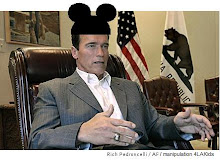
Gov. Arnold Schwarzenegger said Friday he is willing to reconsider his most recent proposal to help close the state's $26.3 billion budget shortfall by suspending state constitutional rules that control education spending in order to make deep cuts in school funding.  View Larger Image


Sat Jul 4, 2009 3:56pm EDT

By Jim Christie - Reuters

SAN FRANCISCO, July 4 (Reuters) - Governor Arnold Schwarzenegger, optimistic California can finish its budget negotiations in a few days, is willing to reconsider his proposed cuts to education in hopes of averting a cash crisis, the San Francisco Chronicle said on Saturday. (ARTICLE FOLLOWS)

A compromise between the Republican governor and Democratic lawmakers may help clear the way for an agreement on an overdue state budget and avert a cash crisis for the government of the most populous U.S. state. California already is issuing billions of dollars in "IOUs" and, without a deal, is on track to run out of cash this month.

The San Francisco Chronicle reported that Schwarzenegger, in a Friday meeting with its editorial board, said he would be willing to reconsider his proposal to help reduce California's $26.3 billion budget deficit with cuts to school spending that would require suspension of constitutional rules on education expenditures.

"We are not stuck ... about the suspension," Schwarzenegger said during the meeting. "We've got to analyze all this."

He said budget negotiations are moving fast. "I think if we continue this way we can get this done in the next few days," he said.

Backing off on education spending cuts would go a long way with Democrats who control the state legislature.

On Thursday Democrats said they would no longer hold out for increasing taxes to help raise revenues to fill the budget gap. That was a major concession to Schwarzenegger and Republican lawmakers, who had opposed tax hikes and pressed for balancing the state's books with deep spending cuts.

That helped Republicans gain confidence that a budget deal could be reached soon.

"I think there is at least a 50-50 chance that we'll find a solution that is acceptable to all parties within a week," Assembly Republican Leader Sam Blakeslee said.

Democrats see backing off on education spending cuts as an important concession by Schwarzenegger.

"While taxes may be off the table, education cuts also have to be off the table," Democratic state Senator Leland Yee told Reuters.

GRIM REVENUE OUTLOOK

Lawmakers failed to agree on balancing the state's budget on Tuesday and the state government began its fiscal year on Wednesday without a spending plan in place.

In response, state finance officials began issuing "IOUs" in lieu of payments for tax refunds owed to taxpayers to preserve cash from higher prior payments, including payments to investors holding the state's debt. They warned that local agencies overseeing health programs and a variety of recipients of state financial aid, including the disabled and college students, could be in line for IOUs.

The state controller plans to issue more than $3 billion this month in registered warrants promising payments if Schwarzenegger and lawmakers fail to agree on a budget.

California is experiencing a severe revenue downturn as a result of the recession, rising unemployment and the lengthy housing downturn that will leave the state's government with an austere budget. It likely will force additional spending cuts throughout the fiscal year.

"The reality is that the revenues are not looking good," Yee said. "We just simply don't have the money to keep up the pace of services we're providing."

California finance officials hope a budget deal is reached soon so they can stop their IOU effort, which aims to reassure the municipal debt market that the state will honor its bond payments ahead of nearly all other obligations.

Finance officials also want to reassure the market in anticipation of having to sell short-term debt for cash-flow purposes once a budget deal is reached.

California's budget turmoil has made Wall Street nervous. Standard & Poor's warned in a statement on Wednesday that if California's budget is not settled soon, the state's A-credit rating, already the lowest of any of the 50 states, is at risk of falling.


GOVERNOR BACKS OFF PLAN TO SUSPEND PROP 98

Matthew Yi, sAN Francisco Chronicle Staff Writer

Saturday, July 4, 2009 -- Gov. Arnold Schwarzenegger said Friday he is willing to reconsider his most recent proposal to help close the state's $26.3 billion budget shortfall by suspending state constitutional rules that control education spending in order to make deep cuts in school funding. That concession may help him avoid a political battle with the influential California Teachers Association. Although the powerful union has been largely quiet during budget talks, it could sway lawmakers who are desperately needed to pass a budget. A source told The Chronicle on Friday that the union is preparing a statewide television advertising campaign to fight any attempt to ignore the education spending rules that voters passed in 1988 as Proposition 98.

On Wednesday, Schwarzenegger had proposed suspending Prop. 98, which among other things requires that school funding be based in part on what was spent the previous fiscal year. The requirement can make it difficult, if not nearly impossible, to make large cuts in education - an expense that makes up about half of the state's discretionary spending.

Such cuts became even more inevitable when the state's gaping deficit grew overnight by $2 billion because the Legislature failed to approve a budget fix by midnight Tuesday, the end of the 2008-09 fiscal year.

Still, the governor, who has proposed cutting this year's education spending by $3 billion, said he was willing to consider other solutions.

"We are not stuck ... about the suspension" of Prop. 98, he said in a meeting Friday with The Chronicle's editorial board. "We've got to analyze all this. ... We have to figure out how to deal with it."

Democratic lawmakers said they are encouraged by Schwarzenegger's willingness to reconsider the Prop. 98 issue. Yet Senate President Pro Tem Darrell Steinberg quickly pointed out that the issue would have never surfaced had the governor on Tuesday supported three budget bills that would have saved $3 billion.

"This problem was completely avoidable. The administration is stuck because of its own ... strategy," said Steinberg, D-Sacramento.

The governor has refused to support partial budget fixes. But the budget impasse has caused a cash crunch that on Thursday forced the state controller to begin issuing IOUs to some taxpayers, businesses and creditors.

That impasse would become even more complicated by an enraged California Teachers Association and other education groups.

"They had not declared war on this governor who had made billions of dollars in cuts to education in his budget proposals ... and to have additional rounds of cuts proposed by him on top of the huge reductions they've already made have gotten them very, very upset," said Kevin Gordon, an education lobbyist.

Gordon noted that the California Teachers Association, which led the effort to torpedo Schwarzenegger's ballot measures to reform government in 2005, had supported the governor's budget-related ballot measures that failed in the May 19 special election. That could spell trouble for the governor, who is one of the biggest proponents of next year's ballot measure that would create an open primary system.

Telephone calls to CTA representatives were not returned Friday.

Nevertheless, despite this new wrinkle in the budget negotiations, Schwarzenegger said talks with Democratic legislative leaders have been progressing and he's hopeful that a resolution is near.

The governor said there has been a greater sense of urgency since Tuesday. Since then, the bulk of the budget negotiations have centered on how much to cut spending in health and human services.

"There's more willingness to look at our proposals more seriously - to look at reforms more seriously ... and to look at cuts more seriously," said Schwarzenegger, who has backed away from outright elimination of popular state programs such as health care for poor children, a welfare-to-work program for single mothers, and in-home support services for the elderly and the disabled.

The governor said "there's movement" in budget negotiations. "I think if we continue this way we can get this done in the next few days."

Monday, March 2, 2009

UNIONS HOLD THE WILD CARD ON PROPOSED STATE SPENDING CAP

By Kevin Yamamura | The Sacramento Bee


How ‘sweet’ does it have to be before the diabetes kicks in?1W2ELECTION.JPG
  - Gov. Arnold Schwarzenegger urges support for six budget measures – topped by a state spending cap and school funding sweeteners – in a special election May 19. [BRIAN BAER Sacramento Bee file, Feb. 26 ]

Monday, Mar. 2, 2009 --Labor unions that blasted a state budget deal for its constitutional spending limit have gone quiet as the state gears up for a May 19 election asking voters to ratify the agreement.Campaign veterans believe Gov. Arnold Schwarzenegger and legislative leaders can only succeed in persuading voters to pass six budget-related ballot measures if unions remain on the sidelines.

Labor groups will hold internal meetings over the next month to decide how to proceed.

"That's the multimillion- dollar question," said Dan Schnur, a former Republican strategist who now directs the Jesse M. Unruh Institute of Politics at the University of Southern California.

"Initiatives like this only pass when there isn't much money spent against them," he said. "And the only people who have that kind of money and that kind of motivation are unions. If they decide to sit this one out, it probably passes."

Schwarzenegger hopes the special election will be nothing like the one four years ago, when he suffered multiple defeats at the hands of labor groups.

One immediate difference is that the powerful California Teachers Association has backed Proposition 1B to ensure that schools receive $9 billion in future years, one of the six proposals that Schwarzenegger and legislative leaders are selling as part of an overall "budget reform" package.

In 2005, the CTA worked against the governor by galvanizing opposition to his various ballot proposals.

The most controversial ballot measure this year is Proposition 1A, which establishes a cap on future state spending based on a trend line over the previous decade.

Public employee labor unions fear the measure would mean less money for government jobs, yet the cap was essential to winning Republican support for the budget package.

Unions last month were attacking the budget deal for including a limit on future state spending growth and $15 billion in cuts to state programs. The spending limit must be approved by voters in Proposition 1A to take effect.

Fearing that unions could mount a successful opposition campaign, lawmakers and Schwarzenegger crafted the budget deal so that increased taxes on income, sales and vehicles would last up to an additional two years if Proposition 1A passes.

The strategy assumed that the additional state tax revenue, worth as much as $16 billion between 2011 and 2013, would provide enough incentive for unions to let Proposition 1A go unchallenged.

Different branches of the Service Employees International Union, which represents tens of thousands of public-sector workers, are having internal discussions about what approach they want to take toward the ballot measures.

"We have always been against the spending cap," said Jeanine Meyer Rodriguez, spokeswoman for the state council of SEIU, representing 750,000 workers statewide. "We have to go through our internal process."

If unions decide to pony up money in the special election, they will find vocal partners in the Howard Jarvis Taxpayers Association, an anti-tax group usually on the opposite side of labor in public policy debates. The group opposes the tax hikes linked to Proposition 1A and believes the spending limit allows for too much growth in the state budget.

"I think the opposition is not only there, but I think it will grow the closer we get to May 19," said Jon Coupal, president of the Jarvis group. "It's well known that some bargaining units are not happy and may have motivation to oppose Proposition 1A. Politics makes for strange bedfellows."

Lawmakers and Schwarzenegger crafted the budget deal to win support from education groups. They placed Proposition 1B on the ballot to specify that the state would pay schools $9.3 billion beginning in 2011-12. They tied the measure to Proposition 1A, partly to discourage teachers unions from opposing the spending limit.

CTA President David Sanchez said that his group has taken an interim support position on Proposition 1B, but that it will take positions on all the measures at a state council meeting next month.

"We're going to be having a campaign to encourage electorate support for repayment back to schools," Sanchez said.

Schwarzenegger held a kickoff news conference Thursday for the six ballot proposals with Senate President Pro Tem Darrell Steinberg, D-Sacramento, former Senate Republican leader Dave Cogdill and leaders from business, public safety and construction groups.

The governor plans to build a substantial war chest in case any financial heavyweights emerge to oppose the six budget-related ballot proposals.

Schwarzenegger, who has set gubernatorial fundraising records, already has the support of major business-backed groups, including the California Chamber of Commerce and the California Taxpayers Association.

"We will get enough money together so we can have an effective TV campaign because even though there's no opposition at this point, you never know," Schwarzenegger said last week. "We want to make sure that if there is opposition coming up and spending money against it, that we have enough money available to push back and get the message out."

The unions may not be Schwarzenegger's only concern.

Republican gubernatorial candidate Meg Whitman, a former eBay CEO whose net worth has been estimated at more than $1 billion, hasn't ruled out using the special election as a means to court the party's anti-tax base by spending heavily to oppose Proposition 1A. She already is on record opposing the measure.

Friday, February 27, 2009

THE MAY 19 BALLOT MEASURES

The State Legislative Analyst’s Office has prepared a summary and analysis for each of the six measures.

The Secretary of State has now posted the ballot summaries, arguments for and against, and other information.

Thursday, February 19, 2009

LAUSD BUDGET UPDATE AS OF 2/18/09

Subject to change based on updates from the State

from the office of superintendent Ramón C. Cortines

OVERVIEW

1. Based on current projections from the State, our projected district shortfall is between $600 and $700 million and the prospects do not look any brighter for future years. We also do not know if we will have class size or categorical flexibility, so we must prepare for the worst case scenario.

2. My philosophy for moving forward will be the same as the 2000 Plan adopted by the Board

a) Central offices are to be right-sized and to focus on core operations, monitoring and oversight

b) The local districts are to provide support and service to schools

c) The schools are the heart of our District and are where teaching and learning takes place

3. Federal Stimulus money will provide some temporary relief, since the money is for one time expenses (spread over two years). Flexibility and use of this money still has not been determined.

a) Although the stimulus money has yet to be finalized, I will recommend that the majority of any unrestricted resources to be set aside to protect the schools.

CENTRAL – RIGHT-SIZED

We will be streamlining the central office to ensure the majority of our resources are at the school site.

1. I have recommended a 30% reduction in most central offices. We are in the process of reviewing the budgets and discussing how to implement our decentralized governance model.

2. Further, I am considering a recommendation to reduce the work year for most non-school based employees. Besides providing substantial savings, it will emphasize that our highest priority is support of the local school.

3. We are also reviewing outside contractors with the goal of substantially reducing costs and administered accounts.

LOCAL DISTRICT OFFICES SUPPORT AND SERVICE TO SCHOOLS

Via the decentralization of the central office, the local district offices will be responsible for working with their schools to ensure each school receives the service and support they need.

1. However, I am recommending that local district offices be cut up to 50%. I will expect my leaders in the local districts to work smarter to target services to the schools that need the most support.

2. While we have benefited from many ancillary programs that support our student population, we must now cut some of these programs to focus our limited resources on our core instructional program.

LOCAL SCHOOLS – WHERE TEACHING AND LEARNING TAKES PLACE

My approach is to build a school district from the classroom out, so that we can minimize the impact on teachers. The percentage of cuts will be the lowest at the school level, but given the cumulative size of our school budgets, the dollar amount will be large.

1. Since we don't have all of the necessary budget information from the State, we must be conservative by noticing a potentially larger number of certificated employees on March 15th

a. All certificated administrators will be notified

b. Since central and local district certificated employees have rights to the classroom, we will need to notify some permanent teachers.

c. To ease the impact on our novice teachers, we have implemented an aggressive early retirement incentive program (ERIP)

NEXT STEPS

February 26th: 2009-10 Budget Development process with recommendation for March 15th letters

March –June: Hold public reviews of the budget to ensure we all agree on our priorities

Council of Great City Schools – Update on Stimulus Package 2/17/09

Disclaimer – details have not been finalized on how and when the funds will be allocated to LAUSD, especially the State Fiscal Stabilization funds

Overview of Federal Stimulus Package - Jeff Simmering

Five major types of aid to be expended over a 2 yr period (potential for flexibility to spread over 3 yrs)

  1. Non Categorical Aid – State Fiscal Stabilization: $40B for education (broadly defined)
    1. Proportionally allocated based on split b/w K-12 and higher education state reductions
    2. Distribution of funds will vary state by state, but can be used to backfill state cuts
    3. Distributed on per capita basis
    4. Use of funds are based on ESEA, IDEA, Perkins, School modernization or repair
  2. Categorical IDEA: $12.2 B ($11.3B traditional part B, $400M early Childhood, $500M infant and toddler)
    1. 50% of funds can be used to offset Spec Ed use of General Funds
  3. Categorical Title I: $13B ($10B Regular, $3B School Improvement)
    1. Allocated by targeted and equity formulas
    2. 95% will be passed through to LEAs
    3. 1% used for State Administration
    4. 4% school improvement activities
  4. Secretary Bonus or Incentive: states that have made good progress will be awarded $5B ($2.5 allocated on basis of Title I)
    1. Progress defined as states that are increasing equitable distribution of teachers, improved data systems, and improved assessments
  5. School Construction Bonds - $22B tax subsidizes or bonding authority
    1. After you sell your bonds the interest that you pay will be given a tax credit
    2. Can be used as new construction and land acquisition

Council of Great City Schools estimate of stimulus for LAUSD (over two years)

- Title I: $398M

- IDEA: $168M

- Ed-Tech: $9.7M

- State Stabilization has not been determined

Key Takeaways for LAUSD

1. We will need to be flexible in our projections until we receive the final allocations from the State

2. We need to be conservative with our projected use of our funds, because we do not know the magnitude of the cuts that from the State

3. Stimulus funds are one time funds, so we can not rely on using them to cover ongoing expenses

4. Depending on the cuts from the State, we will use the majority of the funds to help schools offset some of their reductions

Day 106 | 6:17 AM: SENATE APPROVES BUDGET PLAN!

http://cl.exct.net/?ju=fe5e1775726501787513&ls=fdf01672736d037572177274&m=fefc1172766306&l=feca16737661057a&s=fe391572756d017d761670&jb=ffcf14&t=

http://cl.exct.net/?ju=fe5d177572650178751c&ls=fdf01672736d037572177274&m=fefc1172766306&l=feca16737661057a&s=fe391572756d017d761670&jb=ffcf14&t=

Senate approves budget plan

The state Senate voted early Thursday to approve a massive budget package of tax increases, spending cuts and borrowing to close a $40 billion deficit after granting major concessions to one holdout Republican senator.
Read More
 

Wednesday, February 18, 2009

STATE HELD HOSTAGE

Sacramento Bee cartoonist Rex Babin

996-SED_G0218_3BABIN0218.standalone.prod_affiliate.4.jpg

AM Alert - REPUBLICAN SENATORS FIRE THEIR LEADER: Hollingsworth in, Cogdill out

The Sacramento Bee CapitolAlert

Senate Republicans have a new leader today after the caucus ousted Sen. Dave Cogdill and replaced him with Sen. Dennis Hollingsworth shortly after midnight.

Despite speculation that Senate Republicans may ask to reopen budget talks, Senate President Pro Tem Darrell Steinberg insisted the change has absolutely no effect on his strategy to break the budget deadlock this week.

"We're going to maintain our focus towards solving the problem of getting one vote regardless of who the leader is," Steinberg said after his house took a recess around 1 a.m. "Leadership doesn't change the fact that there is no other idea put forward that would take $41 billion out of a budget deficit. And so, for me, it doesn't change anything."

After the Senate failed to approve the contentious tax hike bill, Steinberg made good on his threat to keep his members locked in for the night. He said he plans to resume talks later Wednesday with Sen. Dave Cox, R-Fair Oaks, and Sen. Abel Maldonado, R-Santa Maria, to see if either one will back the budget package.

"I would describe it as a bit of a discouraging day," Steinberg said of Tuesday. "Despite a lot of effort, and a lot of work today by our office, the governor's office, they're not there. But they have to be there eventually."

Schwarzenegger flew home to Brentwood around 9 p.m., a sign that the budget deal remained elusive Tuesday. His spokesman, Aaron McLear, said the governor plans to continue speaking to Cox and Maldonado on Wednesday.

Hollingsworth, an ardent tax opponent, made it clear that he continues to oppose the budget. When asked whether he wants to reopen the "Big 5" negotiations, he said he'd take a wait-and-see approach.

"I think the majority of my caucus doesn't want to see a tax increase passed in this particular package," Hollingsworth said. "But we'll see what happens in the next few minutes, the next few hours, the next few days."

Monday, February 9, 2009

THREE TOUGH STEPS TO FISCAL SANITY IN CALIFORNIA

George Skelton

George Skelton, Capitol Journal | LA Times


February 9, 2009  -- From Sacramento -- California state government is collapsing. It has been for years, actually. Something needs to change drastically.

As President Obama remarked last week at a congressional Democratic retreat: "If you're headed for a cliff, you've got to change directions."

Sacramento is sliding fast toward the cliff's edge.

The state can't pay all its bills. Can't sell bonds to finance public works. Can't even afford, Gov. Arnold Schwarzenegger says, to keep most of its doors open two Fridays a month.

The chief culprit: The Legislature's inability to pass a state budget on time. Frustrated local governments and schools can't plan. Private vendors selling to the state get stiffed. Worst of all, the Capitol politicians ultimately panic, punt the state's fiscal mess into the future and pass a fraudulent budget.

Rather than cutting spending and raising taxes slightly to escape a looming deficit, the lawmakers have passed gimmicky budgets with cooked numbers that soon dig the state into an even deeper hole. And that's where we are today: in a $42-billion pit. Even with a recession, that's ridiculous.

I've harped on this for years, thinking that surely one day California would wake up.

The Legislature can't produce an on-time budget -- honest or phony -- because of the archaic requirement for a two-thirds majority vote of each house. Only two other states, Arkansas and Rhode Island, have such a monstrous hurdle. And, unlike California's, their legislatures are lopsidedly dominated by one party.

The California Legislature requires some minority party votes for a budget -- currently three Republicans in each house. And virtually all Republicans regard a vote to raise taxes as ideological blasphemy. More important, they consider it potential political suicide, fearing they'll be challenged from the right in a primary election.

So give the Republicans a break. Relieve them of any responsibility to vote for budgets and taxes that rip their souls and imperil their careers.

Here's my solution to the budget procrastination:

* Lower the vote requirement for a budget to 55%. That's still a supermajority, but one that's practical given California's increasing diversity of people and interests represented in Sacramento. A budget then would need 44 votes in the Assembly and 22 in the Senate, rather than 54 and 27. Democrats normally could handle that by themselves.

* Also drop the two-thirds vote requirement for taxes to 55%, with one caveat: All the new revenue must be used to help balance a status-quo budget -- not a penny for spending increases above inflation and population growth.

* If they still don't pass a budget by the July 1 start of the new fiscal year, the lollygagging lawmakers forfeit their pay and per diem for every day the spending plan is late. For most, that would be a hard hit. Legislators make $116,208 a year; house leaders get $133,639. Per diem is $173 tax-free each day -- even weekends -- while the Legislature is in session.

Sever the governor's pay, too, although Schwarzenegger is so wealthy he doesn't take his $212,179 salary. He does, however, mooch off special interests for Sacramento lodging, as have previous governors. That's because California doesn't provide an official governor's residence. Pretty tacky.

The concept of prodding lawmakers in the wallet is endorsed by Schwarzenegger. "If the people's work doesn't get done, I think the people's representatives shouldn't get paid," the governor said in his State of the State speech.

That should ensure an on-time budget.

I'm not totally convinced it would be good public policy. It would be unfair to legislators who vote for budgets and aren't rich. Moreover, we shouldn't be blackmailing lawmakers to pass bad budgets just to keep their pay.

But it's time to be drastic. And I am convinced it would be good politics. It could be just the inducement the electorate needs to approve a ballot measure finally eliminating the unworkable two-thirds vote.

A similar ballot measure, without the tax limit caveat, was killed in 2004 by a nearly 2-to-1 vote. But since then, the voters have become more acutely aware of Sacramento's ineptness. They may be ready to rethink the notion.

As reader Andrea e-mailed me last week: "Soon people will take to the streets with pitchforks and torches if these clowns don't get to work."

A recent statewide poll by the Public Policy Institute of California found, for the first time, that a majority of likely voters -- 53% to 41% -- think it's a good idea to lower the budget vote threshold to 55%. The poll also found that only 9% approve of how the Legislature is handling the budget-tax issue; 84% disapprove.

Some GOP leaders have said privately that they could support a majority-vote budget rule if the two-thirds requirement remained for taxes. Then Democrats alone would be accountable for spending priorities, giving the GOP a potential election issue.

Yes, it's time to let the majority party rule and to end gridlock.

Sen. Mimi Walters (R-Laguna Niguel) has proposed a constitutional amendment that would revive a pre-1962 law: A budget could be passed on a majority vote if it didn't increase spending by more than 5%. That would amount to a spending cap.

Sen. Abel Maldonado (R-Santa Maria) has introduced a measure that decrees: "No budget, no pay, no per diem." He knows it will never pass the Legislature.

"It's the only bill where I get bipartisan opposition," he says. "If you want the Legislature to work together, you put in a bill that cuts their pay."

Cut off their allowances if they don't do their chore? Yeah, that is treating them like children. But like many parents with undisciplined kids, we're at the end of our rope.

First, however, we should make the chore doable.

Friday, February 6, 2009

CALIFORNIA’S @ ROCK BOTTOM: If California wants its share of federal largesse, Sacramento had better get its act together, fast.

Editorial From the Los Angeles Times

February 6, 2009 -- California is now the Wile E. Coyote of states. Our governor and lawmakers have dickered and dawdled all of us off a cliff, but we're trying desperately to resist the realization that there is no ground beneath us. Our legs  imageare pumping and our eyes are on Obama administration stimulus packages and bailout money on the far, sunny slope, and we might just reach them if we don't acknowledge that the bridge is out, or that we've run off the road, or that our Acme wings have failed. Once we notice that we're hanging in midair, we'll fall.

Too bad for us, but Standard & Poor's has already noticed. It said this week that California is a monumentally bad bet for investors, presumably because the state lacks both the will to adopt a budget and the ability to raise enough tax money to guarantee it will pay back all those bonds voters keep approving; S&P now ranks California 50th among states in credit ratings.

If ratings agencies recommend California as the last choice for bond buyers, how attractive could the state look to Washington? President Obama and Congress want federal dollars to go to work immediately, so they hardly could be blamed for guiding those dollars to states with governments that pay contractors with Federal Reserve notes rather than IOUs, with budgets that balance, with governors who lead and legislatures that function. Take a look -- that's not us.

Gov. Arnold Schwarzenegger has identified "shovel ready" projects lined up for federal cash. But they will fall behind similar projects ready to go in states where governors and lawmakers are not arguing about permits and approvals, and where state treasuries are solvent so state dollars can go to work. The State Children's Health Insurance Program, reauthorized and expanded and signed by Obama on Wednesday, means $1.5 billion in funding for California's much-needed Healthy Families program only if the state is functioning sufficiently to run it. Federal aid for Medi-Cal will be wasted if California fails to produce its state match.

So it's hard not to pretend that Obama will ride to the rescue because of all the campaign fundraising and phone calling by true-blue California Democrats.

A budget vote is set for next week, and with any luck, California will once again join the ranks of functioning states, but powerful people here keep tripping over their own cleverness. Two cases in point: the recent warning by a union official that he will target Democrats for recall if they cut the wrong things from the budget, and the pronouncement by state GOP official and blogger Jon Fleischman that Republicans who vote to increase taxes will be censured. With folks like these pulling the levers of power, the best way out of the recession may be to invest heavily in Acme.

FRIDAY BUDGET UPDATE: The state of emergency in the State of Emergency

From Wikipedia, the free encyclopedia: A state of emergency is a governmental declaration that may suspend certain normal functions of government, alert citizens to alter their normal behaviors, or order government agencies to implement emergency preparedness plans. It can also be used as a rationale for suspending civil liberties. Such declarations usually come during a time of natural disaster, during periods of civil disorder, or following a declaration of war (in democratic countries, many call this martial law, most with non-critical intent). Justitium is its equivalent in Roman law.

from SacBee Capitol Update

Feb 6 -- The news Thursday was that Senate leader Darrell Steinberg said a vote was upcoming next week. No deal yet, as the negotiations continue behind closed doors.

That secretive process is being pretty well criticized here, here, here, here and here.

Asked if there would be any time for public input before any sort of deal is rammed through the Legislature, Steinberg expounded:

"Certainly, the public has the absolute right to review what we do eventually put forward. And our members certainly do as well. We're going to afford the public, our members that full opportunity," he said. "On the other hand, this is an emergency. We're going to balance those two concerns."

THE CONE OF SILENCE

 “The one safe bet seems to be that there will be no public hearings and no opportunity for public input on major decisions that will shape California for years, if not decades, to come.”

Jean Ross | California Budget Project

Wed, 4 Feb 2009 22:34:00  - Some of you may wonder why, and even be frustrated by the fact that, we haven’t been blogging about the status of budget negotiations. That’s because a virtually impenetrable cone of silence has descended upon the Capitol. Secrecy in budget negotiations is nothing new. However, the level of secrecy around budget negotiations that reached a new high last summer has been far surpassed by the lack of information in the current negotiations. While rumors fly daily - often several times a day - as to when a vote on a budget deal may occur, these rumors are neither confirmed nor denied by those truly in the know.

The one safe bet seems to be that there will be no public hearings and no opportunity for public input on major decisions that will shape California for years, if not decades, to come. The taxes and spending cuts that are likely to be included will no doubt be drawn from some combination of the Governor’s proposals and plans supported by Legislative Democrats in late 2008. However, there are increasing signs that additional measures, such as a “hard” spending cap and sizeable tax cuts for the state’s largest corporations, may also be part of the package. The cone of silence has been particularly airtight with respect to “add ons” such as these. No details have been made available to rank and file lawmakers or the public that would enable a critical assessment of the impact they might have on current and future budgets.


more from CBP:
  • Another Urban Legend
    Posted: Fri, 06 Feb 2009 01:26:40 +0000

    A recent comment on our blog post reminded us of a persistent, but factually incorrect, rumor frequently heard in state policy circles - that rich people are leaving California in droves for states with lower personal income tax rates. Curious to find out whether this was actually true, CBP staff dove into data provided by [...]

 
  • The Personal Income Tax Is Not the Problem
    Posted: Wed, 04 Feb 2009 01:16:37 +0000

    One of the frequently cited causes of California’s budget crisis is “revenue volatility” - the fluctuations in state income tax revenues that occur when income tax collections, primarily taxes collected on capital gains, rise and fall during boom and bust periods. In fact, a key goal of the Governor’s Commission on the 21st Century Economy [...]

  • Congress Poised To Approve Children’s Health Coverage Bill
    Posted: Sat, 31 Jan 2009 00:13:03 +0000

    After more than one year of waiting - and two vetoes by former President Bush - Congress is poised to approve a bill that will help California significantly increase the number of children with health coverage. The House and Senate have approved bills to renew, or “reauthorize,” the State Children’s Health Insurance Program (SCHIP) with [...]

  • A Proposed Hard Cap on Spending Is Misguided
    Posted: Wed, 28 Jan 2009 22:04:48 +0000

    We’ve been swamped lately at the CBP with budget-related work. That’s why we’re just now getting around to posting this op-ed written by CBP Executive Director Jean Ross that appeared in the Los Angeles Times yesterday. In the op-ed, Jean examines a Republican proposal to place a hard spending cap on the ballot in exchange [...]

  • Sowing the Seeds of Future Budget Problems
    Posted: Tue, 27 Jan 2009 00:27:59 +0000

    Press reports and the rumor mill suggest that lawmakers may be close to reaching agreement on a deal that attempts to address most, if not all, of the state’s $40 billion budget gap. A reasonable voter might wonder why, in the face of an impending cash flow crisis, reaching an agreement is so difficult. One [...]

  • California Stands To Receive Nearly $20 Billion Under House Economic Recovery Plan
    Posted: Fri, 23 Jan 2009 01:43:06 +0000

    Our colleagues at the Center on Budget and Policy Priorities (CBPP) have released preliminary analyses of the state-by-state impact of the House Economic Recovery Plan. The CBPP estimates that California would receive $11.1 billion from provisions that would increase the federal government’s share of Medicaid spending (Medi-Cal in California) in the current and next two [...]

  • Limiting California’s Future - An Elaboration
    Posted: Thu, 22 Jan 2009 19:30:07 +0000

    We received a number of good questions on yesterday’s post. Explaining the impact of a hard budget cap is a tough thing to do in a blog post! The $31.2 billion figure is the difference between budgeted 2008-09 General Fund spending and the level of spending that would be allowed under a cap similar to that [...]

  • Limiting California’s Future
    Posted: Thu, 22 Jan 2009 00:25:49 +0000

    Republican lawmakers have called for the Legislature to place a “hard spending cap” on the ballot in return for Republican support of a tax increase to help close the state’s budget gap. First, it is important to note that California already has a hard cap in the state’s constitution. In fact, we’ve had one since [...]