Monday, September 15, 2008

77 Days, 21¾ hours later: LATEST STATE BUDGET IS THE WORST IN MEMORY

By Dan Walters / The Sacramento Bee | 09/15/08 21:42:55

They had to be kidding.

Nobody could have dreamed up a less responsible, more gimmicky, sure-to-backfire state budget than the one California's political leaders cobbled together and were jamming through the Legislature to end a months-long stalemate.

But it wasn't a joke, or at least not a funny one. They violated every principle of fiscal responsibility by conjuring up billions of dollars in sham revenues, basically money borrowed from corporate and personal taxpayers that would have to be paid back later to cover a huge deficit.

Remember those Democrats who promised to end years of deficit borrowing and bookkeeping trickery with a straightforward budget that raised taxes to cover obligations? They embraced a get-out-of-town scheme that's the antithesis of common sense budgeting, and hid most of the details until the last minute.

Remember those Republicans who made noise about not raising taxes, even temporarily, because they would damage an already declining economy? Nevermind. They opted for siphoning billions of extra dollars out of Californians' paychecks through "accelerated withholding" money that consumers won't get back until they receive tax refunds in 2010.

Remember Gov. Schwarzenegger, who vowed never to sign a budget unless it had "reforms" to end the cycle of deficits and debts? He may be willing to accept a budget that not only does virtually nothing to preclude future deficits, but probably would make them worse.

If Californians needed even more evidence that their state government is completely and irrevocably dysfunctional, those they elected to high state office provided it with easily the worst budget in memory.

Yes, the small businesses and individuals who have borne the brunt of the long budget impasse will get their overdue state checks, but everyone will be paying the price for this debacle for many years.

As details of the "compromise" emerged, the Bay Area Council renewed its call for a constitutional convention to overhaul state government.

"This year's budget deadlock shows better than perhaps any other recent event that our state needs a constitutional convention to fix a governance system that is hopelessly broken," said the council's president, Jim Wunderman.

"The defining feature of this budget is that it only makes next year's budget worse, and 'next year' is only nine months away. Of course, it's not just the budget. As we have previously stated, California's government suffers from drastic dysfunction, our prisons overflow, our water system teeters on col- lapse, our once proud schools are criminally poor, our financ- ing system is bankrupt, our democracy produces ideologically extreme legislators that can pass neither budget nor re- forms, and we have no recourse in the current system to right these wrongs. Drastic times call for drastic measures."

SCHWARZENEGGER'S THREE DEMANDS

8:35 PM Sept 15

image

CALIFORNIA LAWMAKERS TO VOTE ON PATCHWORK BUDGET PLAN

By JUDY LIN – Associated Press | 8PM - 15 Sept

SACRAMENTO, Calif. (AP) — State lawmakers on Monday were considering a compromise plan to end California's longest-ever budget stalemate, a proposal that includes increasing the paycheck withholding for state income taxes.

The withholding provision was one of several steps lawmakers used to close a $15.2 billion deficit without borrowing or new taxes. They acknowledged the proposal would get the state through its current fiscal year but not solve California's ongoing fiscal problems.

The Senate and Assembly scheduled floor sessions for Monday evening. Rank-and-file lawmakers scrambled to understand the compromise that was announced Sunday afternoon, while Republican and Democratic leaders sought to revise the language in a way that would assure the bill's passage.

The budget requires a two-thirds vote in both houses so it can be sent to the governor, who indicated he would not sign the plan in its original form.

In a letter to the four legislative leaders, Gov. Arnold Schwarzenegger said he will not sign the budget unless it includes a stronger rainy day account that could be tapped in years when revenue declines.

The budget proposal includes $7.1 billion in spending cuts and fills the remaining gap by moving up tax collection deadlines and closing some tax loopholes. Those maneuvers will generate $9.3 billion, leaving a small reserve for unanticipated expenses.

A large portion of the revenue depends on increasing income tax withholdings by 10 percent for working Californians, a move that would raise $1.6 billion. It also would require those who pay quarterly taxes — including limited-liability corporations and wealthier Californians — to pay 30 percent of their taxes in each of the first two quarters of the fiscal year instead of 25 percent. That move would generate $2.3 billion.

Tax experts said the result of higher withholdings will mean less take-home pay for many workers. Taxpayers can adapt by adjusting withholdings once the change takes effect, said Lenny Goldberg of the California Tax Reform Association.

"It's really about timing," he said. "It will come out of people's take-home pay, and they will end up getting a bigger refund in April."

Assembly Speaker Karen Bass said the $104.3 billion general fund spending plan does not address California's long-term difficulty in balancing spending with revenue. But the Los Angeles Democrat said it was important for lawmakers to finish work on the budget for the current fiscal year, which began July 1.

During the impasse, Republicans have refused to raise taxes on corporations and the wealthy, as Democrats had proposed. The impasse continued despite Schwarzenegger's offer to increase the state sales tax 1 cent for three years.

"At the end of the day, we weren't able to raise the revenues we wanted," Bass told reporters Monday. "But we were able to close significant budget loopholes that is giving us revenue in this budget year that prevent us from having to make the draconian cuts."

The agreement was announced Sunday by the Legislature's Democratic and Republican leaders, who were pitching it to their respective caucuses ahead of the floor sessions.

The cuts include many of those the governor proposed in his May budget revision, although Democrats rejected what they considered the worst of those cuts. They did not want to reduce foster care funding or kick children off welfare if their parents don't find work within five years.

Editorial: SCHWARZENEGGER SHOULD VETO THIS BUDGET

The Sacramento Bee:  Published 7:32 pm PDT Monday, September 15, 2008

If this is the best the Legislature could do, California voters should be wondering what their lawmakers have been up to all summer.

The state budget plan cobbled together by legislative leaders over the weekend and scheduled for a vote Monday night is mostly a sham. The balance it claims between revenues and spending is so tenuous it will hardly survive until the bill reaches the governor's desk.

And when it gets there, Gov. Arnold Schwarzenegger should veto it.

If there is one message Schwarzenegger has repeated consistently since before he took office, it is that the government should live within its means. The state should not spend more than it collects from taxpayers.

But if Schwarzenegger has trumpeted that message, he has not always lived up to it. Five years after he took office, the state still struggles with the same stubborn gap between income and spending that he inherited in 2003. Now is the time for Schwarzenegger to stand firm and say, "No more."

Legislators - and voters - must come to terms with the reality that we all must pay for the government services we want, or else reduce the amount of government we're getting.

The state must either cut spending, raise taxes, or both. No good can come from, in the governor's own words, "kicking the can" down the alley for another year. But that's exactly what this budget would do.

The Legislature's plan would spend more and take in less money than the budget the governor proposed in May, despite the fact that the outlook for the economy is worse today than it was then. Legislative leaders claim their budget is balanced and would leave the state with a shortfall of only $1.2 billion next year. But the real gap is much bigger than that.

The legislators are assuming that voters will approve a proposal to expand the California Lottery and then borrow against its future proceeds. If adopted, that scheme would bring in perhaps $5 billion a year for two years, reducing the shortfall temporarily before allowing it to expand again, just as Schwarzenegger is leaving office in 2011.

The plan also relies on a host of temporary measures to accelerate the collection of tax revenues and tinker with the way the state accounts for them. These tricks make it appear that more money is in the coffers when the truth is that next year's money is being counted, and spent, this year.

We recognize that the lack of a budget is causing real hardship to public agencies and private vendors who do business with the state and have not been paid what they are owed. It's tempting to cave in to expediency for the sake of those victims of the Legislature's partisan stalemate.

But those same agencies and vendors will be at risk again next year, when the same set of problems will exist and the same set of solutions will be on the table. Chances are that, by then, things will be even worse.

The governor has wisely tried to steer the Legislature's warring parties toward a sensible middle ground with a temporary tax increase, some tough spending cuts and long-term reform to try to prevent future deficits. But the latest plan ignores that strategy and takes the easy way out instead.

Schwarzenegger has the public on his side. He shouldn't give up now. He should veto this budget and tell lawmakers to get back to work.

And keep working until they get the job done.

77 Days and counting: LAWMAKERS IN CALIFORNIA (appear to) REACH BUDGET COMPROMISE


LA TIMES STORY FOLLOWS

By JENNIFER STEINHAUER | NY Times

September 15, 2008 -- LOS ANGELES — California lawmakers appeared to have resolved the state’s budget impasse Sunday, but it was far from clear whether Gov. Arnold Schwarzenegger would sign the proposal into law.

Lawmakers did not release details of the plan, but said they had reached an agreement that avoided new taxes and borrowing, thereby closing a roughly $15 billion hole in the most overdue budget presented by the Legislature in state history. The Democrats and the governor had sought to increase the state sales tax temporarily by a penny, but state Republicans rejected it.

“The four leaders have reached a deal, but they need to take it to their caucuses,” said Alicia Trost, a spokeswoman for Don Perata, the Senate president pro tem, referring to the majority and minority leaders of the State Assembly and Senate. “There will be no taxes and no borrowing.”

Lawmakers are likely to vote on the plan on Monday.

The gap in the budget, now nearly 80 days late, would be filled with $10 billion in cuts and $5 billion in increased revenue from things like eliminating tax amnesties and other such moves bound to confound anyone but a budget expert.

“We are analyzing their proposal,” said Aaron McLear, a spokesman for Mr. Schwarzenegger, a Republican, in an e-mail message. “But we have concerns that budget reform may not be strong enough.”

The negotiations were essentially a fight among three forces: Republicans, who rejected tax increases; Democrats, who wanted to stave off program cuts; and the governor, who wanted to reform the budget process and avoid borrowing.

In the end, there was a stalemate over $5 billion that became the subject of great haggling. The difference would be filled with one-time revenue increases like the suspension of certain business tax credits and tax amnesties and the acceleration of existing taxes and fees. Although Mr. Schwarzenegger is almost certain to frown on the solution, he may well choose it over borrowing schemes. But he may demand an increased rainy-day fund and other reforms. His veto could be overridden, but he does have leverage with bills.

The state has been unable to pay millions of dollars to vendors, colleges and health care providers because the budget was not passed by July 1, the beginning of the fiscal year. Mr. Schwarzenegger had already ordered a temporary pay cut, to the federal minimum wage of $6.55 an hour, for roughly 176,000 state workers, something the state controller refused to implement, and has laid off nearly 10,000 other workers.


LA Times: CALIFORNIA LAWMAKERS REACH COMPROMISE ON BUDGET: The proposed state spending plan involves no new taxes. Votes on the plan are scheduled for Monday.

By Evan Halper, Los Angeles Times Staff Writer

September 15, 2008  -- SACRAMENTO -- Legislative leaders announced Sunday that they had reached a deal on a no-new-taxes state spending plan, bringing the longest budget impasse in modern California history nearly to an end.

Their proposal would increase spending for education and healthcare, though not enough to avoid cutbacks in services. It would borrow against the state lottery. And it relies heavily on maneuvers that would push the state's financial problems into the future at a time when economists have little hope that revenue is on the rebound.

That plan would require hundreds of thousands of businesses and individuals to hand over more of their taxes sooner, so the state could use the cash infusion to pay its bills. The payments made now would not be available for next year's budget.

Votes on the plan are scheduled for today in the Assembly and Senate.

Gov. Arnold Schwarzenegger, who appears to have been left out of the final deal-making, is not yet on board, and administration officials suggested he could demand changes. Nevertheless, legislative leaders said they expected the governor to approve the package.

"We will very quickly send the budget down to the governor, and we will expect his signature," said Assembly Speaker Karen Bass (D-Los Angeles) at a Sunday news conference with Senate President Pro Tem Don Perata (D-Oakland) and Republican leaders.

Once the governor signs a budget, the state can resume paying its bills.

The deal came days after Democrats in the Senate abandoned their months-long crusade to close the $15.2-billion budget gap with the help of increased taxes. They argued that balancing the budget any other way would be fiscally irresponsible and bleed state services.

Schwarzenegger supported that argument, but his fellow Republicans in the Legislature would not go along with a tax hike. The budget needs a two-thirds vote to pass, requiring at least eight Republicans.

"This won't make my highlights reel," Perata said Sunday, after he and other leaders put the finishing touches on the deal behind closed doors. But on the 76th day of the fiscal year, he said, "it was time to end this."

Schwarzenegger spokesman Aaron McLear said the lawmakers' agreement, which includes a provision to boost the state's rainy-day fund, may not meet the governor's demand for restraints on spending when state coffers are flush.

"We are analyzing their proposal but have concerns that budget reform may not be strong enough," he said.

If the governor were to veto the budget, lawmakers could override him with the same two-thirds vote required to pass it.

Meanwhile, legislators said the proposed cuts to schools, healthcare programs and social services were no deeper than those Democrats had already agreed on. And they said their plan would not borrow from local governments or transportation accounts.

The tax-related measures, which Perata called revenue "accelerations," would affect businesses and individuals in several ways, beginning in coming months.

Withholding of state taxes at the workplace would increase by 10% for families with two wage-earners and for all taxpayers with income from investments. The state could use the extra $1.5 billion generated by the scheme to reducethe budget gap; it would send those taxpayers extra refunds later.

Taxpayers who file quarterly would have to pay more of their taxes earlier in the year. And those who earn more than $1 million and experience a big jump in income would no longer have extra time to pay taxes on the increase. These measures, according to legislative staff, would generate $3.8 billion in the current fiscal year.

Limited liability companies would have to prepay fees that normally would not be due until the next fiscal year. The state would give tax cheats amnesty to encourage them to pay what they owe. And tax write-offs for business losses would be suspended temporarily. These measures would generate $2.7 billion this year.

Advocates of a tax hike criticized the budget deal for pushing this year's problems into the future.

"The proposed budget not only fails to fix the ongoing budget crisis but places health and other vital services at even more risk in future years," said Anthony Wright, executive director of the nonprofit Health Access California, which advocates for the poor.

Republican legislative leaders said they were pleased the state would not be raising taxes, though they expressed little enthusiasm for the final agreement.

"It doesn't solve the structural deficit problems we have in our budget," said Senate Republican Leader Dave Cogdill of Modesto.

Voters would ultimately have to approve, perhaps next spring, some elements of the budget deal. The proposal to bolster the state's rainy-day fund would require changes to the state Constitution, as would plans to modernize the California lottery and borrow against future earnings. If voters said yes, the lottery proceeds would not be available to the state until the 2009-10 fiscal year.

The absence of a state budget has wreaked havoc on providers of government services and those who rely on them. Billions of dollars in scheduled payments to healthcare clinics, day-care centers, group homes for the disabled and others have been withheld since July.

Some small providers were forced to shut their doors. Others have borrowed from friends and relatives to fund their payrolls or asked employees to work without pay until a budget is passed.

The passage of a budget would ease the anxiety of most state employees, whose pay the governor has been trying to cut to the federal minimum wage of $6.55 per hour until a budget is passed. The governor, however, has been unsuccessful so far in getting the courts to force State Controller John Chiang, who runs the state payroll, to carry out his pay-cut order.

77 Days without a budget: DON PERATA'S PRIVATE E-MAIL

from the Sac Bee Capitol Alert : Monday 15 SeptemBEr

There are only nine months left until the constitutional deadline to pass next year's budget.

Or, put another way, state lawmakers are now three months past the constitutional deadline to pass this year's budget.

The story of the weekend, though, was the private e-mail Senate leader Don Perata sent to his Democratic colleagues late last week. The Bee obtained a copy.

In it, he talks strategy for crafting a no-tax budget.

"Reps won't go on a tax. And he (Schwarzenegger) has no truck with them to get them," Perata wrote. "I said we urgently need a budget - let's see if I can work on a deal with Reps that is no tax, no borrowing. (Schwarzenegger) agreed."

"We'll do our best to hold the line on borrowing," he writes later.

Once a plan is done, Perata wrote, "We'll then bring in the assembly leaders to show them what we're sending them. And then we go to the floor the moment we have mocked-up language ready."

Perata also names names of GOP lawmakers he and the governor were trying to pick off: "I spoke with Ashburn who wasn't willing to go up without a stable mate. Margett apparently refused the gov."

But the best parts are Perata's raw political assessments, such as:

"SEIU was OK with borrowing"

"The gov's recall gives him extra motivation to join us."

"Gray Davis wasn't dumped because he didn't have budget reform."

The complete e-mail:

Sent: Fri Sep 12 04:23:04 2008
Subject: Budget Saga

Here's what happened to today's floor session:

It became clear throughout Thursday that the gov had no Rep votes. I spoke with Ashburn who wasn't willing to go up without a stable mate. Margett apparently refused the gov.

Late afternoon, I told the gov I saw no point in going to the floor only to prove what we all know: Reps won't go on a tax. And he has no truck with them to get them.

I said we urgently need a budget - let's see if I can work on a deal with Reps that is no tax, no borrowing. He agreed.

So Denise, Mike and I will work today with Cogdill and Dutton. And tomorrow. And Sunday, or until whenever there is a deal.

We'll then bring in the assembly leaders to show them what we're sending them. And then we go to the floor the moment we have mocked-up language ready.

The gov still insists on a budget reform amendment as a condition of his signature. We'll see. As of yesterday morning, he was back to his most draconian version, which is not acceptable.

Darrell and I met with the ed coalition. They were unwilling to support taking up the gov's budget. Too much risk for not enough gain. The tax cut bothered them (a la fate of car tax) and they view the budget amendment as end of days. (They are not certain it could be beaten on the ballot).

On "what's next" they were divided. CTA didn't like borrowing because 98 doesn't benefit. SEIU was OK with borrowing. AFSCME and CMA more to armageddon option on the
theory their members are being "bled out".

(SEIU - as many of you know- has been calling selected members to ask them not to vote. But the entire "revenue coalition" were working the phones. Opposition to our strategy, but none of their own).

That brings us current.

We'll remain on call of the chair day-to-day. 12 hour notice. Realistically, nothing over the week-end.

We'll do our best to hold the line on borrowing. The gov's recall gives him extra motivation to join us. Gray Davis wasn't dumped because he didn't have budget reform.

As an aside, there was hope in the horseshoe to still get the lottery on the November ballot! Well, no, that's not possible.

So there you have it. Lemme know if you have questions.

Diane, Erin, pro tem and budget staff have worked themselves to exhaustion. We gotta get this done if only to prevent them from being institutionalized!

Today's also a busy day on the fund-raising front, with the state Republican Party hosting an high-priced golf event on the Nevada side of Lake Tahoe.

"For all the Republican hot air about jobs fleeing to Nevada you'd wonder why they wouldn't support a local California golf course," sniped Brian Brokaw of the California Democratic Party.

GOP leaders Mike Villines and Dave Cogdill backed out of the event late last week, citing the stalled budget.

Assemblywoman Fiona Ma, D-San Francisco, has a fundraiser in San Francisco with a mix of past legislative firepower (Willie Brown and John Burton) and future legislative hopefuls (Tom Ammiano, Joan Buchanan, Paul Fong, Jerry Hill, Bill Monning and Nancy Skinner) set to attend.

Assembly Speaker Karen Bass will headline, though spokesman Steve Maviglio said she's playing her attendance by ear, depending on the status of budget talks.

Gov. Arnold Schwarzenegger, meanwhile, is fund-raising for Proposition 11, the redistricting measure, with events in Los Angeles and the Bay Area. His attendance also depends on the budget.

Friday, September 12, 2008

74 Days w/o a Budget/The View from Elsewhere: CALIFORNIA SCHOOLS SQUEEZED IN FISCAL VISE - Fallback Plans Readied Amid Budget Stalemate


clip_image002

California Senate President Pro Tem Don Perata reacts Sept. 8 during debate over a Republican plan for the state’s budget, now more than two months late. Senate Democrats later defeated the GOP proposal. —Photograph by Rich Pedroncelli/AP

By Linda Jacobson - Education Week

Published Online: September 12, 2008 --The failure of California lawmakers to enact a budget more than two months after it was due has schools operating in what one official called a “very bizarre, unknown place” and contemplating drastic steps to cope with the fiscal crisis.

Without a state budget, districts will have to do without more than $3 billion for programs such as special education, remedial and gifted instructional programs, professional development, and school transportation.

In anticipation of a funding cutoff, some districts already are canceling bus routes, increasing class sizes, raising school lunch fees, and dipping into reserve accounts to operate schools.

Payments for certain targeted programs—including child-care centers—have been put on hold because of the stalemate between Democrats and Republicans in the legislature over how to make up a $15.2 billion deficit in the $101 billion state budget.

  • See other stories on education issues in California.
  • See data on California's public school system.

If a budget is not enacted soon, schools, hospitals, and other human-service agencies will have lost a total of more than $12 billion since the new fiscal year began on July 1, state Controller John Chiang has announced. Although the agencies may get some of that back once a new budget is passed, the amount would depend on what shape the final fiscal 2009 package takes.

The situation is likely to create cash-flow problems for some districts and force others to consider borrowing money to cover their expenses.

“People are planning for the worst and hoping for the best,” said Scott Plotkin, the executive director of the California School Boards Association. “On our advice and others’, they are spending very conservatively because we don’t know what the final numbers will be.”

The crisis has consumed the attention of state and local officials for months, and even generated a threat by the California Correctional Peace Officers Association last week to seek the recall of Gov. Arnold Schwarzenegger.

Education officials, including state Superintendent Jack O’ Connell, initially supported a conference committee bill in July that restored much of the $3.9 billion in cuts to education that the governor proposed in May for fiscal 2009. But that bill stalled in both houses of the legislature, failing to receive the two-thirds vote in each house required by law.

The Republican governor, in August, then recommended a compromise plan that includes a temporary 1-cent increase in the state sales tax, bringing it to 8.25 cents on the dollar. His compromise proposal included an additional $2 billion in statewide spending cuts on top of the $10 billion recommended by the conference committee.

Gov. Schwarzenegger’s August plan also called for a permanent quarter-of-a-cent reduction in the sales tax after three years.

Senate Democrats then tried, but failed, to pass their own version of a budget plan that included the tax increase, but did not include the later rollback. As a result, Republicans in the Senate rejected it.

The Senate plan also included a large “rainy day” fund that could grow to as much as 12.5 percent of the state’s general fund and give greater authority to the governor to make midyear spending cuts if revenue decreases in the future.

Meanwhile, the Senate last week defeated a Republican budget proposal—opposed by the Republican governor—that relied more heavily on cuts and borrowing to close the deficit.

State affiliates of the American Federation of Teachers and the National Education Association also criticized the plan.

David A. Sanchez, the president of the California Teachers Association, a National Education Association affiliate, said in an Aug. 30 statement that the plan was “filled with smoke, mirrors, and risky borrowing schemes,” and “would be a disaster for students, public schools, and colleges.”

District-Level Impact

Gov. Schwarzenegger says he remains hopeful that his plan will get consideration.

“What I have proposed is truly a compromise budget, because it includes elements that both parties want but also requires that everyone come out of their partisan corners and give something up—myself included,” he said in a Sept. 8 statement.

Districts, meanwhile, have to pass their own budgets without knowing how much they will receive from the state for the fiscal year. The uncertainty has led to a number of pre-emptive budget decisions.

While most of the more than 14,000 California teachers who received pink slips in March were ultimately not laid off, Mr. Plotkin said it’s likely that many are working on “temporary contracts.”

While state law provides districts with another deadline by which they can cut positions before the beginning of the school year, that would have required the state budget to be adopted by Aug. 15.

In addition to public schools, state-financed preschool classrooms and other child-development programs operated by child-care centers are not receiving payments as long as the budget impasse continues.

“There are 792 child-care agencies across California, and these centers provide a range of services to about 500,000 children, but without a budget in place, we do not have the authority to pay these agencies for services rendered,” Mr. O’Connell said in a press conference in July.

He added that while such agencies are encourage to have reserves, “it is difficult for agencies to manage the fiscal burden of operating a program over an extended period of time with no income to cover costs.”

Credit Crunch

Many child-care and preschool providers are used to having to get short-term “bridge” loans when budgets are delayed, but restrictions from banks on borrowing have increased because of the recent credit crunch, said Sandra Giarde, the executive director of the California Association for the Education of Young Children.

Some agencies she knows of were able to secure funding for July and August but expected a state budget to be in place by September. The delay has her and other advocates worried.

“Many of these centers who were already on the financial brink of disaster are going to go over the side,” said Dennis Vicars, the president of the Sacramento-based Child Development Policy Institute, an advocacy organization. “We’re not going to get a lot of those schools back. Those centers are going to be closed.”

Mr. Plotkin, of the state school boards’ group, predicted that most districts won’t run out of money this school year, but that they will have “depleted their reserves.” If the economy doesn’t improve, “it’s next year that people are worrying about,” he said.

While the late budget has overshadowed most other policy matters this year, the state was able to take a step toward continuing to improve its student-data system, a move that researchers and other experts have repeatedly warned is necessary if the state is going to accurately target students’ instructional needs.

74 Days w/o a Budget: EDUCATION LEADERS: "Give us a budget (one we like)"


SacBee Capitol Alert - Posted by Shane Goldmacher

September 12, 2008  == Education leaders held a news conference yesterday to lament California's missing budget, saying the uncertainty of funding and the lack of certain checks being cut is hurting the state's students.

"Education is suffering," said Jack O'Connell, the state's superintendent of public instruction. "Our students are suffering."

The state budget is a record 73 days late. As a result, many bills are going unpaid, most notably for schools' categorical programs.

Speakers from various school unions said the uncertainty of funding had led to ballooning class sizes, as districts prepare for potential budget cuts, with more problems to come as more and more checks are withheld during the budget delay.

Worst of all, lawmakers seem nonplussed, said Bob Wells of the Association of California School Administrators.

"If you look at the fact that our doors are open and our students are showing up, teachers are showing up in the classrooms, you can get the impression that things are fine," said Wells. "This sense of relaxed attitude toward the budget that exists here in Sacramento somehow has to get shaken up."

The so-called Education Coalition has endorsed the Democratic budget plan floated by the leaders of the Assembly and Senate that would raise taxes on wealthy Californians. But that plan has found no traction in the Legislature.

The speakers invariably criticized the GOP budget plan that Democrats in both houses voted down this week.

"Republicans in the Legislature want to mortgage the future of our children," accused O'Connell, a Democrat.


Thursday, September 11, 2008

A State w/o a Budget: Day 73 (cont.)

Sac Bee Capitol Alert | Sept 11, 2008

Neither the Assembly or Senate has session scheduled for today, after Democratic lawmakers in both houses voted down GOP budget proposals earlier this week.

So how far are Democrats from wooing enough GOP votes for their own tax-raising plans?

Well, pretty far, especially if the offensive conservatives have mounted against the California Taxpayers' Association is any indication. The 82-year old group endorsed Gov. Arnold Schwarzenegger's compromise proposal, which is built around a three-year 1-cent sales tax hike, followed by a permanent 1.25-cent cut.

Thirty-one of the 32 Assembly Republicans co-signed a letter blasting the taxpayers' group for "a cynical political calculation" in backing the plan.

The only GOP non-signer? Assemblyman Greg Aghazarian of Stockton, who just so happens to be running for state Senate in a Democratic-leaning district.

There may be no budget yet, but the state's bureaucracy continues to lumber along.

73 Days w/o a Budget: THREE PLANS, NO AGREEMENT

By Dan Smith - smith@sacbee.com

September 11, 2008 - Lawmakers are debating three main plans to resolve the state's overdue budget - one proposed by Gov. Arnold Schwarzenegger in August, one advanced by Democrats from two-house conference committee deliberations, and one from legislative Republicans. So far, none of them has received enough support to reach the needed two-thirds vote for passage. Here's a look at how they differ in key areas.


See a larger version of this graphic

TAXES/REVENUES

SCHWARZENEGGER

• Raise sales tax by one cent on the dollar for three years (except on gasoline and diesel); cut sales tax by 1.25 cents on the dollar on Sept. 1, 2011. $4 billion in first year

• Suspend net operating loss deductions for tax years 2008 and 2009; make other changes for businesses to recoup the money in future years. $1.1 billion in first year

REPUBLICANS

• Suspend net operating loss deductions for tax years 2008 and 2009; make other changes for businesses to recoup the money in future years. $1.1 billion in first year

• Borrow from future lottery funds. $1.9 billion

DEMOCRATS

• Create higher tax brackets for high-income taxpayers. $5.6 billion

• Raise corporate income tax rate from 8.84 percent to 9.3 percent. $470 million

• Eliminate indexing of income tax brackets. $815 million

• Eliminate child dependent credit for high-income taxpayers. $215 million

• Suspend net operating loss deductions indefinitely. $1.1 billion in first year

SHIFTS/TRANSFERS

• All three plans propose to accrue income tax payments from the next fiscal year. $1.9 billion

SCHWARZENEGGER

• Shift transportation money from special fund to pay for transportation programs in general fund. $1.7 billion in savings

• Transfer from special state funds. $648 million

• Shift 5 percent of local redevelopment funds to schools and community colleges. $344 million

• Grant income tax amnesty. $360 million

REPUBLICANS

• Shift transportation money from special fund to pay for transportation programs in general fund. $1.7 billion

• Borrow from special state funds. $648 million

• Shift 5 percent of local redevelopment funds to schools and community colleges and redirect funds set aside for low-income housing. $694 million

• Grant income tax amnesty. $360 million

DEMOCRATS

• Shift transportation money from special fund to pay for transportation programs in general fund. $1.1 billion in savings

• Borrow from special state funds. $498 million

• Shift local redevelopment funds to schools and community colleges. $98 million

• Grant income tax amnesty. $1.5 billion

K-12 EDUCATION

SCHWARZENEGGER

• Provide $57.8 billion for schools. No cost-of-living increase is included.

REPUBLICANS

• Provide $57.9 billion for schools, but $1.9 billion is dependent on lottery borrowing plan and would not be built into base for calculating future education funding under Proposition 98. No cost-of-living increase is included.

DEMOCRATS

• Provide $58.9 billion for schools, which includes a 2.1 percent cost-of-living increase.

HEALTH/WELFARE

• All three plans suspend cost-of-living increases for low-income elderly, blind and disabled on SSI/SSP ($264 million in savings) and for welfare families ($162 million in savings).

SCHWARZENEGGER

• Cut Medi-Cal provider rates. $500 million in savings

• Deny federal cost-of-living increase for low-income elderly, blind and disabled on SSI. $172 million in savings

REPUBLICANS

• Cut Medi-Cal provider rates. $392 million in savings

• Cut Medi-Cal services for illegal immigrants and legal immigrants in the country less than five years. $87 million in savings

• Require undocumented immigrants to file monthly for Medi-Cal eligibility. $42 million in savings

• Cut welfare grants to 1989 levels; make other CalWORKS changes. $548 million in savings

• Cut pay for in-home supportive services workers to minimum wage, other reductions to program. $265 million in savings

• Eliminate program for elderly, blind and disabled legal immigrants no longer eligible for SSI. $111 million in savings

• Cut payments to counties for Child Welfare Services. $84 million in savings

DEMOCRATS

• Cut Medi-Cal provider rates. $302 million

PRISONS

• All three plans deny pay raises for correctional officers. $521 million in savings

SCHWARZENEGGER

• Make sentencing changes that increase monetary thresholds for property crimes and change petty theft with a prior conviction to a misdemeanor; other inmate credit and parole changes. $175 million in savings

• Reduce local assistance to various programs by about 10 percent. $54 million in savings

REPUBLICANS

• Make inmate credit changes. $35 million

• Reduce local assistance, including grants for Mentally Ill Offender Crime Reduction program. $94 million in savings

DEMOCRATS

• Eliminate parole for inmates who have completed sentences for "non-serious, non-violent offenses and have no prior serious or violent offenses or sex offenses." $110 million in savings

• Revamp prisoner credit program, resulting in shorter time served. $140 million in savings

• Make sentencing changes that increase monetary thresholds for property crimes and change petty theft with a prior conviction to a misdemeanor. $100 million in savings

• Make other parole changes. $95 million

• Reduce local assistance, including grants for Mentally Ill Offender Crime Reduction program. $157 million in savings

LONG-TERM BUDGET CHANGES

SCHWARZENEGGER

• Create rainy day fund, fed by borrowing against future lottery earnings, that is designed to save money in good economic years for use in bad years. Allow governor authority to make midyear budget cuts in bad years.

REPUBLICANS

• Allow governor authority to make midyear budget cuts in bad years.

• Set hard spending limits for general fund and special funds based on inflation and population growth.

DEMOCRATS

• Support rainy day fund.

Wednesday, September 10, 2008

72 Days w/o a Budget: HELLO, MY NAME IS _______________ -or- ANOTHER DAY, ANOTHER FAILED BUDGET VOTE

Sac Bee Capitol Alert | September 10th

Assembly Democrats said no to the GOP budget proposal along party lines. Meanwhile, the state's revenues dipped below expectations in August.

After the vote, Gov. Arnold Schwarzenegger met separately with members of both the Assembly Democratic caucus and the Assembly Republican caucus.

Last week, Assembly GOP leader Mike Villines said, "Some of my guys want to meet him for the first time,"

He wasn't kidding.

Name tags were distributed for the GOP lawmakers before the governor's arrival.

Assembly Speaker Karen Bass said her caucus' meeting with Schwarzenegger was "honest and frank," but that he needs to wrangle some GOP votes.

"The question remains on how the governor is going to get votes from his fellow Republicans in the Assembly so their budget blockade comes to an end,"

He could start by learning their names

Tuesday, September 9, 2008

71 days w/o a budget: SENATE DEMOCRATS REJECT GOP PROPOSAL FOR ENDING CALIFORNIA BUDGET IMPASSE - Republican plan would have avoided a sales tax increase through $3.4 billion worth of spending cuts.

By Jordan Rau, Los Angeles Times Staff Writer

September 9, 2008  -- SACRAMENTO -- Senate Democrats rejected the Republicans' proposal for ending California's budget deadlock Monday, saying the state would not tolerate $3.4-billion worth of spending cuts they proposed.

The GOP plan failed along party lines, 13 to 21, nine days after the GOP had blocked a Democratic alternative because it increased sales taxes to close a $15.2-billion budget gap.

Though Sen. Bob Dutton (R-Rancho Cucamonga) said he hoped the GOP budget would "act as a starting point" for a reconciliation, more than an hour of debate produced no political movement.

"The Democrats have compromised as far as we can," said Sen. Dean Florez (D-Shafter). "This is a budget quite frankly worthy of dismissal."

The Republican plan would have avoided sales tax increases, originally proposed by Gov. Arnold Schwarzenegger, through cuts in welfare grants, child-care programs, college financial aid, the salaries of in-home care workers who tend to the elderly and disabled, and dozens of small programs. The plan also would have accelerated borrowing against the lottery beyond what Schwarzenegger and Democrats have proposed to infuse the state treasury with nearly $2 billion in cash for the fiscal year that began July 1.

"As a caucus, we believe tax increases are the absolutely wrong way to go," said Senate GOP leader Dave Cogdill (R-Modesto).

Behind-the-scenes negotiations are not going any better. A private meeting between Schwarzenegger and Senate Republicans on Thursday did not lead to any breakthroughs, and there are similar expectations for his scheduled meeting today with Assembly Republicans.

Schwarzenegger said: "Now that the Senate has voted down both the budget proposal put up by Democrats and the proposal put up by Republicans, I'm asking that senators take up my compromise budget, which is a fair, responsible, middle-of-the-road proposal, and pass it."

Democratic Assembly leaders are considering bringing it up for a vote in their chamber as early as today to demonstrate that it has insufficient support in both parties.

Under California's rule that fiscal measures need a two-thirds vote of each chamber, the Legislature needs at least eight Republicans -- two in the Senate and six in the Assembly -- to pass a budget. Near the end of Monday's debate, Senate President Pro Tem Don Perata (D-Oakland) loudly berated the Republicans, saying that a few have privately outlined to Schwarzenegger the terms under which they would defect from their caucus, but that those demands keep changing.

"Why don't you stand up and tell me what you need!" Perata yelled. "I'm done guessing."

But Cogdill said, "If there's a Republican willing to raise taxes, they haven't talked to me."

71 days w/o a budget: THE MADNESS CONTINUES

SAC BEE CAPITOL ALERT - Sept 9

"This madness has gone on far too long," Gov. Arnold Schwarzenegger said in his Saturday radio address of the budget impasse.

But the spending plan-free fiscal year will continue today.

On Monday, Senate Democrats voted down the Senate Republicans' budget plan, along party lines.

Senate President Pro Tem Don Perata made the most disheartening comment of the whole debate, saying lawmakers are "no closer today than we were three months ago."

What was notable were the voting abstentions of GOP Sens. Abel Maldonado and Roy Ashburn, whom the governor and the Democratic leadership are eyeing as potential supporters of some type of compromise plan.

Schwarzenegger seems to think his August proposal could close the deal and pushed the Senate put it up for a vote.

"It is also the only budget proposal remaining that has not been voted on," the GOP governor said in a statement. "For the sake of all Californians, the Senate should take up and pass my compromise budget proposal now."

Schwarzenegger will make his case for his August compromise budget to Assembly Republicans behind closed doors today, after asking Assembly GOP leader Mike Villines to help set up a meeting with the 32-member GOP caucus last week.

The Assembly, meanwhile, amended the governor's plan into a bill on Monday, making it eligible to be taken up as early as today.

71 days w/o a budget: A Message from Senator Tom Torlakson (D-7) Antioch/Concord

Senator Tom Torlakson
9 September 2008

Dear Friend:

With the state budget stalemate now over two months old, I wanted to take a few moments to update you on my thoughts about this dreadful situation.

I am extremely disappointed in the State Legislature's inability to pass a budget that includes a balanced solution to the $15.5 billion projected deficit.

THE CONSEQUENCES OF LATE BUDGETS

I know the failure to pass a state budget has a real and deep impacts on our community. The ramifications are all too real for people and organizations providing necessary services. My staff and I have talked to school leaders, small business owners supplying health care and food to state institutions, providers of homes for people with developmental disabilities, child care providers, students who will soon not receive their CalGrants, senior day care center operators, and others who are facing the consequences of the budget gridlock every day.

State Controller John Chiang reports that he has been unable to make $4.25 billion in payments so far because no new state budget is in place. There are $7.6 billion in payments that will go unpaid if the budget stalemate were to tragically continue through the end of September.

It may cost up to a half billion dollars to borrow money to pay the state's bills in the absence of a budget. That is money that instead should go fund services Californians require. We need to act!

MAKING CONCESSIONS, SEEKING COMPROMISE

My colleagues in the Democratic caucus have offered numerous concessions over the past few months, without success. A half year's work on the budget produced a balanced budget agreeable to the majority of both houses of our legislature. But this carefully crafted budget was unable to gain the required two-thirds support in the legislature.

Since June, Democrats have reluctantly agreed to billions in additional cuts to our schools, child care, children's health, medical providers, and other programs. Our budget to close corporate loopholes and to reinstate higher tax brackets on the wealthiest Californians was rejected by the Republicans, so we have accepted the Governor's temporary sales tax increase. We have, so far, rejected plans to borrow from Proposition 1A (2004) local government or Proposition 1A (2006) transportation funds.

SENATE REPUBLICANS OFFER BUDGET PROPOSAL TODAY

We were finally able to debate a detailed budget plan from my Republican colleagues on the Senate floor today. Unfortunately, it was a budget that would starve our schools at a time when they need more resources to meet rigorous federal and state accountability standards.

The Republican budget literally gambles with our school funding. It uses a risky and legally dubious securitization scheme to "fill the gap" between funding schools at the minimum level and achieving the $1.9 billion higher spending amount Democrats put forward in the spirit of compromise. The Governor's Department of Finance believes this lottery proposal is not legally viable because such securitization requires a vote of the people.

So the Republicans want to rely on gambling and "rolling the dice" to fund our schools. It is highly probable that when their lottery scheme does not work, schools would receive $600 million less this year than they did last year. Schools have already made series of cuts--and then cut more again.

I adamantly urged a NO vote on this irresponsible, destructive budget--which would compound harm by an on-going reduction of $2 billion per year in the Proposition 98 schools guaranteed funding. It is a gamble we must not accept!

This scheme is on top of spending reductions many school districts have put in place already--a situation which has led to increased class sizes, dismantling of career technical education courses, elimination of arts and music, reductions in technology, and other decisions that will harm our students and our state over the long-term.

STARVING OUR SCHOOLS

As I told my Senate colleagues today, given our students' needs, we should be debating increasing public education spending by billions of dollars--not starving our schools even further. Last year's Getting Down to Facts adequacy study estimates that California should spend at least $15 billion to $24 billion a year more to ensure every student can meet "academically rigorous content standards and performance standards in all major subject areas."

Should we really talk about further starving our schools of needed resources when we rank 45th in eighth grade math achievement and 43rd in eighth grade science achievement? When we rank 46th in per pupil spending when adjusted for regional cost-of-living differences?

We must not pass a budget that dishonors and ignores our students' positive aspirations and dreams. That rejects the promises of our state's education master plan. That leaves our students ill-prepared to compete in the 21st century global economy.

There is no doubt that spending cuts are required this year and we must always strive to spend every dollar efficiently. But, as I have previously argued, we must make certain that any resolution to this current budget deadlock does not leave California incapable of providing a public education system offering a rigorous and relevant curriculum, the infrastructure needed to support continued economic vitality, services for the most vulnerable members of our society, or a health care system able to care for and protect our residents.

STATE BUDGET PROCESS REQUIRES REFORM

The budget failures of the past two years highlight the need to reform our broken state budget process. As someone who has authored several budget process reform bills during my time in Sacramento, I believe we must change the way we craft a state budget. I authored SCA 22 earlier this year because I believe we must bring democracy back to the budget process by eliminating the two-thirds vote rule. I also have also been a long-time proponent of creating real consequences for state legislators when a budget is late.

To this end, I am not going to accept any per diem payments for Senate sessions dedicated to debating the state budget after the August 31 scheduled adjournment date. I do not think I should benefit from the legislature's and Governor's failure to pass a budget. For similar reasons, I did not to accept the pay increase offered to members of the state legislature after the current budget deficit crisis became clear.

I appreciate and value your feedback. I appreciate your support for my strong stand against further reductions to our schools and health care programs--cuts that would harm our kids, senior citizens, and most vulnerable residents.

Sincerely,

Tom Torlakson

Paid for by Senator Tom Torlakson Officeholder Account, ID #1297989

P.O. Box 21636, Concord, CA 94521. Phone: 925-682-9998
www.sen.ca.gov/torlakson
Tom on Facebook: www.facebook.com/people/Tom_Torlakson/711624013
 
Senator Torlackson is a former teacher and declared candidate for Superintendent of Public Instruction.

Monday, September 8, 2008

70 days w/o a budget: ALLOW A MAJORITY BUDGET VOTE - The delay in passing a state fiscal plan is not the fault of Republicans or Democrats but of the state's supermajority rule.

At the very least, California should return to a pre-1962 law that allowed budgets to be passed on a majority vote if spending didn't increase above 5%.

George Skelton

George Skelton, LA Tines Columnist | Capitol Journal

September 8, 2008  -- SACRAMENTO -- Don't blame Democrats for the record-long budget stalemate that is forcing the state to stiff private suppliers, community colleges and healthcare centers for the poor.

They've tried to compromise, agreeing to cut programs for schools, welfare families and the impoverished aged, blind and disabled. They're even willing to accept some of Gov. Arnold Schwarzenegger's budget "reforms."

Related Content

Don't blame Republicans either. They're being asked by the governor to break their pledges -- however misguided they were -- not to raise taxes. Moreover, most are philosophically opposed to taxing people more -- particularly during a recession -- and are sticking to their principles. That's supposed to be an admirable trait.

And Schwarzenegger? The Republican governor has little clout with GOP lawmakers and seems incapable of eliciting any of their votes. But give him credit: He did recently offer a revised budget proposal -- including a one-cent sales tax increase and deeper program cuts -- that could provide the framework for probably the best, most honest deal anyone's going to get.

No, don't blame the politicians, at least not entirely. The chief culprit is that archaic demon: the required two-thirds majority vote for passage of a budget.

It's a good bet that 51% of the Legislature would have voted for a budget by now -- maybe even had one in place for the July 1 start of the new fiscal year. But 67% is required.

Only two other states have such a monstrous hurdle. And both are better positioned to deal with it because, unlike California, their legislatures are lopsidedly dominated by one party.

California's Senate is 63% Democrat; its Assembly 60%.

But in Arkansas, the Senate is 77% Democrat and the house 75%. That state actually requires a three-fourths majority vote on appropriations except for education, highways and paying down debt. That leaves a sizable chunk of the budget that can be passed on a simple majority vote.

Rhode Island's Senate is 84% Democrat; its house 81%. A two-thirds majority is needed, but with that kind of party control, the budget should fly through the Legislature.

Illinois has an intriguing law aimed at ensuring on-time budgets. Until June 1, a budget can be passed by a simple majority. After that, it takes three-fifths.

State Sen. Tom McClintock (R-Thousand Oaks), a hero of fiscal conservatives, long has favored allowing a majority budget vote.

"The two-thirds vote for the budget has not contained spending, and it blurs accountability," McClintock says. "If anything, in past years, it has prompted additional spending as votes for the budget are cobbled together."

Cobbled together by trading votes for pet programs and pork projects.

"It dilutes the responsibility of the majority party for the budget," McClintock continues. With a simple majority vote, he believes, the ruling party "would be much more careful about what it put in the budget."

Assembly Republican leader Mike Villines of Fresno County is moving toward McClintock's position, but isn't quite there yet. "There's a discussion to be had," he concedes.

"As a conservative Republican, it's frustrating to work out a budget that's always bad. You're just trying to make it a little bit better, but it's still never one you like."

Villines adds: "I can understand the argument to let the majority party own the budget. If people realized how out of touch the liberal majority party was, they'd be shocked. Voters would say, 'Why are we electing these liberal Democrats to run California?' "

Whatever. At least the budget might get passed on time.

Both incoming Senate leader Darrell Steinberg (D-Sacramento) and Assembly Speaker Karen Bass (D-Los Angeles) say they'll consider developing a 2010 ballot initiative to permit majority-vote budgets.

"I'm telling you, I'm very serious about it," Steinberg says. "We can't keep doing this. This is ridiculous. It's unproductive."

Bass figures there would be plenty of financial support for a ballot campaign from labor unions, healthcare providers and others who rely on public funds and are frustrated by incessantly tardy budgets.

"This budget crisis we're in is a perfect example of why we need to be like 47 other states," Bass says. "I'm not sure what we have in common with Arkansas and Rhode Island. . . .

"We would have had a budget by the constitutional deadline, June 15."

Maybe not this year. Without a tax increase, it's virtually impossible to permanently plug the current $15-billion deficit hole. And a tax hike also requires a two-thirds majority vote, a handcuff applied 30 years ago by Proposition 13.

Selling Californians -- let alone Republican politicians -- on a simple majority vote for tax increases would be a tough sell. McClintock and Villines would oppose that.

Steinberg and Bass will order up a lot of polling and focus groups before they decide whether to attempt that move. "When you try to do all or nothing, too often you wind up with nothing," Steinberg notes.

Most states, 34, allow taxes to be raised on a majority vote of the legislature. The other 16 require some supermajority.

At the very least, California should return to a pre-1962 law that allowed budgets to be passed on a majority vote if spending didn't increase above 5%. That provision apparently had never been used because budget growth always exceeded 5%. So the clause was clumsily deleted in a constitutional streamlining.

That idea is endorsed by Joel Fox, former president of the Howard Jarvis Taxpayers Assn., the Prop. 13 sponsor. "The 5% cap would serve as a spending limit," he notes.

But I'd go all the way and require only a majority vote for both budget and taxes. Get things moving in Sacramento. The governor can always use his veto.

Let the legislative majority rule and be held accountable. We'll know whom to blame -- maybe even credit.

Friday, September 5, 2008

67 Days without a Budget: TAXPAYERS ASSOCIATION BACKS SCHWARZENEGGER BUDGET

By Dan Smith and Jim Sanders - Sacramento Bee

Published 6:18 pm PDT Friday, September 5, 2008

Breaking its long practice of opposing tax increases, the California Taxpayers' Association on Friday agreed to support Gov. Arnold Schwarzenegger's state budget proposal, including a sales tax boost.

The 82-year-old association is a non-profit representing all taxpayers, but some of California's largest corporations dominate its sizeable board of directors, which voted 28-19 to back the proposal Friday.

Schwarzenegger's latest spending proposal would close the state's $15.2 billion budget gap, in part, by imposing a three-year, one-cent-on-the-dollar sales tax increase on most taxable products, except gasoline and diesel fuel.

The boost would raise $4 billion this year and $9.9 billion more over the next two years, but be replaced by a 1.25-cent decrease on Sept. 1, 2011.

That decrease, along with long-term budget changes Schwarzenegger is proposing, played into the group's decision.

"As an association representing taxpayers, we have not arrived at our position lightly," said CTA President Teresa Casazza, in a statement. "Given the current circumstances, however, we can support a temporary sales tax increase as long as it is accompanied by meaningful budget reform, an economic stimulus plan and a future reduction in the sales tax rate that will make the change a net tax reduction over time."

The state is 67 days into the fiscal year without a budget, the longest the state has ever gone.


Thursday, September 4, 2008

STAND UP FOR CHILDREN: No More Cuts!

 You don't have to be a PTA member to be mad as hell and unwilling to take it anymore ...this is a little song we can all join in with!image

Wednesday, September 3, 2008

A State without a Budget - Day 65 begins: AM ALERT: CONTINUOUS BLOVIATIONS

Sacramento Bee: Capitol Alert | Shane Goldmacher - Capitol Alert Coordinator

Sept 3/6:02 AM -- Assembly Speaker Karen Bass cancelled plans for an Assembly floor session today. Instead, the Assembly Budget Committee will hold a hearing on the Republican budget proposal.

The wonkish fun begins at 1:30 p.m., with the Legislative Analyst's Office and the Department of Finance invited to testify. Before that, though, Bass and other Democrats will hold a press conference to discuss (and presumably criticize) the GOP spending plan.

State senators will again convene at 4 p.m. to talk about the budget, though there's no voting expected. The Big Five -- the four legislative leaders and the governor -- is tentatively scheduled to meet at 2 p.m. today.

One topic that's likely to come up is whether the state should pass some type of "continuous appropriation" law to make good on its unpaid bills. Republican lawmakers have been pushing for that stopgap approach, as the budget deadlock stretches into its third month. Senate leader Don Perata has blocked such legislation, but punted the decision to the governor on Tuesday, writing in a letter to Schwarzenegger that "only you have the constitutional authority to ask for legislation to appropriate funds" for unpaid bills. Schwarzenegger fired back a letter saying, "Legislators should not be devising band-aid solutions like continuing appropriations. What legislators should be focused on is passing a budget." With the state short of cash, Schwarzenegger said any such appropriations would require a costly loan that could "dig our budget hole" deeper by hundreds of millions of dollars.

Finally, if you thought legislative fundraising ended in August...well, you'd be wrong. Today Assemblyman Joe Coto, D-San Jose, has a golf outing for donors at Teal Bend. Assemblyman Roger Niello, R-Fair Oaks, woos contributors at the Sutter Club. While Assemblyman Bill Emmerson, R-Redlands, and Assemblyman Bob Huff, R-Diamond Bar, are both collecting checks at the Esquire Grill during the lunch hour.

A State Without a Budget - Day 65 and counting: STARS OF SHAME FOR SEVEN LEADERS

LOOKING FOR SOMEBODY TO BLAME FOR THE STATE'S BUDGET DEBACLE? THESE NAMES SHOULD TOP THE LIST


SACRAMENTO BEE EDITORIAL

Wednesday, September 3, 2008 -- Once again, the state of California is a national disgrace.

Its budget is now 65 days late. Its legislative session ended Sunday in embarrassing fashion. Health clinics are running out of money because of the impasse. Schools are starting without spending plans in place.

And it likely will get worse. With divisions running so deep among Democrats, Republicans, the governor's office, the Senate and the Assembly, lawmakers are becoming desperate. Surely they are tempted to slam through a budget that raids funds and uses gimmicks to delay the tough choices until next year. Such an outcome would be a disaster. It would extend the budget crisis until at least 2010, hurt the state's debt rating and make it less likely that California will come to terms with challenges ranging from health care to water.

Who's responsible for this mess? Start with the seven leaders at right who helped create it. The star ratings under their photographs (rendered, appropriately enough, in red ink) indicate the wretchedness of their performance on budget issues. The more stars, the worse.

Assembly Republican leader Mike Villines. He opposes tax proposals by Democrats and the governor, yet hasn't laid out what combination of cuts, including cuts to education, he'd support to eliminate a $15.2 billion budget deficit. Why not? Is he afraid of how teachers in his district would react to such cuts?

• Senate Republican leader Dave Cogdill. His caucus has put together a budget proposal, but as of mid-Tuesday, it still wasn't ready for floor debate in the Senate. Like Villines, he seems comfortable with massive borrowing to duck this budget jam. So much for fiscal responsibility.

Senate President Pro Tem Don Perata. Perata has so far held the line against borrowing, but why did he wait until now to do the drill of daily Senate sessions? And why does he continue to take money from groups – such as the California Correctional Peace Officers Association – that have a direct interest in the budget he is negotiating?

• Darrell Steinberg, Perata's successor. Steinberg has stayed on the sidelines and says he is comfortable with how Perata is handling the budget negotiations. Is that really what he thinks? Does he call that leadership?

Assembly Speaker Karen Bass. She's a nice person. But is she too nice? Why has she abdicated the pace of the budget deliberations to Perata? Will she hold firm on a pledge not to raid local funds?

Gov. Arnold Schwarzenegger. Does this guy have a strategy? He pulls gimmicks like threatening to cut the pay of state workers. Then he pledges to veto all bills sent to his desk until a budget is passed. The latter ploy may only prompt Republicans to become more intransigent, since most bills passed this year came from Democrats.

• Pete Wilson. The former governor helped bridge a budget deficit in 1991 by approving a $7 billion tax increase, far more than what Schwarzenegger has proposed this year. Yet Wilson seems more interested in salvaging his ties with the GOP's far right than in helping a successor. On Monday, Wilson criticized Schwarzenegger's tax proposal, undercutting what little leverage the governor has left.

The members of this star-studded lineup deserve to hear from you. If they don't, you can't blame them for appearing indifferent to your concerns.

E-MAIL YOUR GOVERNMENT OFFICIALS

Assembly Republican Leader Mike Villines

Senate Republican Dave Cogdill

Senate Pres Pro Tem Don Perata

Senate leader in waiting Darrell Steinberg

Assembly Speaker Karen Bass

Gov. Arnold Schwarzenegger

Former Gov. Pete Wilson: No e-mail address

Tuesday, September 2, 2008

A State Without a Budget: Looking forward to Day 65 - ASSEMBLY SCRATCHES WEDNESDAY SESSION

Sac Bee Capitol Alert by Shane Goldmacher |  Published 1:52 PM Tuesday, September 2, 2008

September 2, 2008 -- With no deal in sight, Assembly Speaker Karen Bass has cancelled plans for an Assembly floor session on Wednesday, instead opting to hold a hearing on the Republican budget proposal.


The budget committee hearing is scheduled for 1:30 p.m., her office reports, with the Legislative Analyst's Office and the Department of Finance invited to attend.

A State With a Budget: Day 64 - [EVERY DAY] A NEW RECORD

The Sacramento Bee CapitolAlert

September 2 -- State lawmakers worked through the weekend, passing legislation ahead of the August 31 bill deadline. Both houses adjourned on Sunday afternoon.

But of the hundreds of bills they've passed, none include the 2008-09 budget, which is now in record-setting territory.

"That's the history that will be written about this year," declared Senate President Pro Tem Don Perata, who has called for Senate floor session every day at 4 p.m. until lawmakers strike a budget deal.

Legislative Republicans, who have blocked passage of Democratic-backed budgets in both houses, outlined a spending plan of their own over the weekend. Perata promised them their day in the sun, or at least a floor debate.

"I do not want to rain on their parade," Perata said of the GOP plan, which does not include new taxes but deeper cuts and more borrowing. "I wish they'd have started marching a little earlier in the season."

Gov. Arnold Schwarzenegger said the plan was "not fiscally responsible." The budget, he said, should "not kick the can down the alley for others to deal with in the future."

On Monday, Schwarzenegger missed attending the scaled-down Republican National Convention in St. Paul due to the budget debacle.

In his stead, he sent former Republican Gov. Pete Wilson.

Who proceeded to criticize Schwarzenegger's temporary 1-cent sales tax proposal to balance the state's books.

"If you're going to do any tax, that's the right one, but I just disagree," Wilson said. "Number one, we're already a high-tax state. I mean, that's the problem."

With daily sessions, four GOP senators could miss out on the St. Paul festivities. And in the Assembly, a spokesman for Speaker Karen Bass said she'll be requring lawmakers stay within three hours of the Capitol, which could interfere with convention plans for seven Assembly Reeps.

Capitol Alert has a list of all the GOP lawmaker delegates.

Monday, September 1, 2008

A State Without a Budget: Day 63 - HISTORIC DELIVERANCE + FAILURE + UNCHARTED TERRITORY

Deliverance

smf sermonizes: Never before has California ended a legislative session, gone more than 62 days or seen the month of September without a budget. This is not good - but rushing ahead and getting a budget for the sake of getting a budget no matter what could and/or would be worse.   "The more is on the line, the easier it is to get swept into an irrational decision." Economist Ori Brafman and his psychologist brother Rom explain in their treatise Sway: The Irresistible Pull of Irrational Behavior. Before there were self-help business books there was the itinerant rabbi from Galilee : "Lead us not into temptation".  Let us not be so led.

Historic failure on state budget

LEGISLATIVE SESSION ENDS; NO PLAN IN SIGHT

By Edwin Garcia | Mercury News Sacramento Bureau

Article Launched: 09/01/2008 01:31:38 AM PDT

SACRAMENTO - The California Legislature's ambitious effort to improve the quality of education, transform the way political districts are drawn and upgrade the state's vulnerable water supply system came to an unsuccessful and anti-climactic end Sunday afternoon when lawmakers reached the end of their two-year session unable to even pass a budget.

When the final gavel came down, the 120 members of the Senate and Assembly became the first lawmakers in at least three decades - and possibly longer - to close the traditional Aug. 31 legislative deadline without a budget in place.

"What strikes me as interesting is that this is going to go down as one of the least productive sessions in California history," said Tony Quinn, a longtime political analyst and onetime head of the Assembly Republican Caucus.

"It's pretty negative history, I'll tell you that," said Michael Zarcone, president and chief executive of Subacute Saratoga Children's Hospital, where 36 children breathe on ventilators and which hasn't received Medi-Cal reimbursement for weeks because of the state's finances. Zarcone is now searching for a loan to make his next employee payroll Wednesday.

The various budget proposals - which bounce from the hands of Democrats eager to raise taxes to Republicans who forcefully oppose them, then to Gov. Arnold Schwarzenegger, who tries to please both sides - are nowhere near being adopted.

A series of complex issues make state budgets difficult to pass for several reasons, including the two-thirds majority voting requirement.

The standoff has had a minimal effect on politicians, who face no penalties for the 63-day record budget delay, and the public, which largely continues to enjoy uninterrupted programs and services.

"Californians will start to pay attention to all of this when it begins to hurt them," said Sherry Bebitch Jeffe, a senior scholar at the School of Policy, Planning and Development at the University of Southern California.

That point may come later this month.

State Controller John Chiang warned Friday that he will be unable to write checks worth billions of dollars by the end of September.

College students who rely on state aid for books, tuition and room and board will be shut out of more than $120 million. Community colleges will be owed $1.4 billion. Hospitals, nursing homes, rural health-care clinics and regional developmental services centers will be out more than $4.7 billion in Medi-Cal payments.

The end of the legislative session, Aug. 31, is the last day to get bills to the governor, including, until now, the budget. Beginning Sept. 1, many lawmakers hang their policy hats in Sacramento and don their political hats in their home districts, where they campaign for re-election or walk precincts for their party's colleagues before the November elections.

But over the weekend, Assembly and Senate leaders announced they were essentially extending the session for the purpose of working on the budget.

The Assembly will meet at noon Wednesday and the Senate will gather daily, which means most if not all Republican senators will miss out on the GOP convention in Minnesota.

Schwarzenegger, who would have been one of the convention's most celebrated speakers, confirmed in a statement Sunday he will skip the event entirely because a budget is not in place.

Normally during September, he's busy deciding which of a few thousand bills to sign or veto. But in an attempt to pressure legislative leaders into agreeing on the budget, the governor has pledged to reject all measures as long as the state is without a spending plan for the fiscal year that began July 1.

Assemblyman Jim Beall, D-San Jose, who landed in Sacramento nearly two years ago and has about 20 bills waiting their fate before the governor, said he never experienced this kind of budget delay as a San Jose city councilman or Santa Clara County supervisor.

"It's very frustrating," he said, "to see this happen."


California enters uncharted territory with no budget

Some say the stalemate could last into next year, leaving the incoming Legislature to solve the problem. That will leave those dependent on state funds without the money to operate.

By Evan Halper | Los Angeles Times Staff Writer

September 1, 2008 — SACRAMENTO — As the Legislature lurched to its close Sunday with no budget in place, California toppled its own record for fiscal dysfunction.

Never in recent memory has August ended without a spending plan, so the state is now thrust into uncharted territory.

Gov. Arnold Schwarzenegger's administration has been busily preparing a blueprint for keeping the state afloat through the fall.

The governor told Fresno Bee editors last week that he would wait until winter to sign spending bills into law, if necessary, to get what he considers a decent budget.

That means one with a mechanism to limit future spending, with temporary taxes to help wipe out the state's $15.2 billion in red ink and without the multibillion-dollar borrowing from local government and transportation accounts that some lawmakers appear to favor.

Others in the Capitol say the stalemate may indeed last into next year, leaving the incoming class of legislators, many of whom will be rookies elected in November, to solve the problem.

Meanwhile, hospitals, community colleges, day-care centers and other facilities dependent on state funds go without the money they need to operate.

"There is no victory for anybody when we . . . come into Monday and have no budget," said Mike Villines of Clovis, leader of the Assembly's Republicans. "I don't think Californians are sympathetic."

With the deadline for legislative business passed, lawmakers can no longer work on regular lawmaking. But they will still be tethered to Sacramento as they wait for their leaders to strike a budget deal.

The past record for state budget delay was set in 2002, when Gray Davis was governor and the Legislature did not pass a spending plan until Aug. 31 -- the final day of its session.

At the core of that impasse was a dispute over taxes. The same is true now, 63 days into the current fiscal year.

The governor's office held a meeting last week with two former state finance directors and former Senate Republican Leader Jim Brulte, seeking advice on how to make it to November or beyond without a budget.

The group, according to some participants, discussed the state's options for getting cash once it runs out in a month or so; whether the governor has the authority to release emergency funds to health clinics and other programs; and how California will be able to repay arrears on state services once a spending plan is finally in place.

In the case of some large education and health expenditures, the state cannot make cuts retroactively. So some reductions that lawmakers hope to make to save money would apply only to the portion of the year when a budget is in place.

Administration officials say the costs of delaying such reductions, together with the costs of securing short-term loans to keep the state solvent, could add as much as $1 billion to the budget shortfall if the impasse drags through the fall.

Meanwhile, the arguments continue.

Republicans unveiled a plan Saturday that would rely on borrowing against the lottery and on deep program cuts. A vote on their proposal is expected soon, though it has no support from Democrats.

"There is no doubt in my mind that the silent majority does not want taxes," Villines said.

Democrats and the governor say closing the budget gap without new levies would cripple state services. Republicans blocked the latest proposal that included them -- along with the spending restraints promoted by the governor -- in the state Senate on Friday.

"We compromised more than we thought prudent," said Senate President Pro Tem Don Perata (D-Oakland). "We are done."

According to people involved in confidential budget talks, Democrats in the Assembly have been looking for ways to raise taxes without Republican votes. California requires a two-thirds majority to pass a budget or raise levies; in the existing Legislature, that means two GOP votes in the Senate and six in the Assembly.

Assembly staffers have been scurrying to find loopholes that might permit a tax hike on a simple majority vote, said those involved in the negotiations. One proposal would have the effect of increasing sales taxes by eliminating a tax cut put in place several years ago.

Legislative lawyers have suggested the plan could be approved without Republican votes. But it would almost certainly wind up in court. Anti-tax activists hold the two-thirds vote requirement sacred.

As the standoff continued, some Californians had already begun paying the price.

Earlier in the summer, checks stopped going to thousands of healthcare clinics, nursing homes, child care facilities and other providers of government services.

The longer the delay, the more dire their situation.

By the end of September, according to state Controller John Chiang, $12 billion in payments will not have been made.

"We had to suspend our payroll for the last week of August to all our staff and providers," said Amparo Ortiz, administrator of Casa Healthcare, which provides care for developmentally disabled children.

The state already has missed $250,000 in payments to her, and she is borrowing from friends and relatives. Her staffers earn the state minimum wage of $8 an hour and do not have savings to fall back on.

"What are we to do? Where do we turn?" Ortiz asked. "If we take out loans, the interest rates will kill us, not to mention all the late charges we are going to receive for our mortgages we don't pay on time."

Times staff writers Patrick McGreevy and Michael Rothfeld contributed to this report.

FROM SEA TO SHINING SEA: Bellwether states are falling off the fiscal cliff

"Everyone knows that when the nation is going to hell in a hand cart, California usually gets there first. "
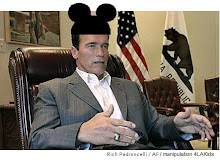
COMMENTARY by THOMAS G. DONLAN  | Editorial Page Editor of BARRON'S


MONDAY, SEPTEMBER 1, 2008  -- ARNOLD SCHWARZENEGGER FLOATED TO THE GOVERNOR'S OFFICE in California on the foam of a fiscal crisis in 2003.  The "governator" replaced old what's-his-name, Gray Davis, because Davis couldn't handle the state economy. The people voted the gray ghost out of office and selected the Teutonic Republican movie actor to fix their problems.

This year, Schwarzenegger is in the middle of a fiscal crisis of his own, proving that he has no super powers. He isn't really much of a Republican, either. His firmest proposal so far is a one-cent increase in the state sales tax, already one of the highest in the country.

Everyone knows that when the nation is going to hell in a hand cart, California usually gets there first. But for those who have failed to notice the looming crisis shaping up -- not just in California but in a number of states -- we provide a summary.

On July 1, California entered fiscal 2009 without having enacted a state budget. Nothing new in that: Budgets have been late in 16 of the past 20 fiscal years. The cause was also not unusual: There was a budget gap, generated partly by the slump in housing, partly by the absence of enormous stock-market profits and partly by the ongoing boom in state spending. Nothing new in that, either.

Meanwhile, the productive, private part of California's economy has been cyclical for decades, while the unproductive government part keeps growing, and spending money it doesn't have. The size of the gap is not a record, but $15.2 billion is nothing for Sacramento to sneeze at.

Holding Firm

The state constitution requires a two-thirds majority in each legislative house to pass a tax increase. Democrats don't quite command this level of power and, so far, Republican lawmakers have hung together and refused to raise any taxes.

Schwarzenegger hasn't even been with the Republicans in spirit. He has been more interested in a package of long-term "reforms," such as giving the governor power to make budget cuts by decree if deficits loom in the middle of a fiscal year. In addition to the sales-tax hike, his other idea for fixing the immediate crisis was to borrow $15 billion against the putative future profits of the state lottery.

To bring his unruly lawmakers to heel, Schwarzenegger refused to sign any legislation until they passed the budget. Down went several of their favorite programs, along with a couple of his, without changing the obdurate Republican bloc of tax opponents. Last week, he permitted a borrow-and-spend transportation package to go to referendum this fall.

Schwarzenegger also tried to bring the state employees' unions over to support his propositions -- by making their lives miserable. He ordered that most state workers' pay be cut to the minimum wage. (The state can continue nearly all spending on salaries and services without benefit of an enacted budget.) This was his substitute for the tactic employed by Presidents Reagan and Clinton in the 1980s and 1990s. They shut the federal government, and quickly prevailed in confrontations with Congress.

Californians, however, are made of sterner stuff. John Chiang, the state controller, who is also elected statewide, has simply refused to follow orders. First, he said the computer systems that manage state payrolls are too old and too hard to reprogram. He reported:

"In 2003, my office tried to see if we could reconfigure our system to do such a task, and after 12 months, we stopped without a feasible solution and with the knowledge that recovery for such a sweeping adjustment to minimum wage would take at least six months before all employees would see the right amounts in their hard-earned paychecks."

At first, he had said that the state's computers were programmed in Cobol, and no one was left who knew how to reprogram them. He was quickly advised that there are thousands of Cobol programmers employed in California's private sector. After that confession of bureaucratic incompetence, the controller returned to pure defiance, adding a dash of spurious econometrics:

"Aside from the expense of costly and lengthy litigation over my authority to pay state workers their full wages, [the governor's] move would harm thousands of families who already are struggling with mortgages and higher gas, food and energy costs. The loss of their spending dollars will increase the loss in consumer confidence, and further deteriorate California's fragile economy."

The Republican legislators, meanwhile, haven't proposed any spending cuts to take the place of the tax increases they so abhor. Their plan is to have no plan, which means following the examples set in previous state fiscal crises, and borrow, borrow, borrow.

Rotten Apple

That's the news from the left coast. Across the country in New York, things are not much better. The golden goose of Wall Street has stopped laying eggs that the city and state can tax. In particular, Wall Street bonuses and investment profits are so heavily taxed that the revenues make up 20% of the whole state-tax take. Wall Street bonuses, however, are somewhat dependent on Wall Street profits, and Wall Street has been busy making losses on mortgages.

Faced with a $6 billion shortfall in the current $121 billion budget, state legislators have been casting about for other things to tax, such as incomes over $1 million and cigarettes sold on Indian reservations. Spending cuts aren't an issue because every legislative seat is at stake in this fall's election. Few want to face voters without bearing grifts from Albany.

Gov. David Paterson, who is not currently up for election, also waffled. He called for painful spending cuts, and agreed to a large pay increase for the state troopers' union to match other big pay hikes negotiated under former Gov. Eliot Spitzer. He is in favor of limiting taxes, but only the property taxes levied by local governments.

Paterson called the legislature back to Albany recently to deal with the $6 billion problem, and presided over victory celebrations when the legislators agreed to somewhat more than $425 million of reductions in planned spending increases.

New York and California are leading the way off the fiscal cliff; other states are sure to follow.