Monday, August 18, 2008

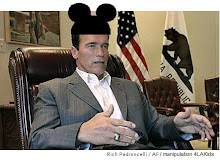
A State Without a Budget: Day 49 ASSEMBLY DEMOCRATS BUDGET BILL FAILS + CALIF. GOP LAWMAKERS KILL DEMS $6.6B TAX PACKAGE + SACRAMENTO'S FUNDRAISING FOLLIES

• from the AP: "California is the last state in the nation on a July fiscal calendar to enact a budget. " The LA Times editorializes: "The state budget is past due, so why are lawmakers spending time raising big bucks from donors?" At a party Sunday afternoon a friend opined that "all the lawmakers, Republican and Democrat alike, should be tossed out".  4LAKids would like to second the motion.


Assembly Democrats Budget Bill Fails

BY Matthew Yi & John Wildermuth, San Francisco Chronicle Staff Writers

California Governor Arnold Schwarzenegger file photo. Fre...

Monday, August 18, 2008 04:00 PDT - Sacramento -- A revised budget proposal by Assembly Democrats failed Sunday night in the lower house of the state Legislature during an unusual weekend session that quickly morphed into nearly five hours of finger-pointing that didn't end the 48-day budget stalemate.

The 45-30 vote fell well short of the 54 "yes" votes needed to satisfy the two-thirds majority required. And the lengthy session gave no indication the Democrats would get additional Republican votes needed to pass their spending plan.

"I'm definitely disappointed," said Assembly Speaker Karen Bass, D-Baldwin Vista (Los Angeles County). "But now that everyone has aired their feelings, (today) we can get back to work."

The speaker suggested it is time for Republican Gov. Arnold Schwarzenegger to "turn up the heat" in an effort to reach a compromise.

Aaron McLear, a spokesman for Schwarzenegger, said the governor will continue to push lawmakers to pass a bipartisan budget that he can sign.

Assembly Republican leader Mike Villines from Clovis (Fresno County) said he thought Sunday night's debate would help push the negotiations forward, but added: "What's important now is that they know we're not willing to (vote for) taxes."

Democrats presented what they billed as a compromise proposal that would close the state's $15.2 billion budget gap with a combination of tax increases and spending cuts.

"Nothing in this budget is easy," said Assemblyman John Laird, D-Santa Cruz. "I believe the cuts go too far in some instances, and I'm unhappy to see the reinstatement of the higher corporate tax rate and other taxes. But no one has put together a plan to balance the budget without significant new revenues."

But Republicans, holding tough to their "no new taxes" pledge, said the plan to raise $6.7 billion in new revenue by boosting taxes on Californians with taxable income of $321,000 or higher, increasing the corporate income tax and suspending some business tax breaks was never going to pass.

The proposed budget "runs the risk of putting California on the brink of bankruptcy, along with many of its citizens and businesses," said Assemblyman Roger Niello, R-Fair Oaks (Sacramento County). "We have a $15 billion deficit, thanks to the irresponsible budget choices by Democrats in this Legislature, spending on new programs and bigger government."

True compromise

Speaker Bass argued that the budget represented a true compromise. It dealt with many of the concerns of Schwarzenegger, keeping a number of the cuts the governor proposed, she said, as well as agreeing to make changes in the state lottery that would allow the state to take $10 billion for repaying state debts in fiscal years 2009-10 and 2010-11.

"We are ready with a compassionate, balanced budget that meets the governor's demands and will keep our economy strong, maintain our commitment to education and protect the state's most vulnerable citizens," she said in a statement before Sunday's session.

But Republican lawmakers argued that the Democrats' plan to double the size of the state's "rainy day fund" budget reserve wasn't anything like the spending cap the governor had demanded.

The Democratic proposal says that any revenue more than 5 percent above the state budget estimates would be moved into the reserve fund, until that fund reached 10 percent of the state budget. Any money beyond that could only be spent on one-time expenditures, such as debt repayment and one-time tax cuts.

GOP wants spending limit

Republicans called the plan meaningless, saying that the rules also allowed the Legislature to transfer the money out of the reserve fund on a simple majority vote.

"We need a spending limit to force the state to save money," said Assemblyman Chuck DeVore, R-Irvine.

The Republicans had proposed a state constitutional amendment to impose a "hard" budget spending cap that would have only allowed the budget to rise at the combined rate of the cost of living rate and the state's population growth, but it was killed in committee Friday in a party-line vote.

Republicans argued that the majority Democrats had virtually ignored them in putting together the budget plan, pushing aside their concerns and presenting them with the final budget proposal only a day before Sunday's session. But Democrats complained that the Republicans were far more willing to complain about the budget than offer suggestions of their own.

'It's time to get real'

"If the cuts we've proposed aren't deep enough, what cuts would you make?" asked Assemblyman Mike Feuer, D-Los Angeles.

But amid the name-calling and partisan rhetoric, there were signs that members on both sides of the aisle had had enough and wanted to see a serious effort to find a budget plan that both parties could live with.

"We need to be at the table right now," Feuer argued. "It's time to get real, it's time to get practical, it's time to get it done."

"We're sitting today giving a performance," agreed Assemblywoman Bonnie Garcia, R-Cathedral City (Riverside County). "I want to come up here and be a responsible adult. Let's just fix this."

With Sunday's failed vote, a new state budget could be a long time coming. The state Senate still hasn't weighed in with its own budget plan, but few are optimistic that any agreement is in sight.

Assemblywoman Loni Hancock, D-Berkeley, said she was "sick at heart at what we've had to cut," and suggested that Democrats might wait until after the November elections to reach a budget agreement, after Democrats had won some more Republican seats.

"That may be the only alternative," she said. Republicans "have not made any moves to be productive and resolve this crisis."

What's on the table

The new Assembly budget proposal has a number of changes from the spending plan approved July 17 by a joint Assembly-Senate conference committee. They include:

Budget reform: A constitutional amendment, which goes on the November ballot, would double the size of the state's "rainy day" reserve fund to 10 percent of general fund revenues.

Lottery: A November ballot measure would allow the state to change the way it operates the lottery, bringing the state at least $10 billion extra, beginning in fiscal 2009-10.

Revenue: Raises the tax rate for Californians with joint taxable income over $321,000 to 10 percent and to 11 percent for those making more than $642,000. Increases the corporate tax rate, but drops plans to roll back dependent credits for high-income taxpayers.

Cuts: Trims the prison reform plan by $270 million and moves public transit funds to pay for home-to-school bus transportation.


Calif. GOP lawmakers kill Dem's $6.6B tax package

By JUDY LIN – the associated press

August 18 - SACRAMENTO (AP) — California's Republican lawmakers on Sunday rejected a Democratic proposal for $6.6 billion in tax increases on the wealthy and corporations despite an offer to boost the state's rainy day fund. The failed vote now pushes California's budget impasse into its eighth week with no compromise in sight.

The 45-30 vote in the state Assembly was the first since the state began its new fiscal year July 1 without a budget. It came after four hours of debate during which 49 of the Assembly's 80 members spoke.

Democrats offered a revised tax plan that's smaller than the $8.2 billion package they initially proposed last month. Under the new proposal, Democrats called for imposing top income tax brackets of 10 percent on joint filers making more than $321,000 per year, and 11 percent on the portion above $642,000. The highest tax bracket is currently 9.3 percent.

The proposal also called for a temporary suspension on the net operating loss deduction allowed for businesses. And it reinstates a higher corporate tax rate.

Assembly Speaker Karen Bass, D-Los Angeles, characterized the package as a compromise because it contained both cuts and new revenues. She said her plan reinstates tax brackets that were last in place under former Gov. Pete Wilson, a Republican, in the 1990s.

The Democratic leader said the proposal included a constitutional amendment for increasing the state's existing rainy day fund from 5 to 10 percent of general fund revenues.

It also includes measures that would allow the state to borrow $10 billion from future lottery funds to generate more revenue. According to the Democrats' plan, lottery proceeds would go toward retiring debt and filling the rainy day fund beginning in the 2009-10 fiscal year.

GOP members, whose votes are needed for a two-thirds vote, said they refuse to burden people with taxes while the economy remains weak. California's unemployment rate is now 7.3 percent, the highest in 12 years.

It was unclear whether the state Senate planned to take up the Democratic plan.

Last week Republicans proposed a spending cap that would have restricted growth to population change and inflation. The plan was rejected by Democrats, who hold a majority in both houses.

Gov. Arnold Schwarzenegger has been unsuccessful in leading budget negotiations. Democrats recently backed off from a temporary 1 percent sales tax Schwarzenegger proposed.

Schwarzenegger has tried to add pressure to the talks by laying off more than 10,000 state workers and trying to roll back wages for about 175,000 other employees. Some would receive the federal minimum wage of $6.55 an hour under Schwarzenegger's order, which is being challenged by state Controller John Chiang.

California is the last state in the nation on a July fiscal calendar to enact a budget.


Sacramento's fundraising follies: The state budget is past due, so why are lawmakers spending time raising big bucks from donors?

LA Times Editorial

August 18, 2008 - It was bad enough that members of the Senate and Assembly gave themselves a vacation in July, when the state budget was already past due. What really rankles is how they have spent their evenings since rolling back into Sacramento.

After each fruitless day in the Capitol, they walk across L Street to one of the clubby watering holes or hotel ballrooms or quasi-swank restaurants -- or maybe a few blocks farther afield to a more exclusive spot -- to rub elbows with, and pick up checks from, influential donors.

To parents worried that schools may be defunded, or to the typical Californian wondering whether sales taxes are about to go up, this is budget season; but for lawmakers, this is fundraising season. It means little to elected officials that they don't get their paychecks while the state budget is past due, as long as they scoop up the important stuff -- political cash. That's the flow that needs to be cut off pending an adopted-and-signed spending plan. Political fundraising by state legislators and the governor should be banned when the budget is past due.

The Times has called for a fundraising blackout during the weeks just before and just after the end of the legislative session, when lawmakers are in their final bill-passing crunch and the governor is mulling whether to sign or veto. Gov. Arnold Schwarzenegger even vowed that he wouldn't collect money during that period, because doing so smacks of backroom deal-making. Legislation should stand or fall on its own merits; decisions to pass or not pass, to sign or veto should not be made while big bucks are being dangled by special interests trying to secure action on bills.

Those same corporate and labor interests gather when budgets are overdue. Like miniature devils with little pitchforks, they swarm cocktail parties to prick Republicans seeking reelection and urge them not to give an inch on taxes. They prod Democrats eyeing higher office, pressing them to give up nothing on programs. The lawmakers don't mind. The budget can wait, as long as the donations keep coming.

It is extremely unlikely that senators and Assembly members would vote to cut themselves off. Even Schwarzenegger reneged on his pledge. But Californians have every right to insist. This state has far too many initiatives, but a ballot measure that bans fundraising while the budget is past due may be just the thing to jab lawmakers back into negotiations.

A State Without a Budget: Day 48: ASSEMBLYMAN SWANSON: "California must stand for something. Education needs to be a priority."

Swanson-on-budget-081708.gif

By Hon. Sandre Swanson (D)  16th AD/Oakland — From the California Progress Report

Delivered on the Assembly Floor - Sunday, Aug. 17th:  “Our debate on the budget has become very partisan, and having our debate I think is very important for the people of the state of California. The Republican speakers have mentioned on several occasions that the Democrats are interested in raising taxes.

Now, we are interested in a budget that speaks to priorities. I agree with many of the speakers who say Californians are hurting, unemployment is high, we’re in a down economy, we have a recession. we’re in a housing crisis. So, I agree we must act and do something.

The Republicans have offered a spending cap. Now we had a hearing on ACA 19 Friday, and I asked the honorable Vice-Chair, “If the spending cap was in place today, would the rules and the procedures offered in this constitutional amendment from the Republicans allow for us to address the housing crisis?

The answer is no.

Would it allow us to deal with the rising unemployment?

The answer is no.

Would it allow us to fund after school programs to deal with our growing dropout problems in the state of California?

The answer in the Republican plan is no.

One of the things we’re saying is that the Democrats are proposing a budget, and the budget stands for something. California must stand for something. Education needs to be a priority.

Now, let me just address this question of higher taxes. To the average Californian, are they talking about you? When they say they don’t want your taxes raised? I don’t think so. They’re talking about the people who would have to pay under this plan, who make $500,000 a year. They don’t want them to pay any more taxes. They’re talking about corporations, corporations that need to pay the rate they were paying in 1997, because it’s important for everyone to be accountable and to share responsibilities at this moment.

But what they’re not telling you is this: the average Californian, without the help of the State, will pay more. Because we’re talking about your priorities. They will pay more because you will have a parcel tax in your school district and you want your children to learn, so you’ll pay more. So we don’t act, we shift the burden to your school district.

They want us to cut health to the poor and the needy so that we don’t raise taxes in Sacramento, so we don’t get those who make $500,000 a year and those corporations to share. But does that give you any tax relief in your county and your town? No. Because those patients will show up in your county hospital in your trauma center and you have to raise money in your county, and again we’ve shifted the burden.

Now it’s time for some accountability and some truth-telling. This budget is before this house. This budget should be acted on not as Democrats and Republican, but as conscientious legislators who committed themselves to this Constitution to serve the needs of the citizens of this state.

Our people in this state are hurting. I say to you, all my colleagues, cast your vote. I say to the people of California, watch that vote. If you don’t like it, tell your legislator about it. We have to get on with a budget that serves the needs of the people of this state.”

Sunday, August 17, 2008

A State Without a Budget: Day 48 TODAY IN THE CAPITOL ...

  ASSEMBLY DAILY FILE


Sunday August 17, 2008    3.00 pm


ASSEMBLY FLOOR SESSION


CAPITOL CHAMBERS


BUDGET DAY


UNFINISHED BUSINESS                                         

CONFERENCE REPORTS PENDING

Item 94
A.B. No. 1781-Committee on Budget (Assembly Members Laird (Chair)) et al.
An act relating to the Budget Act of 2008.


COMPLETE BILL HISTORY


BILL NUMBER : A.B. No. 1781
AUTHOR : Laird
TOPIC : Budget Act of 2008.

TYPE OF BILL :
Active
Urgency
Appropriations
2/3 Vote Required
Non-State-Mandated Local Program
Fiscal
Non-Tax Levy

BILL HISTORY
2008
July 18 From printer.
July 17 From Conference Committee: With recommendation: That Senate
amendments be concurred in and that the bill be further amended.
Assembly (Ayes 2 ( Laird and Leno) Noes 1 (Niello)). Senate (Ayes 2
(Ducheny and Machado) Noes 1(Dutton)). To print.
June 12 Assembly refused to concur in Senate amendments. To Conference
Committee. (Ayes 1. Noes 66. Page 5705.) Assembly Members Laird,
Leno, and Niello appointed to Conference Committee. Senators
Ducheny, Machado, and Dutton appointed to Conference Committee.
June 9 In Assembly. Concurrence in Senate amendments pending. May be
considered on or after June 11 pursuant to Assembly Rule 77.
June 9 Read third time, passed, and to Assembly. (Ayes 22. Noes 14. Page
4094.)
June 5 Read second time. To third reading.
June 4 Read second time. To third reading. Read third time, amended. To
second reading.
June 2 Withdrawn from committee. Ordered placed on second reading file.
May 15 Referred to Com. on RLS.
May 8 In Senate. Read first time. To Com. on RLS. for assignment.
May 8 Read third time, passed, and to Senate. (Ayes 44. Noes 0. Page
5049.)
May 6 Read second time. To third reading.
May 5 Withdrawn from committee. Ordered placed on second reading file.
Feb. 7 Referred to Com. on RLS.
Jan. 16 From printer. May be heard in committee February 15.
Jan. 15 Read first time. To print.


	CURRENT BILL STATUS


MEASURE : A.B. No. 1781
AUTHOR(S) : Laird.
TOPIC : Budget Act of 2008.
+LAST AMENDED DATE : 07/17/2008


TYPE OF BILL :
Active
Urgency
Appropriations
2/3 Vote Required
Non-State-Mandated Local Program
Fiscal
Non-Tax Levy

LAST HIST. ACT. DATE: 07/18/2008
LAST HIST. ACTION : From printer.
FILE : SEN CONFERENCE REPORTS AT DESK
FILE DATE : 08/18/2008
ITEM : 62

FILE : ASM CONFERENCE REPORTS PENDING
FILE DATE : 08/17/2008
ITEM : 94


TITLE : An act making appropriations for the support of the
government of the State of California and for several
public purposes in accordance with the provisions of
Section 12 of Article IV of the Constitution of the
State of California, and declaring the urgency thereof,
to take effect immediately.


Text of AB 1781, as amended


Analysis of AB 1781. as amended


A State Without a Budget - Day 48 - NO END IN SIGHT FOR BUDGET BATTLE


By Steven Harmon | Contra Costa Times Sacramento Bureau


Subday, August 17, 2008 - SACRAMENTO — A vote will be held today on the state budget, but East Bay lawmakers don't expect the standoff — now in its 48th day — to end any time soon.

Heading into today's 3 p.m. Assembly session, a wide chasm still divides Democrats and Republicans on the major sticking points in negotiating a budget that must pare down an estimated $15.2 billion deficit.

"I think it's a 50-50 chance this could go into September," said Assemblyman Sandre Swanson, D-Oakland, "because some of us are not willing to balance the budget on the backs of children, and Republicans have not abandoned their cuts-only approach."

Assemblywoman Loni Hancock, D-Berkeley, accused Republicans of pursuing a goal of "starving" government and of being "intransigent" in holding out for more spending cuts while avoiding any tax increases.

"It all depends on what Republicans are going to do — whether they're willing to compromise at all," she said, "or if they're bound by their Grover Norquist pledge to demand a cuts-only budget."

Assemblyman Guy Houston, R-San Ramon, was equally doubtful that Democrats will concede on their demands to raise taxes on the wealthy — those making $320,000 or more — as a way to protect state services.

"There are zero votes for this budget," said Houston, the only Bay Area Republican. "The issues haven't changed and there's not one iota of the two sides deviating from their positions. The

Advertisement

Click Here!

purpose of (today's) session is to show Republicans are not cooperating."

Republicans, who are in the minority but hold the key votes in a system that requires a two-thirds majority in both legislative chambers to approve a budget, have remained steadfastly opposed to increasing taxes. They also insist that a budget agreement must include a constitutional amendment to require a spending cap in future budgets.

Democrats insist that the deficit can't be made up through program cuts alone, though they say they're offering more spending cuts and fewer taxes in today's budget plan. Their initial budget called for $10 billion in taxes, largely on the wealthy.

Secretary of State Debra Bowen extended the deadline from Friday to Monday for lawmakers to produce measures intended for the ballot. But unless there's a broader agreement on the budget, it is a long shot lawmakers will agree on reform measures.

Assembly Democrats rejected a GOP budget reform measure, ACA19, at a committee hearing Friday, another signal that the two sides remain at loggerheads in negotiations.

Assemblyman Mark DeSaulnier, D-Concord, said he's ready to reach across the aisle on the budget and on ballot measures that have been stumbling blocks in negotiations.

"It's time for reasonable people to come up with a compromise and produce a budget," DeSaulnier said. But both sides, he said, need to "soften their ideological" positions on budget reform, and possibly a $9.3 billion water bond that Republicans are pushing to get on the November ballot.

Democrats have already moved more than half way, said Assemblywoman Mary Hayashi, D-Castro Valley, offering to institute a rainy-day fund that salts revenues away from good economic years to be used for down years.

"A rainy-day fund is a huge win for Republicans," she said. "That's what they say they want. We're willing to work with them to figure out how we could get the votes to get it done. I'm hopeful something could get done (today), but I'm prepared to continue negotiations with them until we have a budget that makes sense for all Californians. But we're not going to accept their cuts-only approach."

Hancock said she's "very reluctant" to support more spending cuts and fewer taxes, but said she would do it "because of the urgency of the situation. But we're dealing with a very intransigent and irresponsible minority. We can't go any further than this. Any additional cuts would decimate education, transportation, environmental protection."

She said she'd be willing to hold out through the fall elections so that Democrats could see if they could get closer to a two-thirds vote after the election.

Houston said he has offered a continuous appropriations bill to allow state services to run uninterrupted during the budget stalemate. Democrats' opposition to it, he said, shows they are willing to stall long enough that people start feeling the pain of the budget standoff.

"They feel if they make it really bad, Republicans will have to cave," he said. "But our caucus is unified. The only frustration is we didn't do this (have a vote on the budget) six weeks ago, because that's usually the point where everybody starts rolling up their sleeves and negotiating."

Hayashi said she hopes the public has patience while lawmakers sort out their priorities.

"We want people to understand that we're not holding out for the sake of holding out," she said. "We're trying to protect seniors, education and all the things Democrats care about."

Saturday, August 16, 2008

CALIFORNIA BUDGET GIMMICKS: The latest idea to close the state's shortfall involves the wrong kind of tax code manipulation.

Editorial From the Los Angeles Times

August 16, 2008 — Seven weeks into the new fiscal year, the scrum in Sacramento over the California budget continues unabated. How the Legislature and Gov. Arnold Schwarzenegger will close the $15-billion-plus gap between anticipated tax revenues and the cost of ongoing programs remains in doubt, as numerous ideas -- some harebrained, some not -- continue to be tossed into and out of the mix.

One proposal backed by Democratic lawmakers would raise an estimated $1.1 billion from businesses by delaying the deduction of net operating losses (costs that exceed revenue) for three years. At the urging of some corporate lobbyists, Schwarzenegger recently offered a counterproposal: After the three-year moratorium lifts, businesses would be able to deduct their 2008 losses from the taxes they paid in 2006 and 2007, entitling them to hundreds of millions of dollars in rebates.

The biggest beneficiaries of the proposal would be companies that ran up large profits in 2006 and 2007, then saw their fortunes plunge in 2008. Let's see, who might that be? How about the lenders that grew rich off subprime and other risky mortgages before their what-me-worry approach to underwriting caused an explosion in foreclosures. Say, for example, Countrywide Financial Corp. (now owned by Bank of America).

Given how radioactive these firms have become, it's hard to find anyone defending the proposal publicly. Yet there is ample precedent for letting businesses write off losses retroactively. The federal government has long allowed companies to "carry back" a current year's losses and deduct them from the federal taxes they paid for the three previous years. By contrast, California permits companies only to "carry forward" losses, which they can deduct from taxable profits over the subsequent decade.

We're not big fans of the government using the tax code to sway behavior, mainly because such efforts tend to be ineffective and prone to abuse. We'd prefer a simple, fair tax code that merely raises the revenue needed to pay for government programs and services. Yet there's a solid rationale for letting companies carry losses into the future: It encourages larger (and, potentially, riskier) investments that take years to recoup. Pharmaceutical companies, bio- engineering ventures and microchip manufacturers are prime examples of companies making large bets on profits that won't soon be realized.

No such benefit would come from letting companies recoup losses retroactively, however. Instead, it would encourage a less-productive kind of risk-taking by giving companies more protection against the pain caused when a profit-inflating bubble suddenly bursts. Lawmakers should be figuring out how to put the state budget on a steadier path, not helping lenders recover from their subprime bender.

Friday, August 15, 2008

A State Without a Budget :: Day 46 LATEST GAMBIT IN BUDGET IMPASSE | CALIFORNIA EMBROILED IN BATTLE OVER BUDGET | ASSEMBLY SPEAKER PLANS BUDGET VOTE SUNDAY

Latest gambit in state budget impasse

Matthew Yi, San Francisco Chronicle Sacramento Bureau

Friday, August 15, 2008 — The Legislature is likely to vote Sunday on a new version of the Democrats' budget that includes more spending cuts and fewer tax increases than their previous version, Assembly Speaker Karen Bass said Thursday.

But the budget is not expected to garner the required two-thirds majority vote in the Legislative houses because no Republicans have indicated they will vote a spending plan that hopes to help erase the state's $17.2 billion budget gap by raising taxes, GOP leaders in the Assembly and the Senate said.

California has been without a budget since the new fiscal year began July 1, and Gov. Arnold Schwarzenegger and Democratic-controlled Legislature so far have failed to reach a compromise spending plan.

Bass, a Democrat from Los Angeles County, said she and Senate President Pro Tem Don Perata, D-Oakland, intend to coordinate floor sessions of both houses so the budget vote can be held at the same time. Bass said she is 80 percent sure the vote will happen Sunday.

Perata was less sure about the Sunday vote.

"There's some confusion, and we haven't decided that yet, but the point of it is that we've been negotiating for months, and it's time to put up the product of those negotiations, and if they fail, Republicans can come up with their stuff," Perata said.

Republican leaders in both houses said they welcome a public debate on the floors of the Senate and the Assembly.

"Whatever they want to bring to the floor so that we can vote 'no' to taxes and move these negotiations forward so we can get done is fine with me," said Assembly Republican leader Mike Villines from Clovis (Fresno County). "But we will be voting 'no' on Sunday."

Senate Republican leader Dave Cogdill from Modesto said he believes such a debate and vote are healthy, even if the budget doesn't get approved.

"I hope that will engage us in the process and help Democrats and the governor realize that we're not going to support a tax increase," he said.

Aaron McLear, a spokesman for Schwarzenegger, said the governor "believes what the (Democrats) put on the floor should have bipartisan support. He'll continue to push for that compromise until we get a budget."

Neither Perata nor Bass gave much detail on what the new budget will look like, saying their staffs were working on final details of the plan. Republicans say they were told they would be given a copy of the new budget by late today or Saturday.

Bass said it will include changes in the form of a rainy-day fund as well as additional spending cuts and a tax package that is less than the $10 billion package previously proposed, which focused mostly on taxing wealthy residents and corporations.

She would not say whether Schwarzenegger's proposal for a temporary increase of 1 cent per dollar in the state sales tax will be part of the budget plan.

Republican lawmakers and Schwarzenegger have been demanding budget overhauls that also include a spending cap and giving the governor power to make midyear cuts, plans that Democrats have rejected.

The Assembly Budget Committee is scheduled today to hear the Republicans' budget bill, which includes a spending cap based on population growth and inflation rates. The bill is not expected to survive the committee, which is controlled by Democrats.

Still, both sides agree that significant budget changes would require voter approval in November, and Secretary of State Debra Bowen has indicated that Saturday will be the last day the Legislature can approve measures for the November ballot.

Bass said Bowen told her Wednesday that the deadline could be extended to Monday.

"It is critical that we take action before Monday, because the Democrats have taken budget reform very seriously," Bass said.

But the time pressure of trying to place a measure on the November ballot is not enough for Republicans to approve something they don't believe in, Villines said.

"What do we care about going to the ballot for? A phony rainy-day (fund)? It's nothing Republicans would vote on," he said.

State budget 101

Here are answers to some frequently asked questions about the state budget process:

Q: When is the budget supposed to be enacted?

A: The governor must submit a budget to lawmakers by Jan. 10, and the Legislature is required to approve the budget by midnight June 15 for the fiscal year that begins July 1.

Q: What happens if it isn't done by July 1?

A: Some payments cannot be made if the state does not have a budget. They include funding for some special education and remedial summer-school programs, and wages for state employees not covered under the federal Fair Labor Standards Act, such as lawmakers, legislative staffers, constitutional officers and political appointees.

Q: Why must the state have a budget?

A: The state Constitution requires it, and a budget is necessary to provide funding for key operations of state government, including education, health care, transportation and social services.


California Embroiled in a Battle Over the Budget

Francine Orr/Los Angeles Times, via Associated Press

Wendell Prude, left, a union leader, with state workers protesting at Gov. Arnold Schwarzenegger’s home in Los Angeles.

By JENNIFER STEINHAUER | New York Times

August 15, 2008  - LOS ANGELES — Each August in California, there are several givens: Succulent heirloom tomatoes will overflow in farmer’s markets. A fire will rage somewhere. And state lawmakers will fight over the budget, weeks after the deadline for its closing.

Most states have a fiscal year that begins on July 1. California is the only one of those that has yet to hammer out a budget, as legislators wrangle over how to close a budget gap of roughly $15 billion.

In response, Gov. Arnold Schwarzenegger signed an order on July 31 temporarily cutting the pay of roughly 176,000 state workers to the federal minimum wage of $6.55 an hour, and ordered nearly 10,000 state workers to be laid off.

As each day has passed without a budget, the governor, a Republican, has grown increasingly testy, denouncing lawmakers almost daily and insisting that he will veto any legislation — even that which he avidly supports — until a budget is approved. He has also said he will limit his own travel, perhaps bypassing the Republican National Convention in early September, during which he is expected to speak.

Sacramento has produced an on-time budget only four times in the last 20 years, and has been known to snake the process into September. Democrats, who control the Legislature and who seek a temporary increase in the sales tax to plug the budget gap, are at odds with Republicans, who want to cut services.

State Controller John Chiang, a Democrat, has said he would not abide by the pay-cut order because it could open the state to lawsuits and harm workers. As a practical matter, in fact, the state’s computers are too antiquated to deal with a payroll change. Mr. Chiang’s office has been sued by the Schwarzenegger administration, though to what effect remains to be seen.

“It is very hard for Schwarzenegger to get a preliminary injunction, because he has to demonstrate irreparable harm,” said Jonathan Zasloff, a law professor at the University of California, Los Angeles, and an expert on the state’s Constitution. “What’s the irreparable harm in paying salaries to workers that they will eventually get as soon as there is a budget?”

The governor has said he would reimburse workers for their full pay once the Legislature completes a budget.

California is among many states with budget troubles caused by the economic slowdown. In June, as most states ended their fiscal years, 20 states reported budget gaps, according to the National Conference of State Legislatures. California’s gap is worse than that of most other states, but not as large a percentage of the budget as a state like Arizona, which has also been hurt in the housing slump. A national economic slowdown and the foreclosure crisis, and resulting decreases in several forms of state taxes, have combined to make it so.

But California’s problems are both more severe, and, perhaps more intransigent, than those of other states. The state is among the worst-hit in the foreclosure crisis, and a record number of California homeowners were met with foreclosures last quarter. There were 121,341 mortgage defaults, up 125 percent from the second quarter of 2007, according to DataQuick Information Systems.

“Clearly, foreclosures have been a significant challenge,” said Arturo Pérez, a principal of the fiscal affairs program at the national legislatures conference.

California is also one of only three states to require a two-thirds majority in the Legislature to pass a budget, a particularly challenging requirement at a time of large deficits. Further, the state relies on income taxes rather than property taxes for most of its revenues, a difficult formula in tough times.

And the structure of the state’s budget — which is heavily based on borrowed money and peppered with numerous mandatory spending requirements approved by voters — makes it all the harder to balance.

The state has already cut its Medicaid reimbursement rate by 10 percent and deferred payments to vendors. Mr. Schwarzenegger has called for reductions of 10 percent across the board for most departments, and an increase in the sales tax may also be in the offing.

Outside of the layoffs, the pinch is being felt statewide. Vendors that have been cut off from the state are in a worse position this year than in previous years, because the tightening credit market makes it harder to get the short-term loans they need to get through the state’s budget impasse.

Nina Nolcox, who owns Graceful Senescence, which provides nursing care and therapy to the elderly in South Los Angeles, has already cut her payroll to deal with the 10 percent Medicaid cut and cash deferrals from the government in June.

This week she got her last check from Sacramento until the budget is signed. Roughly 70 percent of her business comes from clients paid for by state programs. Cuts to her staff’s hours, she said, are next.


California Assembly speaker plans a budget vote Sunday

By Kevin Yamamura and Jim Sanders - Sacramento Bee

Friday, August 15, 2008Assembly Speaker Karen Bass said Thursday she plans to force a budget vote Sunday, though lawmakers have no deal to end a stalemate that has lasted nearly seven weeks into the fiscal year.

Republicans and Democrats remain divided over whether to use new taxes, cuts or borrowing to resolve a $15.2 billion shortfall in a $101 billion general fund budget. If lawmakers convene Sunday, it would mark their first budget floor vote this summer, 48 days into the fiscal year.

Lawmakers want to register a vote by this weekend to meet a deadline set by Secretary of State Debra Bowen for placing measures on the November ballot. At least two components of budget negotiations require voter approval: a long-term change in budgetary policy and a plan to borrow against profits from an expanded California Lottery.

Many see the deadline as negotiable, however, and believe a Sunday vote may be the first of several floor exercises before a final deal is struck.

Bass, D-Los Angeles, said lawmakers plan to vote Sunday on a modified version of the Democratic conference committee plan, which relied on tax increases on the wealthy.

Senate President Pro Tem Don Perata said his chamber would hold a vote "probably Sunday," though he grew more tentative about those plans late Thursday.

Perata, D-Oakland, said Thursday that lawmakers remain divided over whether to use taxes or borrowing to balance the state's budget shortfall. But he said he is on the same page with Gov. Arnold Schwarzenegger on long-term budget changes that establish a stronger reserve fund but do not tie spending to population growth and inflation, as GOP legislators want.

"That's not an issue anymore," Perata said. "We've worked that out. I think it's to his satisfaction. It's to our satisfaction. I don't know how the Republicans feel about that. Most of them wanted a very hard cap."

Assemblyman Roger Niello, R-Fair Oaks, vice chairman of the Assembly Budget Committee, said the governor's budget plan would be unacceptable to his Republican colleagues, at least six of whom are necessary to pass a budget in the Assembly.

"That is not a reliable reserve," Niello said. "Our caucus believes the only way to have a reliable reserve, a real rainy-day fund, is to limit the growth of spending when revenue growth is strong."

Thursday, August 14, 2008

A State Without a Budget :: Day 45 BUDGET PLAN COULD BE A MAJOR BOON TO SUBPRIME LENDERS

The Closed Loophole That Keeps on Giving: Subprime lenders could get bigger than usual tax breaks if the proposal, which is snarling budget talks, goes through. The idea is to offset a three-year suspension of write-offs, backed by Democrats.

By Evan Halper- Los Angeles Times Staff Writer


August 13, 2008 — SACRAMENTO -- — One reason California still has no state budget is a closed-door dispute over a tax proposal that could be a multimillion-dollar boon to banks that engage in subprime lending.

The proposal, according to legislative sources and industry lobbyists involved in the private budget talks, was brought to the table by the Schwarzenegger administration at the urging of lenders and other corporate interests. The proponents argued that it would help offset costs to businesses that could result from other tax changes under consideration.

The plan would allow many large financial companies that are currently enduring record losses to eventually receive tax breaks millions of dollars greater than are currently available to them. Subprime lenders would be among the largest beneficiaries because they experienced a large boom followed by a bust.

Businesses that have had more modest revenue swings might not benefit at all.

"This is all about bailing out the subprime lending industry," said Jean Ross, executive director of the California Budget Project, a nonprofit that advocates for low-income Californians in the state budget process. "They will have checks written to them by the state of California if this goes through."

The budget stalemate is now more than six weeks old. The new fiscal year began July 1, and neither the Assembly nor the Senate has voted on a spending plan. The negotiation over how businesses are allowed to write off losses -- part of a larger debate about taxes -- is among the latest sticking points and one that threatens to keep lawmakers from reaching a deal.

It stems from a Democratic proposal to close the budget gap by suspending loss write-offs for three years, saving the state $1.1 billion a year. The counter-proposal crafted by the business groups would put the more generous tax breaks in effect once the suspension ended.

The new tax breaks would ultimately permit financial institutions to use this year's losses to claim refunds against large tax bills they paid in 2006 and perhaps 2005, years when they had record profits. Business lobbyists who support the tax breaks point out that companies can already claim them on their federal taxes.

Administration officials refused to comment on the proposal.

"The governor continues to urge Republicans and Democrats in the Legislature to reach a compromise," said administration spokesman Matt David. "He believes the legislators understand that we are running out of time."

Officials at the California Bankers Assn., a trade group that represents 85% of the state's banks, would not comment on details of the proposal but said businesses should get something in return if lawmakers take away their tax credits.

"We do feel it is important for businesses and any taxpayer to be made whole," said Beth Mills, an association spokeswoman.

Most lenders have eliminated or scaled back their subprime loan offerings. But that would not prevent them from claiming big refunds under the proposed changes. The cost to the state would be $420 million in 2010 if the refunds were claimed by all the companies entitled to them, according to state fiscal analysts.

Senate Leader Don Perata (D-Oakland) said through a spokeswoman that he would not sign off on the proposed incentives. "Democrats would not ever agree to any provision that would benefit subprime mortgage companies," said Lynda Gledhill.

And Republican lawmakers say privately that they would not even consider voting to suspend the existing write-offs -- they view a suspension as a $1.1-billion tax increase -- unless companies were entitled to the expanded refunds as part of the package.

"I can't comment on what's being discussed in budget negotiations, but Republicans won't support anything that hurts our economy," said Assembly Republican Leader Mike Villines of Clovis.

Some business groups engaged in the discussions said they would prefer simply keeping the existing tax break for small businesses.

Scott Hauge, president of the trade group Small Business California, suggested that lawmakers exempt from the Democrats' proposed suspension any firms with gross annual receipts of under $5 million.

Hauge noted that large companies, which make up a relatively small share of California's businesses, claim the bulk of existing tax breaks. Even if small businesses continued to use existing write-offs, the state would still save $880 million of the $1.1 billion that Democrats seek, he said.

Wednesday, August 13, 2008

A State Without a Budget :: Day 44 SCHWARZENEGGER PUSHES FOR BUDGET WHILE HOSTING GOVERNORS CONFERENCE

¿what carbon footprint?

Vittorio Hernandez - AHN News Writer

August 13, 2008 1:50 p.m. EST — Sacramento, CA (AHN) - California Gov. Arnold Schwarzenegger will spend Wednesday shuttling back and forth between giving the state budget a push in Sacramento and opening the 26th Annual Border Governors Conference in Los Angeles.

Aside from the meeting of governors, the conference also features a 3D showing of "Terminator 2" at Universal Studios and a private dinner at the governor's Brentwood mansion.

Schwarzenegger would fly his private jet between the state capital and the conference, which will run until Friday.

The governor said if California's budget, seven weeks overdue, remains by end of August, he will miss the Republican National Convention which opens Sept. 1 in Minneapolis.

On Tuesday, the governor said, "I will not make any commitments... I will not go on vacation. I will not leave the state. I will not do anything until I have a budget."

Aside from dividing his time between solving the budget crisis and socializing with the border governors, Schwarzenegger also has to attend to a lawsuit he filed against state controller John Chiang, who did not implement his order to temporarily reduce salaries of state workers until the budget is approved. California employees have also filed a countersuit against the governor.

Because of the impasse, the San Francisco Chronicle suggested that until the budget is passed, the wages of all California legislators and appointive officials be withheld.

A State Without a Budget :: Day 44 PERATA SAYS HE HAS BUDGET DEAL WITH SCHWARZENEGGER, NEEDS GOP VOTES

By Jim Sanders - Sacramento Bee

Posted 10:52 am PDT Wednesday, August 13, 2008 - Senate President Pro Tem Don Perata said Wednesday that Democrats have negotiated key points of a compromise state budget with Gov. Arnold Schwarzenegger and that he considers negotiations over.

"I think we've, frankly, gone about as far as we can go," the Oakland Democrat said.

Perata said the compromise plan includes a major concession by Democrats -- a spending cap to limit annual state expenditures.

Republicans have been insisting on a spending cap as part of any budget pact.

"The question continues to be, are there Republican votes for it?" Perata said of the compromise plan.

The ball is in Schwarzenegger's court, he suggested.

"A Republican governor should have some sway over Republicans," he said.

Perata said he had not yet seen draft language of the compromise.

Other key elements of the compromise plan include a temporary 1-cent increase in the state sales tax and a rainy-day fund to sock money away in boom years.

Perata did not elaborate on details of the proposed spending cap, but said it was intended to break the current standoff with Republicans.

"We've said to the governor, 'What do you need in order to move forward?' So we've negotiated on that point," Perata said.

"I'll guarantee you that there won't be anybody in the house that's going to be happy with the conclusion. But it is a compromise -- new revenues and program cuts, and no borrowing."

Perata said the negotiated proposal does not grant the governor authority to make midyear budget cuts if the economy nosedives.

"We've always said that we're not doing anything that gives away the legislative responsibility for appropriating money in the budget," he said.

Assemblyman John Laird of Santa Cruz, a Democrat who serves as a point man in the Assembly on budget issues, declined to comment on Perata's characterization of the negotiations.

Perata said the next step is to place the compromise spending plan before the Senate for a vote.

He said that no vote will be taken today, however, and that he did not want to call for a vote if the proposal was certain to die.

Passage of a state budget requires a two-thirds vote in each legislative house.

"When we go (for a vote), we're going because it's a budget that the governor can get some votes for," Perata said.

Bakersfield Rep. Roy Ashburn left the door open Wednesday to voting in favor of a compromise plan. At least two GOP votes are needed in the Senate.

Ashburn said he has been talking with the governor's office, and that his understanding is that the compromise would include a temporary sales tax increase -- that would last for several years and then revert to a permanent tax reduction -- as well as solid budget reform and an economic stimulus package.

The stimulus package would provide tax advantages meant to "help create jobs and stimulate the economy," Ashburn said.

"This is a proposal that I'm interested in looking at, and we will see if this, in fact, is what is brought to the Senate for consideration," Ashburn said of what he understands the budget compromise to be.

Ashburn said he feels no pressure to close ranks with GOP dissenters.

"The people have sent each of us here to do a job," he said. "And I think establishing the fiscal health of California is about the most important job that legislators have right now."

Assembly Republican Leader Mike Villines, R-Clovis, said Perata overstated the extent to which his negotiated plan would blunt future spending. Though GOP lawmakers are open to concessions to Democrats if the budget includes a spending cap, Villines said Perata's negotiations with the governor have not accomplished that goal.

"There is no spending cap," Villines said. "It'd be a phony cap, if anything. And I've seen it all. It's all for a rainy-day fund, which is a good start. But it's not a hard spending cap that would solve the problem. You can characterize it anyway you want, but it is what it is."

Perata says he has budget deal with Schwarzenegger, needs GOP votes - sacbee.com

The news that didn't fit from August 24th

uh oh!  There has been a mistake and the the news that didn't fit from August 24th has been moved HERE.

A State without a Budget :: Day 44 FUZZY OUTLINE OF BUDGET DEAL EMERGES


Dan Walters, Sacramento/Modesto Bee Columnist

August 12, 2008 10:55:04 PM — It's still a long way from being fully cooked, but the fuzzy outline of a deal on the much-delayed, deficit-ridden state budget is becoming visible as the deadline for placing measures on the November ballot draws near.

Secretary of State Debra Bowen says Saturday is the deadline, but Capitol types believe it could be stretched a week or two. And the deadline, whenever it may be, is an important ingredient in any budget deal, because at least one of the pending elements would have to be placed before voters.

The central element is what Gov. Arnold Schwarzenegger calls "budget reform" – some new constitutional provisions aimed at preventing future fiscal problems by creating a "rainy day" reserve and giving governors more authority to cut spending when revenue falls short.

He's willing to trade some new taxes – especially a temporary boost in sales taxes that would raise about $6 billion a year – for those reforms, even though Republican legislators balk at new taxes and Democrats don't like spending curbs.

"We believe they need to come out of their partisan corners," Schwarzenegger spokesman Aaron McLear said Tuesday, adding that if there's no deal before the ballot deadline, there will be a "total meltdown."

It's apparent that if Schwarzenegger can reach agreement with Democrats on reforms to be submitted to voters, plus other details, he would then work on two Republican senators to vote for the deal, thus giving it the required two-thirds majority, and if that happens, it would ramp up pressure on Republican Assembly members to agree.

It's assumed that Republican Sen. Abel Maldonado of Santa Maria would go along; he broke ranks with other Republicans last year on the budget. And when Bakersfield Sen. Roy Ashburn indicated to a radio talk show host on Monday that he might be open to a deal that included taxes, despite the GOP's no-new-tax pledge, the speculation meter soared and conservative radio talkers and bloggers immediately raised the alarm.

"We are going to have to see what the total package is," Ashburn said. "What the governor proposed I am not sure can be characterized as a tax increase."

There are obviously a lot of "ifs" attached to the scenario, and with the ballot deadline looming, there's not a lot of time to get it done.

It's at least noteworthy that this year, Schwarzenegger is doing something that he eschewed during last year's version of the annual budget battle – getting his hands dirty by trying to pick off individual Republican legislators rather than relying on the GOP leadership to deliver.

Whether the governor can make it happen is still uncertain, if for no other reason than his credibility in the Capitol is not very high, given his tendency to draw lines in the sand and then immediately erase them.

Republicans remain fearful that he'll promise a tough budget reform package, but then cave in to Democrats as he has in the past, leaving only the new taxes in place.

The Modesto Bee | Dan Walters: Fuzzy outline of a California budget deal emerges

Tuesday, August 12, 2008

A State Without a Budget :: Day 43 THE DIFFICULTIES OF DEALING WITH CORNERED WOUNDED PARTY ANIMALS


frankrusso-small.jpg By Frank D. Russo - California Progress Report

The image that is coming into focus on the California budget is unmistakable. California Republican legislators are behaving like a pack of wounded cornered animals—and they are always dangerous. They have little to lose and no responsibility for governing. And the two-thirds rule requiring a supermajority to pass a budget and their irrelevancy on most other matters as a shrinking minority party provides the mechanism for what is being acted on out the state of our legislature’s floor.

Remember when Congressional Republicans overplayed their hand in the 90’s and tried to shut the federal government down? That cost the Republicans votes and public support. You can see the parallels with today’s news about what is happening in our own state.

First, a comment to an article on these pages from a conservative who writes in from time to time:

“The GOP has nothing to lose in shuting [sic] the CA government down. You can't demonize a party already boxed in.

“All the more reason for the budget issue to get settled sooner over later. The GOP is not going to raise taxes. The sooner the Dems recognize this, the sooner they can begin to cut, slash, and burn to get the budget balanced.”

And from today’s Chronicle, comes an editorial: "Self-inflicted budget wounds," with this analysis:

“But the biggest losers of all - at least from a political sense - may be the Republican legislators who have barricaded themselves behind a no-tax pledge that has made it impossible to emerge from this mess with their credibility intact.

“They clearly do not have the stomach to make the cuts that would allow a balanced budget without new revenues. As it is, they are complaining about the ruling Democrats' reductions to health-care reimbursements and certain law-enforcement programs. The Republicans' trial balloons about borrowing from funds that are supposed to be set aside for local government would shred any remaining illusion about being a party of fiscal responsibility. …

“The Republican governor has laid out a template for a compromise. The biggest obstructionists are in his own party -and they appear to be their own worst enemies.”

This is similar to what Noreen Evans, Chair of the Assembly Democratic Caucus is saying as we approach day 43 of stalled budget negotiations:

“The countdown continues. The Republicans’ failure to produce a budget proposal shows contempt for the people of California. We have gone 42 days with nothing but 'bait and switch' tactics.
“Instead, Republicans introduced a constitutional amendment - ACA 19 - that completely fails to address California’s immediate budget crisis. It makes our budget beholden to Grover Norquist's neo-conservative agenda. It encourages continuous budget crises that would force massive cuts to key California priorities, such as education, health care, and safety nets for the poor. Just as President Bush's war on terror has no end in sight, neither would this amendment’s war on our state’s finances.
“By refusing to pencil out an alternative budget proposal of their own, Republicans are delaying the compromises that lead to a bipartisan budget agreement. This is leading California to the brink of shutting down. Their commitment to this approach presents Californians with a simple choice: shut down now or shut down later."

Think this is pablum from a newspaper in left leaning San Francisco and a Democrat in the leadership of the Assembly? Take a look at what usually Republican sources are saying.

Mike Madrid is the former political director for the California Republican Party and press secretary for the Assembly Republicans. He has an interesting article from former Assembly leader Bill Leonard on his blog, California City News, which is devoted to local government. Check out: “Former Assembly GOP Leader Speaks Out About Republican Attempts To Borrow Local Government Money:”
“Last week I commended the Senate Republicans for offering solid solutions to our state budget problem and pointed my readers to a website featuring those ideas. Then I learned that Senate Republican Leader Dave Cogdill had been talking about the idea of borrowing local government funds to help bail out the state. This is a bad idea. The state has a poor record of using local government money, including funds set aside for transportation and policing, for state purposes, leaving local governments holding the bag. Voters grew tired of the theft and passed ballot measures requiring the state to keep its hands out of the local cookie jar except in emergencies. …

“So, the idea is to borrow money that voters appropriately intend for use by their cities, then borrow more money to pay that back and then hope that enough people gamble in the future to pay that back. It is crazy talk, but if my friends in the Senate Republican Caucus honestly believe if it is a viable budget option, then their web page touting their budget ideas should at least mention it.”

Still not convinced? From the very conservative and Republican site, Fox and Hounds, Founded by Joel Fox of Howard Jarvis Taxpayers Association fame, an article today by Michael Shires, an associate professor of public policy at Pepperdine University: “3D Failure -- How the GOP Is Losing California.” Here’s a teaser:

“California’s Republican Party is losing ground dramatically across the state. In the Fresno Bee, John Ellis describes how it is even failing in one of its last bastions of power-—the Central Valley. There are three dimensions to the collapse of the party of Ronald Reagan in the Golden State, and all three reflect a collapse of leadership at the highest levels.

“First, there is an abject failure to reach out to the youngest voters in the state. …There is a near-total absence of youth and energy in the party’s outreach plans.

“Last week I was at the Ventura County Fair and the Republican Party and Democratic Party booths were across from each other. The contrast was harsh. The GOP had three life-sized cutouts of Reagan, Bush and McCain and was manned by two white elderly volunteers sitting behind their desk. It was very quiet and bland. The Democratic booth had banners, color, flashy give-aways, campaign posters, buttons, bumper stickers and a young, ethnically-diverse staff aggressively stepping out and speaking to passersby. Which of these is more likely to tap into the energy of our youth?

“Then there is the outreach to the Latino community. …In a state (and eventually a nation) where the population is increasingly Latino, a party characterized by such attitudes will eventually become extinct. …

“Finally, there is the consequence of a crumbling, disorganized state GOP infrastructure and leadership—the exodus of conservatives, both fiscal and conservative. Almost anywhere you turn in conservative communities, people who hold the conservative values of the Republican Party are fleeing the state to other parts of the country where being a Republican is still “politically correct….”

“California is becoming younger, more Latino and more secular. The GOP has completely missed these three trends and is now reaping the consequences of a leadership structure that, for 20 years has struggled to keep the status quo. Now is the time for the Party to completely rethink all three of these dimensions and step forward to rightfully claim the legacy of Lincoln and Reagan. But something has to change and soon, or else it won’t matter—there won’t be much of a Republican Party left.”

Republican voter registration in California is decreasing at the same time Democratic registration if increasing. While they still have more than a third of the votes in both houses of the California legislature, they are not going to be in the majority and may well lose seats in the November election as the young and others flock to vote for Obama for President. All they can do is obstruct, throw stones from the sidelines, refuse to come up with a responsible plan of their own, and threaten to shut the government down.

Need I say more?

The Difficulties of Dealing With Cornered Wounded Party Animals on the California Budget - California Progress Report

Sunday, August 10, 2008

A State Without a Budget: Day 41 SCHWARZENEGGARS HAM - HANDED BUDGET MOVES


Former Mayor Willie Brown poses for a portrait at his apa...Willie Brown 

Willie Brown in the San Francisco Chronicle — Willie brown is that willie brown

Sunday,  August 10, 2008 - Gov. Arnold Schwarzenegger's handling of the budget impasse reminds me of a guy who goes deer hunting with a shotgun.

You blast and blast away, but you don't hit anything.

His call to roll back workers' pay to minimum wage until the Legislature comes up with a budget - bad idea. His refusal to sign any bills until the budget is done - no big deal.

What Schwarzenegger needs to do is take the legislative leaders into a room and not let them out until they have something that at least looks like a budget. Next, put the budget up for a vote to see who is for it and who is against it. That's when you take out the gun and start sharpshooting votes one by one.

A promised judgeship here. A new DMV office there. A state park in this district. A bill signing there. A cut here, a tuck there, until you have lined up the eight or nine votes needed for a two-thirds majority.

And this talk about raising taxes up front - not smart at all. Taxes are a closer, not an opener. You don't put something that onerous on the table until the very last minute. You wait until everyone can see that what they want is within their grasp - and all they have to do is hold their noses and pull the trigger.

But instead, Arnold is just blasting away. He may scare up the forest, but it's not going to bag him any deer.

Schwarzenegger's ham-handed budget moves

Sunday, August 3, 2008

THE END OF SCHOOL FINANCE AS WE KNOW IT: A Brief History, and a New Direction

Commentary from EdWeek By Paul T. Hill & Marguerite Roza —Illustrations by Laura Costas for Education Week

Originally published April 30, 2008, but still good today

Since the late 1960s, school finance has been a field unto itself. But the past may give clues to a much different future.

After Arthur E. Wise, in his influential 1968 book, Rich Schools, Poor Schools, suggested that unequal school funding could be interpreted as a denial of children’s equal-protection rights, the Ford Foundation invested millions in a research and litigation initiative. Scholars documented inequalities in spending, particularly between rich and poor districts in the same state, and lawyers filed suits in 45 states seeking changes in the states’ funding policies.

It was all about the money.

Though school finance scholars and litigators hoped that new funding would lead to more-effective schools for poor children, they did not worry about how the money would be used. Such decisions were left to educators.

Decisions about funding, spending, and educational programs all need to be made together, and all based on evidence about results.

Educators, though, regarded issues of funding and spending as purely technical and legal matters, not their concern. Decisions were driven by court orders, regulations, school board politics, fixed commitments to staff members, and collective bargaining. Superintendents had little leverage over spending. Principals handled only small “pin money” accounts. And teachers had no discretion at all.

But in the early 1990s, forces in the field began to eat away at the isolation of school finance. Successful lawsuits led to higher and more-equitable funding for school districts; yet, outcomes for disadvantaged students did not change much in the process. In some cases (Kansas City, Mo., for example), big money was flagrantly wasted. Many urban districts that got extra money continued spending disproportionately on students in higher-income neighborhoods’ schools. Critics noted that school finance lawsuits did little to benefit the poor students in whose names they were brought.

Education leaders came to see the consequences of leaving finance to others. Superintendents in Seattle, Oakland, Calif., and elsewhere lost their jobs because they did not know how much their districts were spending, and had run up big deficits. Superintendents were astounded, too, when research from the Center on Reinventing Public Education showed that spending patterns often undermined announced district priorities. Superintendents could announce new reform strategies, but spending was still driven by local political deals, collective bargaining agreements, regulations, and court orders.

In the late 1990s, pressure to bridge the gap between school finance and efforts to raise school performance grew. Most states, and ultimately the federal government, adopted standards-based reform laws that pledged to hold schools accountable for student learning. School programs and spending patterns were, at least in theory, to be judged on their benefits to children.

Following this line of reasoning, school finance lawyers argued that equity no longer was enough. They invoked a new financial principle, “adequacy.” States, they claimed, have an obligation to spend an adequate amount, defined as whatever it takes to educate all children to high standards. Scholars, in turn, worked up estimates of adequate spending, a task that proved to be very difficult, since no one had ever achieved the outcomes whose costs were to be estimated. Results were chaotic, often varying by billions of dollars for particular states. Yet courts in many states accepted the adequacy principle, and ordered huge spending increases.

Adequacy lawsuits were the beginning of the end for school finance as an independent field. Big-money court orders in such cases raised state spending by as much as 2 percent, and in some cases even higher, but had about the same effects as the earlier, equity-based settlements. Once districts got the extra money, they used it to increase pay for the same employees and buy more of what they were already buying. Some individual schools did find imaginative uses for the new money (thus proving that extra spending could pay off), but such improvements were rare and isolated.

School finance researchers such as Allan Odden tried to rescue the adequacy principle by arguing that court orders should mandate productive uses of the extra money. But the possible mandates identified by Odden’s research, such as lowering class size and spending more on teacher training, did not eliminate existing misuses of money. Although using extra money for such purposes can, under some conditions, measurably improve test scores, none of these reforms comes anywhere near the goal of eliminating racial and income-based gaps in student achievement.


In the early 2000s, people from outside the school finance community realized that reaching the goal of high standards for all would require a rethinking of how every dollar—and everything dollars buy, from teacher work to student time—was used.

Tom Vander Ark, a former superintendent who then headed the Bill & Melinda Gates Foundation’s education initiative, commissioned a study that would totally re-examine the linkages that connect how much is spent, what resources are purchased, and student learning. With Gates support, Jacob E. Adams Jr., a professor at California’s Claremont Graduate University, founded the School Finance Redesign Project, whose charge was to look for ways of ending the separation of school finance and educational improvement.

After five years and more than 30 sponsored studies, the redesign project has confirmed that money is used so loosely in public education—in ways that few understand and that lack plausible connections to student learning—that no one can say how much money, if used optimally, would be enough.

Accounting systems make it impossible to track how much is spent on a particular child or school, and hide the costs of programs and teacher contracts. Districts can’t choose the most cost-effective programs because they lack evidence on costs and results. The system does not support experimentation. So, we know very little about the effectiveness and cost of alternative instructional models.

We do know that schools with greater spending flexibility—in foreign countries and, here at home, in the private and charter sectors—spend more on teaching and less on support services and specialists than do U.S. public schools. Some public school teachers and principals innovate, but many of the innovators hide what they do, fearing charges of noncompliance.


Under these circumstances, how do legislators know how much to spend on public education? And how do educators know how best to spend the money they get?

The only honest answer is that, today, they can’t know these things—not because the answers aren’t there, but because our school finance system has made it impossible to find them. Yes, we can understand the links among funding levels, uses of funds, and student results, but not if the uses of funds are hidden, or hopelessly complicated, or if educators are kept in the dark about costs and trade-offs.

Decisions about funding, spending, and educational programs all need to be made together, and all based on evidence about results.

School finance can no longer be the province solely of scholars and litigators. Teachers, administrators, and principals can no longer be oblivious about the uses of funds. They need to know what other uses could be made of the same funds, and to feel a clear obligation to pursue the best uses possible.

How can we change the ways we fund education to make such things possible? The final reports from the School Finance Redesign Project, coming out this summer, will explain in detail. To summarize, the system must be:

• Transparent about how funds are used, right down to the classroom and student level.

• Open to analysis linking student characteristics, teacher attributes, instruction provided, costs, and student results.

• Flexible in light of needs and results.

• Contingent, with resources going to schools, teachers, and programs that produce student results, and, by implication, being moved away from less effective uses.

• Open to unprecedented experimentation, with new ideas on new uses of time and money, including trade-offs between teacher work and instructional technology.

A financing system based on these principles can discover new and more productive uses of existing funds. Such a system might also discover greatly more productive ways of educating children that may cost a lot more than existing methods. Then, elected officials can make informed decisions about how much to spend on education.

If public education is to accomplish goals that have never been met before, educators must search for new ideas, try out new models of teaching and learning, and always be ready to abandon a less productive practice in favor of a more effective one.

Policymakers must let this happen—not by imposing new constraints, but by eliminating rules that prevent experimentation and adaptation. States must stop attaching funds to things that should be changeable in light of evidence, such as particular instructional programs, administrative units, or teacher slots. State legislatures and school boards should attach money to students, and account for both spending and results at the student level. This means either eliminating categorical programs or turning them into “weights” in a pupil-based funding scheme.

Public officials have a choice: They can control the uses of funds via mandates, or they can learn what instruction actually costs and what options are possible. They can’t do both. The system we have, in which funding decisions and the real work of education are kept separate, might become more expensive, but it won’t get better.

Paul T. Hill and Marguerite Roza are scholars the Center on Reinventing Public Education at the University of Washington, which managed the School Finance Redesign Project.

Friday, August 1, 2008

LAUSD GOVERNMENT RELATIONS UPDATE

image


LAUSD Office of Legislative & Governmental Affairs

July 31, 2008

News: The Budget

Still Waiting…

It is now a guessing game on when to expect a vote on the budget bill, Assembly Bill 1781, with expectation being that it will take place this or next week. However, nobody really knows when anything of significance is going to happen… something could happen in an hour, next week, or weeks from now.

At this point, we have covered the Governor’s Proposed Budget, then the May Revision, and last month there was a recap of all up to that point. Rather than continually reiterate the same, now we’re hearing more regarding the “climate” of the discussions. The State Legislature is supposed to be on a summer recess until August 4th according to its calendar, but because of the budgetary situation, they really have not gone on a break.

Legislators continue to work in anticipation of a bi-partisan agreement on the State Budget, which is presently on the floors of both houses. So far, we have heard how the Republicans began the process steadfastly insisting there should be cutting of spending rather than levying of taxes, and how the Democrats favored the opposite. Presently, there has been talk that this mood has changed, and that now there has been more of an acceptance of the idea of expanding the sales tax base. Regardless, the clock is ticking, and the month of August is critical because this is when cash flow becomes more of an issue.

Everyone is now aware of the Governor’s cutting state workers’ pay to minimum wage until the passage of the budget; in fact, he signed just today Executive Order S-09-08 to halt payments to vendors for this fiscal year, and withhold payroll to state workers (in addition to other items) until the budget passes. Understandably, this has created an uproar, and State Controller John Chiang has publicly said he will not be complying with the Order.

Many believe the Governor’s action is to pressure lawmakers to finish work on the budget. Additionally, lawmakers are being further influenced by their constituents. Major educational organizations and unions are encouraging their membership to contact their local representatives to vote for the budget bill. Statewide notices have gone out from the State PTA and California School Employees Association.

Our district lobbying effort has remained the same, exemplified by our shift from emphasizing the effects of cuts to promoting what we estimate is a good budget proposal as put forth in Assembly Bill 1781.

Federal Update

Reauthorization of No Child Left Behind (NCLB) Is DC’s No. 1 Issue

Staff from the Office of Legislative and Governmental Affairs (OLGA) spent a few meeting-packed days in discussions with Congressional and governmental relations staffs of the following committee and organizations:

• Congressional Education and Labor Committee: Separate meetings with chief

Democratic and Republican consultants

• National Education Association (NEA)

• National Parent Teachers Association (PTA)

• National School Boards Association (NSBA)

• Office of Governor Arnold Schwarzenegger

• American Association of School Administrators (AASA)

• Council of Great Cities Schools (CGCS)

• Office of Congressman Xavier Becerra

• Office of Congresswoman Maxine Waters

It was an informative and productive time, and the following is a summation of discussions had with the individuals from the above list: Federal funding will remain at present levels because of the weak economy. Also, the war in Iraq continues to draw heavy expenditures away from education and health and human service needs. Some organizations, specifically AASA, are seeking a complete new enactment of NCLB without reference to existing law.

Also, individual lobbying efforts are emphasizing the need to no longer refer to the reauthorized legislation as NCLB, and to start using Elementary and Secondary Education Act (ESEA) as the title.

Within the reauthorization, the contentious issue that has arisen is pay for performance. NEA is adamantly opposed while Congressional members, including leading Democrats, are pressing for some type of pay for performance to be included in the ESEA reauthorization. Congressional staff members are interested in the collection and use of student testing data and its applicability to ESEA reauthorization. The level of sophistication of data collection, to the level of individual classroom student performance, is being linked to pay for performance proposals.

Staff of the National PTA office is focusing on the parent engagement provisions of the ESEA reauthorization. The discussion with these staff members extended to the potential for incorporating parent education as a component along with engagement. OLGA is sending the PTA staff copies of the curriculum that is used in adult education parent education courses to support the parent’s role with their children’s education.

While meeting with the Education and Labor Committee staff, OLGA staff was made aware of their plans to have Richard Simmons, notable exercise and fitness proponent, testify on the present problem of obesity in today’s K-12 schools. Subsequently, the news coverage and testimony by Simmons in essence emphasized that youth physical activities are being minimized or nonexistent because of the pressures to have academic performance as driven by NCLB.

Federal Issues of Interest

Child Nutrition – We expect the child nutrition law to be reauthorized in 2009. In preparation,District staff developed priorities for inclusion in a new bill. Areas of concern include:

• Eligibility, access, and funding improvements

• Nutritional standards

• Competitive food sales

• Technology and innovation advancement

• Commodity food program

• Mealtime management

We are working with other entities to encourage Congressional support for a measure to give USDA authority to set national nutrition standards for all foods and beverages available outside of school meal programs anywhere on campus during the school day.

Definition of Homelessness – Approximately 75% of the homeless children and youth in Los Angeles do not qualify for Department of Housing and Urban Development (HUD) assistance because of a narrow definition of homelessness. That provision disallows services to families and youth who are temporarily staying in the housing of others because they have nowhere else to go or in a motel. We met with Congresswoman Water’s staff and allied organizations in gaining support for the Homeless Children and Youth amendment to the McKinney-Vento Homeless Assistance Act reauthorization legislation, which would align the HUD definition with the education definition of homelessness. The measure is in the Subcommittee on Housing and Community Opportunity, chaired by Rep. Waters.

Poison Pill Removed from Foreclosure Prevention Act – The Foreclosure Prevention Act, signed by the President on July 30, created a new standard deduction for homeowners who do not itemize their deductions on their federal income tax filings. Single persons who do not itemize will be able to deduct up to $500 of their property tax bills, and families will be able to deduct $1,000. The legislation earlier contained a provision that the deduction would be available only if the local jurisdiction did not raise its property tax rate between April 2008 and December 2009. That would have had negative implications on homeowners within the LAUSD and any other school district that approved or sold bonds or certificates of participation, and could have adversely affected support for the November bond. The LAUSD joined with allied organizations in successfully opposing this provision. It was stripped from the final version of the bill.

Higher Education Act Passed by Congress – On July 31 both houses of Congress passed a compromise bill to reauthorize the Higher Education Act for the first time in ten years. The measure includes provisions to simplify and increase post-secondary grants, consolidates three teacher education programs, and raises the standards for teacher education programs. The President is expected to sign the measure.

State Update

Legislation – Priority Bills

At this point in the legislative process, the Office of Legislative and Governmental Affairs (OLGA) has turned its focus to “priority” bills. All bills introduced are initially reviewed for applicability and pertinence to education and LAUSD, and this may well be more than five thousand bills. The OLGA often tracks more than one thousand in any given year. As time passes over the course of the legislative calendar many bills never make it to the final steps of the process – whether on account of being pulled by the author, failing to pass Committees, or being vetoed by the Governor. Priority bills still alive and sponsored (or co-sponsored) by LAUSD are:

AB 2077 (Fuentes) – The California English language development test. This bill would require the annual assessment of the California English language development test (CELDT) to be conducted during a 3-month test period commencing with the day upon which 65% of the instructional year is completed. The bill would require the State Department of Education to biennially release sample questions from the CELDT for the purpose of instruction and to provide the score a pupil achieves on the CELDT to the parent or guardian of the pupil in English and, if available, in the language reported on the home language survey. The bill would require that the score be provided in a format that utilizes terminology that is easy to understand and includes an explanation of the purpose of the test, the pupil's score, and the intended use of that score by the school district.

SB 658 (Romero) – School facilities. This bill shall exempt a school district from increasing school building capacity by the number of pupils reported by the Superintendent of Public Instruction to the Office of Public School Construction for that grade level pursuant to Section 42268 starting with the 2007-2008 enrollment year. In addition, the bill proposes to reduce the level of funding under the Operational grant Program by 20% each year beginning in 2008-09 FY and transferring those funds to the California Department of Education to administer the charter school facility program pursuant to SB 740, per the Governor’s veto message.

SB 1369 (Cedillo) – Pupil nutrition: free and reduced-price means: application. This bill will allow school districts that have knowledge of an active Medi-Cal case for a child to suppress that application at the school’s option. This would have the effect of expediting Express Enrollment in Medi-Cal or Healthy Families for many students, providing them with much needed healthcare services. Forty to Eighty percent of the applications for Medi-Cal received from school districts by counties are for children who already have active Medi-Cal cases. Implementing a procedure to limit the number of these applications forwarded to the county for processing will significantly decrease resource outlays required by counties. The result of this improved process would enable counties, especially large ones such as Los Angeles, to accelerate and increase capacity for student enrollment.

AB 2056 (De Leon) – English learners: California High School Exit Examination. This bill would authorize school districts to use the funds apportioned pursuant to these provisions to provide the intensive instruction and services also to pupils who are enrolled in grade 10, 11, or 12 and have failed one of both parts of the high school exit examination and to pupils who are enrolled in grade 9 and are at risk of not passing one or both portions of the high school exit examination. The bill would specify the order of priority for providing this intensive instruction and services to these additional pupils.

AB 1163 (Krekorian) – Adult Education. This bill increases the cap on adult education entitlement expenditures for approved distance learning programs, as defined, from five percent to fifteen percent. Proposed amendments have been discussed with the Department of Finance would add language that will ensure the accountability of these alternate delivery programs.

B 2390 (Karnette) – State teachers’ retirement: postretirement earnings. This bill would extend current exemptions from retiree earning limits until June 30, 2010. The recruitment of experienced teachers and school administrators to fill vacant classroom and administrative positions, particularly in Deciles1-3 schools, continues to be a challenge for school districts. Despite targeted efforts to recruit highly qualified teachers, there continues to be a shortage of credentialed teachers in math, science and special education. In order to comply with the staffing requirements of the Williams settlement and other state and No Child Left Behind mandates, school districts must take action to ensure that schools are staffed with fully credentialed, experienced teachers and school administrators, particularly in Deciles1-3 schools.

AB 2002 (DeLeon) – Public works: payments. This bill proposes doubling the penalties levied against those contractors or subcontractors who violate the prevailing wage laws under Labor Code Sections 1775 and 1776. Additionally, the bill would hold the contractor liable for violations made by the subcontractor if the contractor had knowledge or should have known of the subcontractor’s negligence.

Events

Assembly Education Chair to be Santa Monica/Los Angeles Legislator Early this month, Assembly Speaker Karen Bass appointed Julia Brownley (D-Santa Monica) as Chair of the Assembly Education Committee for the next two-year cycle of state legislation beginning January 2009. The Assembly Education Committee has the responsibility of judging and acting on the policy implications of legislation affecting education. Assembly Member Brownley brings an experienced background to the Education Committee as evidenced by having served 12 years on the Board of Education of the Santa Monica-Malibu Unified School District. Also, for the past two years Ms. Brownley has chaired the Assembly’s Budget Subcommittee on Education. Ms. Brownley’s field of employment is in Marketing Management. On an added note, Los Angeles Assembly Member Kevin de Leon will be the Chairman of the Assembly’s Appropriations Committee, meaning that both policy and fiscal committees affecting education will be chaired by legislators representing parts of our school district.

State Board of Education Acts on Algebra Requirement, NCLB Corrective Action Plans, District’s ROC/P Waiver, and Charter School Appeal At its meetings on Wednesday, July 9th and Thursday, July 10th, the State Board of Education took action on a number of substantive items as described as follows:

No Child Left Behind (NCLB) Corrective Action Plans: The Board officially received the corrective plans of the State’s program improvement districts, of which Los Angeles is one. California Department of Education (CDE) staff reported to the Board that the 53 school districts required to submit plans did so. Between now and the September State Board of Education meeting, CDE staff will review the plans and present their recommendations. State Superintendent Jack O’Connell and Board members discussed the related necessity to pass legislation allowing for the expenditure of $19 million in federal funds to support the corrective action efforts. To date legislation has not passed because of the differences between Senate Leader Don Perata and the Governor on the policy issue of how much discretion the State Board of Education may have in determining the corrective actions of school districts.

Algebra 1 Test Requirement: Pursuant to a directive from the Governor, the State Board of Education approved the policy that will require 8th graders in California to be tested on Algebra 1 to comply with NCLB testing requirements. The directive was a surprise to interested parties that had been working on the policy, and thought they had consensus on an alternative option focusing on Algebra Readiness.

District’s Regional Occupational Centers/Programs (ROC/P) Waiver: The Board approved the District’s waiver request to delay for one year the implementation of Assembly Bill 2448’s requirement that its ROC/P high school:adult student ratio be 70:30 percent.

Board Denies Appeal of Charter School Revocation: Today’s Fresh Start Charter School’s appeal to overturn its revocation by the Los Angeles County Board of Education was denied. This action sends the interesting signal that this State Board is not providing a blanket approval to overturn charter school revocations by local school districts and county offices of education. Also, it needs to be noted that this Board has at least two members who are major charter supporters and operators.

Fifth Legislative Liaison Meeting Held by the Office of Legislative and Governmental Affairs on Friday, July 11, 2008

With the best attendance to date, 35, the 5th meeting of this group was held. In attendance were representatives from a cross-section of Board offices, District divisions, employee organizations including Administrators Association of Los Angeles (AALA), and parent groups. As a first, the governmental affairs office of the City of Los Angeles sent a representative (we believe that the city’s representation at these liaison meetings is important since the Mayor’s office is guiding the activities of 20,000 students through the partnership schools). As established, we started at 3:30 p.m., meeting in the A-level cafeteria, and ended promptly at 4:30 p.m.

The topics we covered included the following:

• State budget

• State Board of Education actions, inclusive of corrective action plans and Algebra testing

• District sponsored bills

• Appointment of Julia Brownley to Assembly Education Committee Chair • Appointment of Kevin de Leon as Chair of the Assembly’s Appropriations Committee

Office staff member Alan Helfman also conducted an exercise on communicating, supporting, and sponsoring legislation. For our next meeting on Friday, August 1st, we are examining ways to have local district and charter school representation at these legislative liaison meetings.

To minimize scheduling conflicts with other District activities, these meetings are held on the first Friday of the month with a time certain starting at 3:30 p.m. and ending at 4:30 p.m. These meetings are open and invited parties include Board offices, parent groups, community representatives, certificated and classified unions, AALA, ACSA, and sectors of the District including Local Districts, Divisions, and major units.

Information on the meetings: When: First Friday of the Month August 1, September 5, October 3, November 7, and December 5

Where: Beaudry Building Cafeteria (A level) Time: 3:30 p.m. to 4:30 p.m.

Upcoming Events

August 4th: State Legislature Reconvenes and moves towards end of session work with August 31st as the ending date for legislative work. • August 6th: Superintendent and Parent Leaders to lobby legislature in Sacramento.

2008 State Legislative Calendar

· July 3 Summer Recess begins upon adjournment, provided Budget Bill has been passed (J.R. 51(b)(2))

· July 4 Independence Day observed

· August 4 Legislature reconvenes from Summer Recess (J.R. 51(b)(2))

· August 15 Last day for fiscal committees to meet and report bills to the Floor (J.R. 61(b)(14))

· August 18 - 31 Floor session only. No committees, other than conference committees and Rules Committee, may meet for any purpose (J.R. 61(b)(15)).

· August 22 Last day to amend bills on the Assembly floor (J.R. 61(b)(16))

· August 31 Last day for any bill to be passed (Art. IV, Sec. 10(c), (J.R. 61(b)(17))

· Final Recess begins upon adjournment (J.R. 51(b)(3))

· IMPORTANT DATES OCCURRING DURING FINAL RECESS 2008

· September 30 Last day for Governor to sign or veto bills passed by the Legislature before September 1 and in the Governor’s possession on or after September 1 (Art. IV, Sec.10(b)(2))

· November 4 General Election November 30 Adjournment Sine Die at midnight (Art. IV, Sec. 3(a))

· December 1 12 a.m. convening of the 2009-10 Regular Session (Art. IV, Sec. 3(a))

· 2009 January 1 Other than urgency measures, statutes passed in 2008 take effect (Art. IV, Sec. 8(c))

GOVERNMENT RELATIONS UPDATE IS PRODUCED BY THE OFFICE OF LEGISLATIVE & GOVERNMENTAL AFFAIRS, LAUSD 333 SOUTH BEAUDRY STREET, 20TH FLOOR, LOS ANGELES, CA 90017 TEL (213) 241-2600 FAX (213) 241-8954 DAVID BREWER III, SUPERINTENDENT SANTIAGO JACKSON, DIRECTOR